 Add to Chrome
 Add to Firefox
 Add to Edge
SchurQuant: Groupwise Discrete Optimization for Layer-Wise LLM Quantization
Aug 16, 2026
Weight-only post-training quantization (PTQ) enables the deployment of large language models under tight memory budgets, but accuracy often collapses at 2-3 bits. Existing backpropagation-free PTQ optimizers have two limitations: group decisions ignore the correction that the remaining continuous suffix can absorb, and discrete refinements typically keep the affine quantization grid fixed. We introduce SCHUROPT, which analytically eliminates the suffix's optimal continuous response, yielding an exact groupwise quadratic with Schur-complement curvature. It then alternates closed-form row-wise scale/zero-point refitting with coordinate descent over integer codes. With the GPTQ objective fixed, SCHUROPT improves mean zero-shot accuracy on 2-bit Qwen3-4B by 11.88 percentage points (pp). At higher precision, however, tighter reconstruction does not consistently improve end-model metrics. SCHURQUANT therefore combines SCHUROPT with quantized-prefix teacher reconstruction, reference-weight regularization, residual-add targets, and teacher-decision token weighting. Across eight Llama and Qwen models, SCHURQUANT achieves the highest mean zero-shot accuracy among the evaluated backpropagation free PTQ baselines, outperforming the strongest baseline by 9.65 pp at 2 bits.

HOPE: Hand-Object Pressure Estimation from Monocular Videos
Aug 06, 2026Estimating physical pressure from vision is essential for understanding contact-rich hand-object interaction. However, prior vision-based pressure estimation methods are largely limited to planar surfaces and single image input, making them difficult to apply to dynamic hand-object interaction with diverse objects. We instead formulate pressure estimation as a hand-centric video prediction problem with monocular video as input. This formulation predicts temporally evolving per-vertex normal pressure and contact directly on the hand mesh, yielding a unified output space independent of object shape and sensor layout. Building on this formulation, we propose \textbf{HOPE}, a framework with two key components. First, we lift tactile-glove pressure, planar-sensor pressure, and distance-based hand-object contact annotations into a shared hand vertex space, allowing bare-hand contact data to regularize pressure learning where metric labels are unavailable. Second, we introduce a vertex-anchored video transformer that treats each vertex as a persistent token, aggregates visual features and hand pose over time, and uses a contact-gated pressure head to enforce that pressure vanishes without contact. Experiments on OpenTouch, PressureVisionDB, and hand-object contact benchmarks validate HOPE across object-pressure, surface-pressure, and contact-supervised HOI settings. Despite using metric pressure supervision primarily from gloved-hand videos, HOPE generalizes to bare-hand egocentric and in-the-wild videos, producing joint contact and pressure predictions beyond the scope of contact-only or planar-pressure baselines.
Robot-Factored World Models via Robot Rendering
Jul 24, 2026Action-conditioned video world models predict future observations from an initial observation and an action signal. In robotics, actions influence future observations through two distinct processes: they are first realized into robot motion by the robot body and controller, and the scene then responds through contact and object motion. Conditioning directly on action commands asks the world model to learn the realization process itself, while conditioning on logged future states leaks the interaction outcomes it is meant to predict. We propose robot-factored world models, which move two robot-specific factors outside the world model. First, action realization: each command is rolled through the robot's own controller and kinematics into a deployment-available nominal trajectory, a middle signal that avoids both action-realization learning and future-state leakage. Second, robot rendering: this nominal trajectory is rendered through the robot URDF, factoring the robot's geometry, kinematics, and appearance out of the model and into explicit rendered robot geometry. To resolve depth ambiguity, we pair end-effector depth with scene depth, giving geometric cues for contact and occlusion beyond image-plane overlap. Together, camera-aware static RGB/depth context and rendered robot geometry form a shared visual world-model interface that stays consistent across viewpoints and robot embodiments, so the model sees the action only as visible robot geometry and learns how objects respond to it. Our experiments show that the rendered interface outperforms vector-conditioned baselines and generalizes to unseen robot embodiments at inference. We further demonstrate that our model generates robot manipulation videos from human demonstrations by retargeting and rendering the hand motion as robot geometry.
HRDexDB: A Large-Scale Dataset of Dexterous Human and Robotic Hand Grasps
Apr 16, 2026We present HRDexDB, a large-scale, multi-modal dataset of high-fidelity dexterous grasping sequences featuring both human and diverse robotic hands. Unlike existing datasets, HRDexDB provides a comprehensive collection of grasping trajectories across human hands and multiple robot hand embodiments, spanning 100 diverse objects. Leveraging state-of-the-art vision methods and a new dedicated multi-camera system, our HRDexDB offers high-precision spatiotemporal 3D ground-truth motion for both the agent and the manipulated object. To facilitate the study of physical interaction, HRDexDB includes high-resolution tactile signals, synchronized multi-view video, and egocentric video streams. The dataset comprises 1.4K grasping trials, encompassing both successes and failures, each enriched with visual, kinematic, and tactile modalities. By providing closely aligned captures of human dexterity and robotic execution on the same target objects under comparable grasping motions, HRDexDB serves as a foundational benchmark for multi-modal policy learning and cross-domain dexterous manipulation.
Vanast: Virtual Try-On with Human Image Animation via Synthetic Triplet Supervision
Apr 06, 2026We present Vanast, a unified framework that generates garment-transferred human animation videos directly from a single human image, garment images, and a pose guidance video. Conventional two-stage pipelines treat image-based virtual try-on and pose-driven animation as separate processes, which often results in identity drift, garment distortion, and front-back inconsistency. Our model addresses these issues by performing the entire process in a single unified step to achieve coherent synthesis. To enable this setting, we construct large-scale triplet supervision. Our data generation pipeline includes generating identity-preserving human images in alternative outfits that differ from garment catalog images, capturing full upper and lower garment triplets to overcome the single-garment-posed video pair limitation, and assembling diverse in-the-wild triplets without requiring garment catalog images. We further introduce a Dual Module architecture for video diffusion transformers to stabilize training, preserve pretrained generative quality, and improve garment accuracy, pose adherence, and identity preservation while supporting zero-shot garment interpolation. Together, these contributions allow Vanast to produce high-fidelity, identity-consistent animation across a wide range of garment types.
MotionCFG: Boosting Motion Dynamics via Stochastic Concept Perturbation
Mar 14, 2026Despite recent advances in Text-to-Video (T2V) synthesis, generating high-fidelity and dynamic motion remains a significant challenge. Existing methods primarily rely on Classifier-Free Guidance (CFG), often with explicit negative prompts (e.g. "static", "blurry"), to suppress undesired artifacts. However, such explicit negations frequently introduce unintended semantic bias and distort object integrity; a phenomenon we define as Content-Motion Drift. To address this, we propose MotionCFG, a framework that enhances motion dynamics by contrasting a target concept with its noise-perturbed counterparts. Specifically, by injecting Gaussian noise into the concept embeddings, MotionCFG creates localized negative anchors that encapsulate a broad complementary space of sub-optimal motion variations. Unlike explicit negations, this approach facilitates implicit hard negative mining without shifting the global semantic identity, allowing for a focused refinement of temporal details. Combined with a piecewise guidance schedule that confines intervention to the early denoising steps, MotionCFG consistently improves motion dynamics across state-of-the-art T2V frameworks with negligible computational overhead and minimal compromise in visual quality. Additionally, we demonstrate that this noise-induced contrastive mechanism is effective not only for sharpening motion trajectories but also for steering complex, non-linear concepts such as precise object numerosity, which are typically difficult to modulate via standard text-based guidance.
Dexterous World Models
Dec 19, 2025
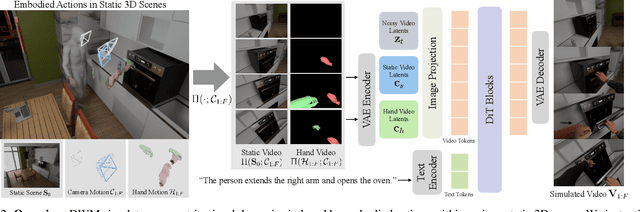

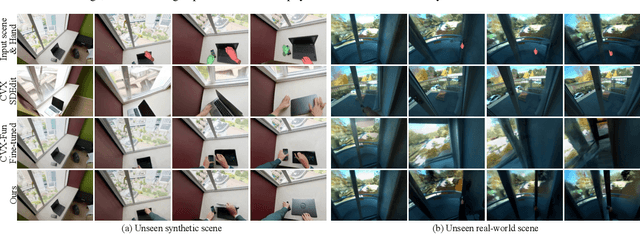
Recent progress in 3D reconstruction has made it easy to create realistic digital twins from everyday environments. However, current digital twins remain largely static and are limited to navigation and view synthesis without embodied interactivity. To bridge this gap, we introduce Dexterous World Model (DWM), a scene-action-conditioned video diffusion framework that models how dexterous human actions induce dynamic changes in static 3D scenes. Given a static 3D scene rendering and an egocentric hand motion sequence, DWM generates temporally coherent videos depicting plausible human-scene interactions. Our approach conditions video generation on (1) static scene renderings following a specified camera trajectory to ensure spatial consistency, and (2) egocentric hand mesh renderings that encode both geometry and motion cues to model action-conditioned dynamics directly. To train DWM, we construct a hybrid interaction video dataset. Synthetic egocentric interactions provide fully aligned supervision for joint locomotion and manipulation learning, while fixed-camera real-world videos contribute diverse and realistic object dynamics. Experiments demonstrate that DWM enables realistic and physically plausible interactions, such as grasping, opening, and moving objects, while maintaining camera and scene consistency. This framework represents a first step toward video diffusion-based interactive digital twins and enables embodied simulation from egocentric actions.
Decoding the Poetic Language of Emotion in Korean Modern Poetry: Insights from a Human-Labeled Dataset and AI Modeling
Sep 04, 2025This study introduces KPoEM (Korean Poetry Emotion Mapping) , a novel dataset for computational emotion analysis in modern Korean poetry. Despite remarkable progress in text-based emotion classification using large language models, poetry-particularly Korean poetry-remains underexplored due to its figurative language and cultural specificity. We built a multi-label emotion dataset of 7,662 entries, including 7,007 line-level entries from 483 poems and 615 work-level entries, annotated with 44 fine-grained emotion categories from five influential Korean poets. A state-of-the-art Korean language model fine-tuned on this dataset significantly outperformed previous models, achieving 0.60 F1-micro compared to 0.34 from models trained on general corpora. The KPoEM model, trained through sequential fine-tuning-first on general corpora and then on the KPoEM dataset-demonstrates not only an enhanced ability to identify temporally and culturally specific emotional expressions, but also a strong capacity to preserve the core sentiments of modern Korean poetry. This study bridges computational methods and literary analysis, presenting new possibilities for the quantitative exploration of poetic emotions through structured data that faithfully retains the emotional and cultural nuances of Korean literature.
Durian: Dual Reference-guided Portrait Animation with Attribute Transfer
Sep 04, 2025We present Durian, the first method for generating portrait animation videos with facial attribute transfer from a given reference image to a target portrait in a zero-shot manner. To enable high-fidelity and spatially consistent attribute transfer across frames, we introduce dual reference networks that inject spatial features from both the portrait and attribute images into the denoising process of a diffusion model. We train the model using a self-reconstruction formulation, where two frames are sampled from the same portrait video: one is treated as the attribute reference and the other as the target portrait, and the remaining frames are reconstructed conditioned on these inputs and their corresponding masks. To support the transfer of attributes with varying spatial extent, we propose a mask expansion strategy using keypoint-conditioned image generation for training. In addition, we further augment the attribute and portrait images with spatial and appearance-level transformations to improve robustness to positional misalignment between them. These strategies allow the model to effectively generalize across diverse attributes and in-the-wild reference combinations, despite being trained without explicit triplet supervision. Durian achieves state-of-the-art performance on portrait animation with attribute transfer, and notably, its dual reference design enables multi-attribute composition in a single generation pass without additional training.
PHISH in MESH: Korean Adversarial Phonetic Substitution and Phonetic-Semantic Feature Integration Defense
May 27, 2025As malicious users increasingly employ phonetic substitution to evade hate speech detection, researchers have investigated such strategies. However, two key challenges remain. First, existing studies have overlooked the Korean language, despite its vulnerability to phonetic perturbations due to its phonographic nature. Second, prior work has primarily focused on constructing datasets rather than developing architectural defenses. To address these challenges, we propose (1) PHonetic-Informed Substitution for Hangul (PHISH) that exploits the phonological characteristics of the Korean writing system, and (2) Mixed Encoding of Semantic-pHonetic features (MESH) that enhances the detector's robustness by incorporating phonetic information at the architectural level. Our experimental results demonstrate the effectiveness of our proposed methods on both perturbed and unperturbed datasets, suggesting that they not only improve detection performance but also reflect realistic adversarial behaviors employed by malicious users.