 Add to Chrome
 Add to Firefox
 Add to Edge
Generative Subgraph Retrieval for Knowledge Graph-Grounded Dialog Generation
Oct 12, 2024
Knowledge graph-grounded dialog generation requires retrieving a dialog-relevant subgraph from the given knowledge base graph and integrating it with the dialog history. Previous works typically represent the graph using an external encoder, such as graph neural networks, and retrieve relevant triplets based on the similarity between single-vector representations of triplets and the dialog history. However, these external encoders fail to leverage the rich knowledge of pretrained language models, and the retrieval process is also suboptimal due to the information bottleneck caused by the single-vector abstraction of the dialog history. In this work, we propose Dialog generation with Generative Subgraph Retrieval (DialogGSR), which retrieves relevant knowledge subgraphs by directly generating their token sequences on top of language models. For effective generative subgraph retrieval, we introduce two key methods: (i) structure-aware knowledge graph linearization with self-supervised graph-specific tokens and (ii) graph-constrained decoding utilizing graph structural proximity-based entity informativeness scores for valid and relevant generative retrieval. DialogGSR achieves state-of-the-art performance in knowledge graph-grounded dialog generation, as demonstrated on OpenDialKG and KOMODIS datasets.

VideoMamba: Spatio-Temporal Selective State Space Model
Jul 11, 2024


We introduce VideoMamba, a novel adaptation of the pure Mamba architecture, specifically designed for video recognition. Unlike transformers that rely on self-attention mechanisms leading to high computational costs by quadratic complexity, VideoMamba leverages Mamba's linear complexity and selective SSM mechanism for more efficient processing. The proposed Spatio-Temporal Forward and Backward SSM allows the model to effectively capture the complex relationship between non-sequential spatial and sequential temporal information in video. Consequently, VideoMamba is not only resource-efficient but also effective in capturing long-range dependency in videos, demonstrated by competitive performance and outstanding efficiency on a variety of video understanding benchmarks. Our work highlights the potential of VideoMamba as a powerful tool for video understanding, offering a simple yet effective baseline for future research in video analysis.
Flow-Assisted Motion Learning Network for Weakly-Supervised Group Activity Recognition
May 28, 2024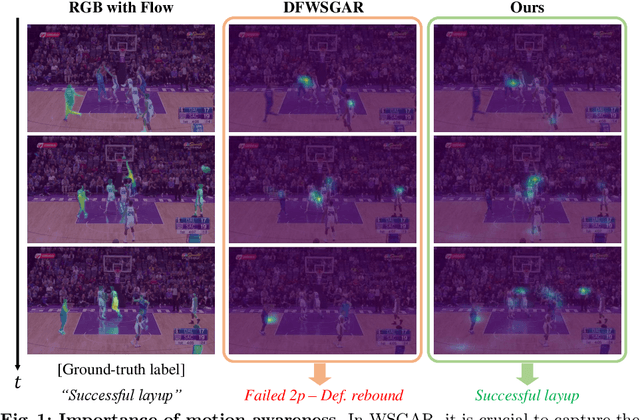
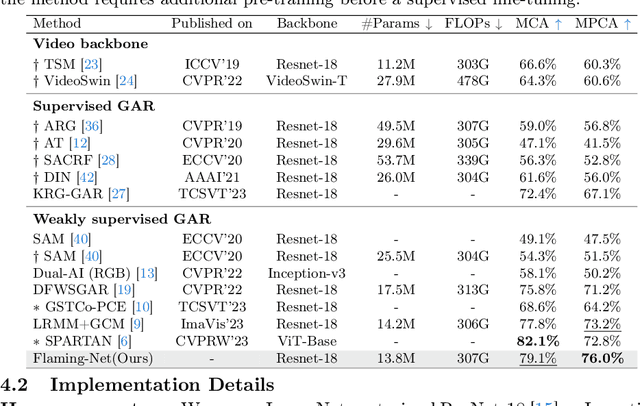
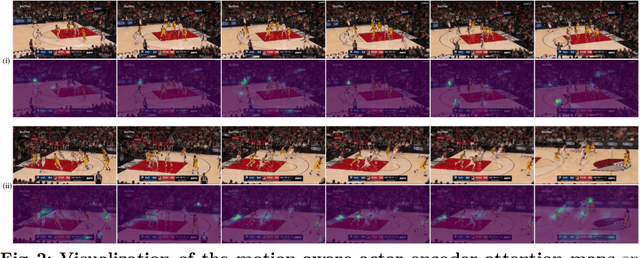

Weakly-Supervised Group Activity Recognition (WSGAR) aims to understand the activity performed together by a group of individuals with the video-level label and without actor-level labels. We propose Flow-Assisted Motion Learning Network (Flaming-Net) for WSGAR, which consists of the motion-aware actor encoder to extract actor features and the two-pathways relation module to infer the interaction among actors and their activity. Flaming-Net leverages an additional optical flow modality in the training stage to enhance its motion awareness when finding locally active actors. The first pathway of the relation module, the actor-centric path, initially captures the temporal dynamics of individual actors and then constructs inter-actor relationships. In parallel, the group-centric path starts by building spatial connections between actors within the same timeframe and then captures simultaneous spatio-temporal dynamics among them. We demonstrate that Flaming-Net achieves new state-of-the-art WSGAR results on two benchmarks, including a 2.8%p higher MPCA score on the NBA dataset. Importantly, we use the optical flow modality only for training and not for inference.
Prompt Learning via Meta-Regularization
Apr 01, 2024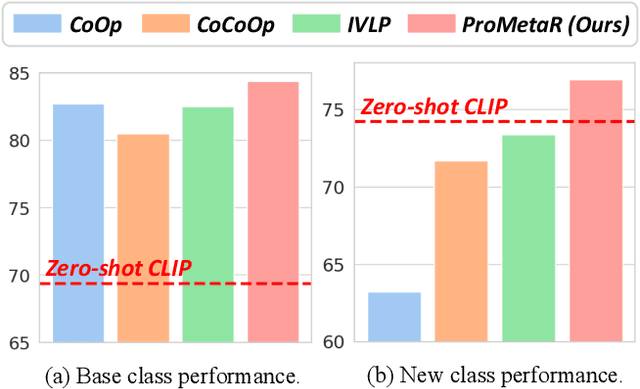
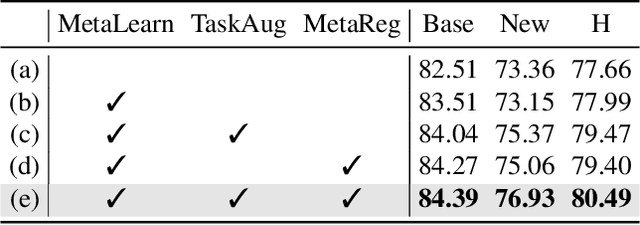
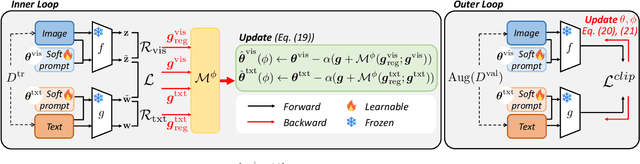
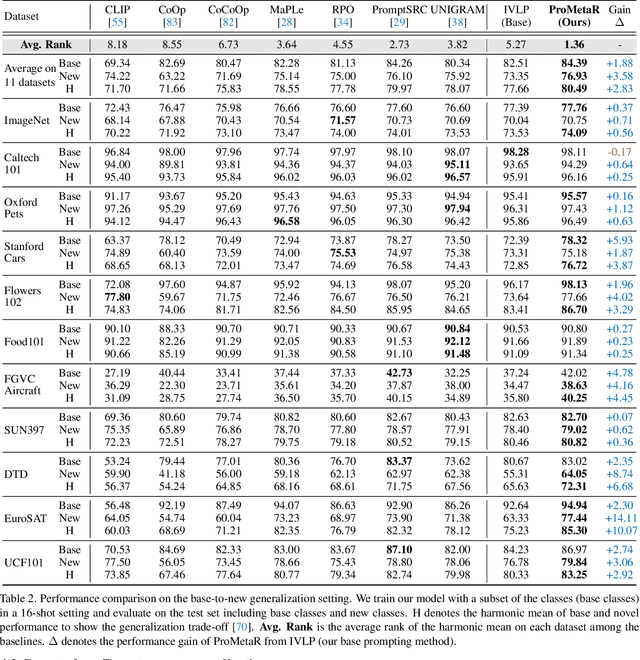
Pre-trained vision-language models have shown impressive success on various computer vision tasks with their zero-shot generalizability. Recently, prompt learning approaches have been explored to efficiently and effectively adapt the vision-language models to a variety of downstream tasks. However, most existing prompt learning methods suffer from task overfitting since the general knowledge of the pre-trained vision language models is forgotten while the prompts are finetuned on a small data set from a specific target task. To address this issue, we propose a Prompt Meta-Regularization (ProMetaR) to improve the generalizability of prompt learning for vision-language models. Specifically, ProMetaR meta-learns both the regularizer and the soft prompts to harness the task-specific knowledge from the downstream tasks and task-agnostic general knowledge from the vision-language models. Further, ProMetaR augments the task to generate multiple virtual tasks to alleviate the meta-overfitting. In addition, we provide the analysis to comprehend how ProMetaR improves the generalizability of prompt tuning in the perspective of the gradient alignment. Our extensive experiments demonstrate that our ProMetaR improves the generalizability of conventional prompt learning methods under base-to-base/base-to-new and domain generalization settings. The code of ProMetaR is available at https://github.com/mlvlab/ProMetaR.
Groupwise Query Specialization and Quality-Aware Multi-Assignment for Transformer-based Visual Relationship Detection
Mar 26, 2024Visual Relationship Detection (VRD) has seen significant advancements with Transformer-based architectures recently. However, we identify two key limitations in a conventional label assignment for training Transformer-based VRD models, which is a process of mapping a ground-truth (GT) to a prediction. Under the conventional assignment, an unspecialized query is trained since a query is expected to detect every relation, which makes it difficult for a query to specialize in specific relations. Furthermore, a query is also insufficiently trained since a GT is assigned only to a single prediction, therefore near-correct or even correct predictions are suppressed by being assigned no relation as a GT. To address these issues, we propose Groupwise Query Specialization and Quality-Aware Multi-Assignment (SpeaQ). Groupwise Query Specialization trains a specialized query by dividing queries and relations into disjoint groups and directing a query in a specific query group solely toward relations in the corresponding relation group. Quality-Aware Multi-Assignment further facilitates the training by assigning a GT to multiple predictions that are significantly close to a GT in terms of a subject, an object, and the relation in between. Experimental results and analyses show that SpeaQ effectively trains specialized queries, which better utilize the capacity of a model, resulting in consistent performance gains with zero additional inference cost across multiple VRD models and benchmarks. Code is available at https://github.com/mlvlab/SpeaQ.
Graph-Guided Reasoning for Multi-Hop Question Answering in Large Language Models
Nov 16, 2023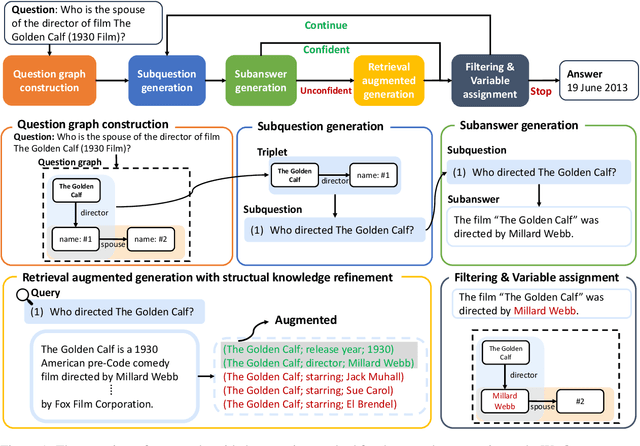
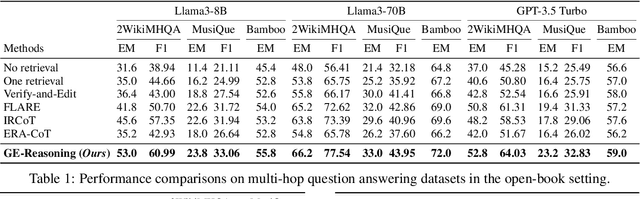
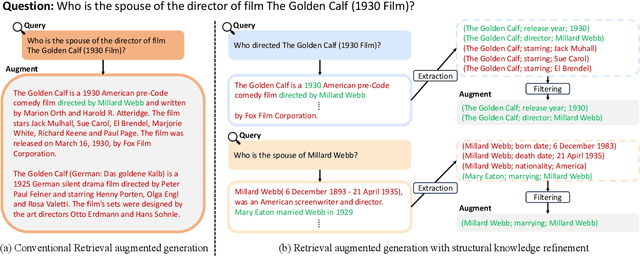
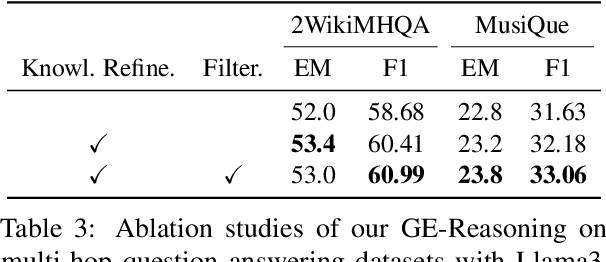
Chain-of-Thought (CoT) prompting has boosted the multi-step reasoning capabilities of Large Language Models (LLMs) by generating a series of rationales before the final answer. We analyze the reasoning paths generated by CoT and find two issues in multi-step reasoning: (i) Generating rationales irrelevant to the question, (ii) Unable to compose subquestions or queries for generating/retrieving all the relevant information. To address them, we propose a graph-guided CoT prompting method, which guides the LLMs to reach the correct answer with graph representation/verification steps. Specifically, we first leverage LLMs to construct a "question/rationale graph" by using knowledge extraction prompting given the initial question and the rationales generated in the previous steps. Then, the graph verification step diagnoses the current rationale triplet by comparing it with the existing question/rationale graph to filter out irrelevant rationales and generate follow-up questions to obtain relevant information. Additionally, we generate CoT paths that exclude the extracted graph information to represent the context information missed from the graph extraction. Our graph-guided reasoning method shows superior performance compared to previous CoT prompting and the variants on multi-hop question answering benchmark datasets.
Sketch-based Video Object Localization
Apr 02, 2023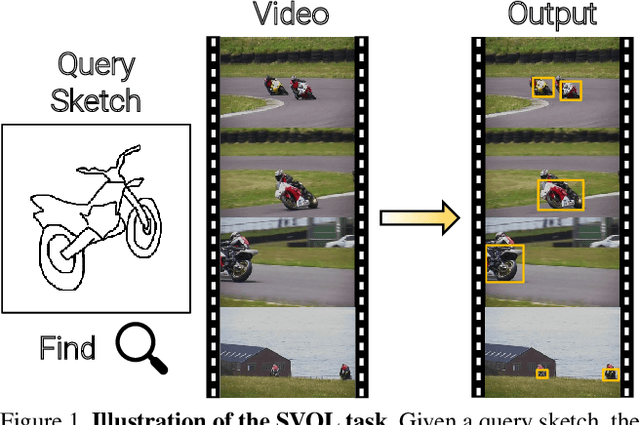

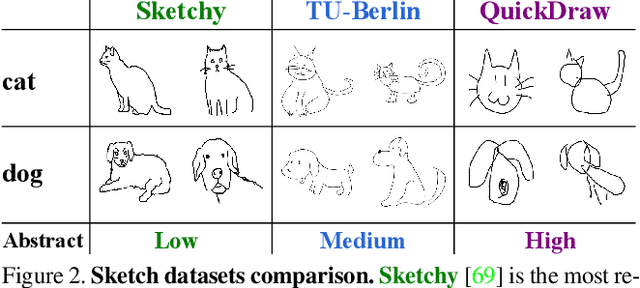
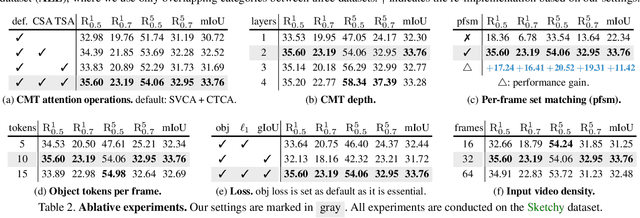
We introduce Sketch-based Video Object Localization (SVOL), a new task aimed at localizing spatio-temporal object boxes in video queried by the input sketch. We first outline the challenges in the SVOL task and build the Sketch-Video Attention Network (SVANet) with the following design principles: (i) to consider temporal information of video and bridge the domain gap between sketch and video; (ii) to accurately identify and localize multiple objects simultaneously; (iii) to handle various styles of sketches; (iv) to be classification-free. In particular, SVANet is equipped with a Cross-modal Transformer that models the interaction between learnable object tokens, query sketch, and video through attention operations, and learns upon a per-frame set macthing strategy that enables frame-wise prediction while utilizing global video context. We evaluate SVANet on a newly curated SVOL dataset. By design, SVANet successfully learns the mapping between the query sketch and video objects, achieving state-of-the-art results on the SVOL benchmark. We further confirm the effectiveness of SVANet via extensive ablation studies and visualizations. Lastly, we demonstrate its zero-shot capability on unseen datasets and novel categories, suggesting its high scalability in real-world applications.
Self-positioning Point-based Transformer for Point Cloud Understanding
Mar 29, 2023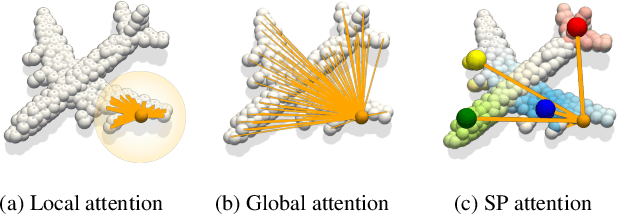
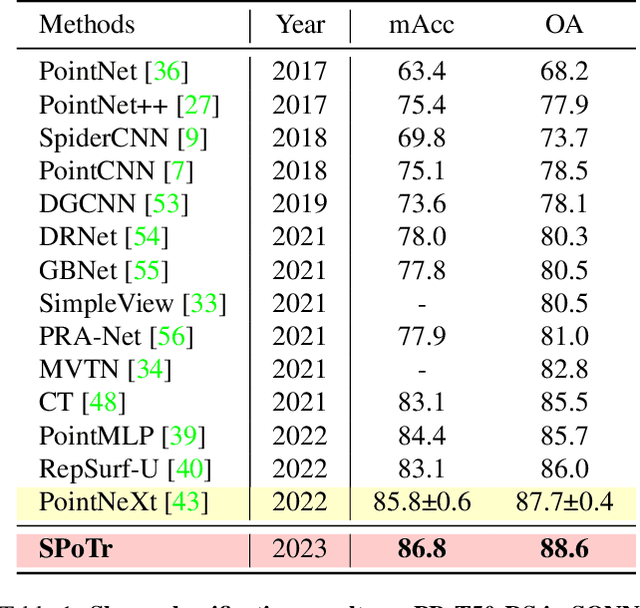
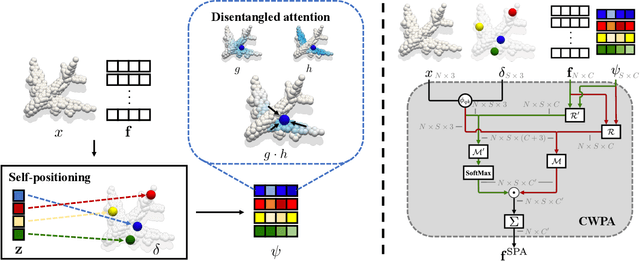
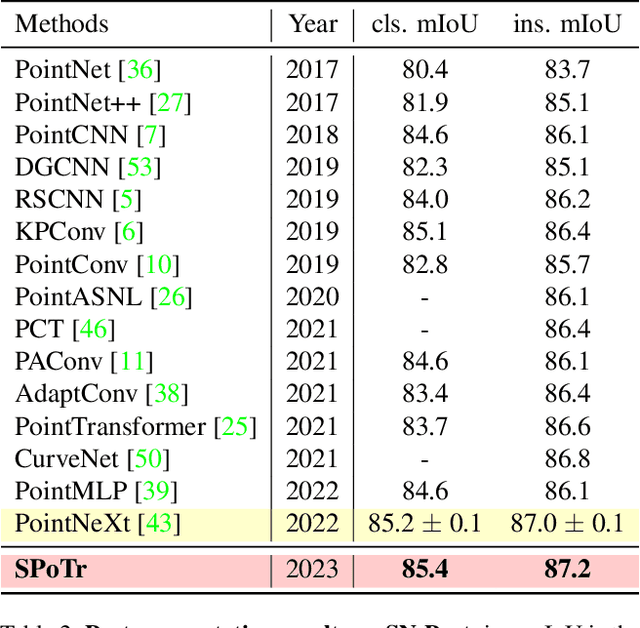
Transformers have shown superior performance on various computer vision tasks with their capabilities to capture long-range dependencies. Despite the success, it is challenging to directly apply Transformers on point clouds due to their quadratic cost in the number of points. In this paper, we present a Self-Positioning point-based Transformer (SPoTr), which is designed to capture both local and global shape contexts with reduced complexity. Specifically, this architecture consists of local self-attention and self-positioning point-based global cross-attention. The self-positioning points, adaptively located based on the input shape, consider both spatial and semantic information with disentangled attention to improve expressive power. With the self-positioning points, we propose a novel global cross-attention mechanism for point clouds, which improves the scalability of global self-attention by allowing the attention module to compute attention weights with only a small set of self-positioning points. Experiments show the effectiveness of SPoTr on three point cloud tasks such as shape classification, part segmentation, and scene segmentation. In particular, our proposed model achieves an accuracy gain of 2.6% over the previous best models on shape classification with ScanObjectNN. We also provide qualitative analyses to demonstrate the interpretability of self-positioning points. The code of SPoTr is available at https://github.com/mlvlab/SPoTr.
RainUNet for Super-Resolution Rain Movie Prediction under Spatio-temporal Shifts
Dec 07, 2022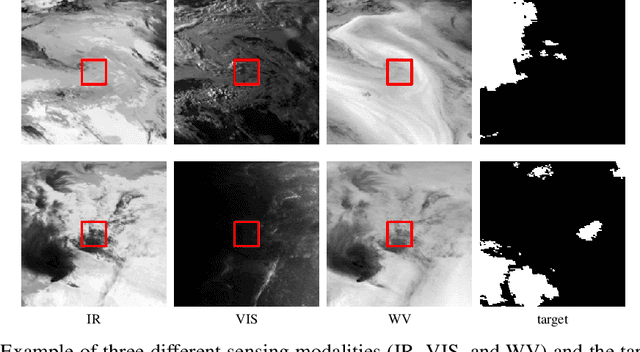
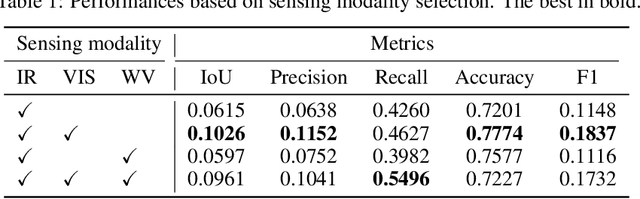
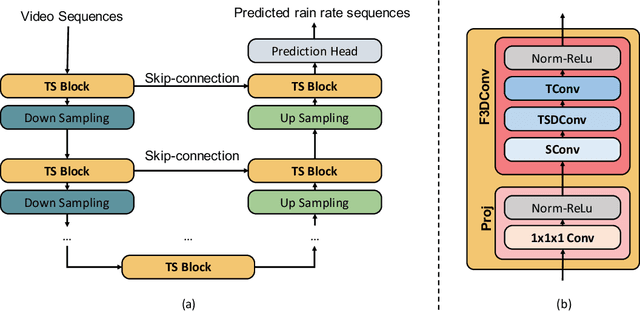
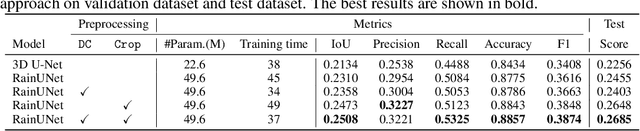
This paper presents a solution to the Weather4cast 2022 Challenge Stage 2. The goal of the challenge is to forecast future high-resolution rainfall events obtained from ground radar using low-resolution multiband satellite images. We suggest a solution that performs data preprocessing appropriate to the challenge and then predicts rainfall movies using a novel RainUNet. RainUNet is a hierarchical U-shaped network with temporal-wise separable block (TS block) using a decoupled large kernel 3D convolution to improve the prediction performance. Various evaluation metrics show that our solution is effective compared to the baseline method. The source codes are available at https://github.com/jinyxp/Weather4cast-2022
Relation-aware Language-Graph Transformer for Question Answering
Dec 02, 2022
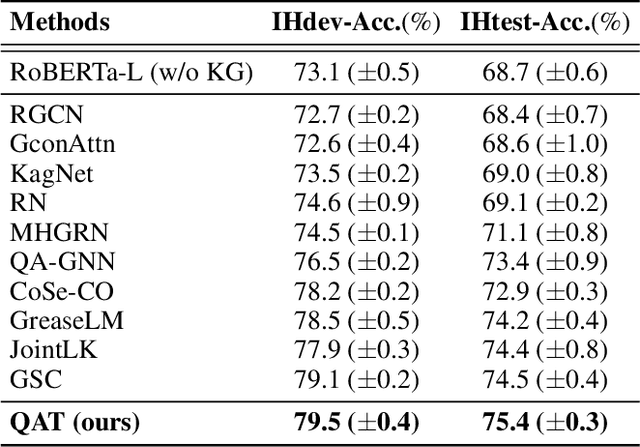
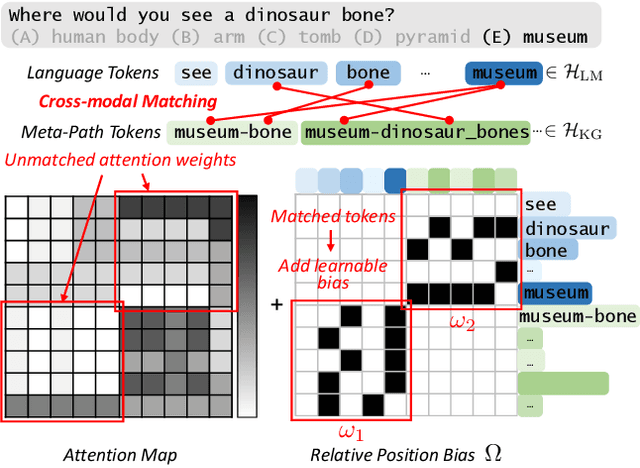

Question Answering (QA) is a task that entails reasoning over natural language contexts, and many relevant works augment language models (LMs) with graph neural networks (GNNs) to encode the Knowledge Graph (KG) information. However, most existing GNN-based modules for QA do not take advantage of rich relational information of KGs and depend on limited information interaction between the LM and the KG. To address these issues, we propose Question Answering Transformer (QAT), which is designed to jointly reason over language and graphs with respect to entity relations in a unified manner. Specifically, QAT constructs Meta-Path tokens, which learn relation-centric embeddings based on diverse structural and semantic relations. Then, our Relation-Aware Self-Attention module comprehensively integrates different modalities via the Cross-Modal Relative Position Bias, which guides information exchange between relevant entities of different modalities. We validate the effectiveness of QAT on commonsense question answering datasets like CommonsenseQA and OpenBookQA, and on a medical question answering dataset, MedQA-USMLE. On all the datasets, our method achieves state-of-the-art performance. Our code is available at http://github.com/mlvlab/QAT.