 Add to Chrome
 Add to Firefox
 Add to Edge
LLM-PDESR: Robust PDE Discovery via Subdomain Weighted Residuals and LLM-Guided Symbolic Hypothesis Generation
Jul 12, 2026
Discovering governing partial differential equations (PDEs) from noisy observational data is a fundamental challenge in scientific machine learning. Traditional symbolic regression (SR) methods often struggle to identify accurate equations within vast combinatorial search spaces, largely due to their inability to incorporate essential domain-specific prior knowledge. Furthermore, reliance on pointwise evaluations and discrete finite differences inherently amplifies high-frequency noise, creating deceptive fitness landscapes that derail the optimization process. To resolve these bottlenecks, we propose LLM-PDESR, a framework that integrates the structural hypothesis generation of Large Language Models (LLMs) with a mathematically rigorous evaluation environment. By employing C^4-continuous quintic splines for robust differentiation and subdomain weighted residuals as natural low-pass filters, our approach effectively mitigates the fitness landscape distortion that plagues existing methods. A Pareto-driven feedback loop then enables the LLM to iteratively refine candidate equations, balancing predictive accuracy with structural parsimony. We evaluate LLM-PDESR on 23 canonical PDEs and five structurally novel equations (including a multivariate system) specifically designed to preclude dataset memorization and test true discovery capabilities. Demonstrating real-world applicability, the framework successfully extracts a consistent structural skeleton for an interpretable 1D dynamical surrogate (1D-CACE) directly from noisy ERA5 reanalysis data. Extensive experiments and out-of-distribution testing confirm that LLM-PDESR significantly outperforms state-of-the-art methodologies in structural recovery, noise resilience, and the avoidance of spurious complexity and equation bloat.

Collaborative Few-Step Distillation and Low-Bit Quantization for Wan2.2 Dual-Expert Video Diffusion Models
May 30, 2026Large video diffusion models achieve strong visual quality but remain expensive to deploy because each sample requires many denoising steps and a large resident parameter footprint. This paper studies a deployment-oriented compression pipeline for Wan2.2-T2V-A14B by combining few-step distribution-matching distillation with low-bit quantization. The pipeline follows the model's dual-expert denoising route, calibrates the high-noise and low-noise branches separately, protects sensitive entrance layers, and uses HiF4-style low-bit representation to improve dynamic-range coverage. Quantization is calibrated on the distilled few-step student rather than on the original long-step trajectory, reducing activation-distribution mismatch during inference. The proposed co-design keeps the quantized model close to the same-step full-precision model and surpasses the original full-precision baseline at 8 and 20 steps on average. The 20-step setting gives the best quality-efficiency trade-off in the tested configurations.
A Survey of Low-bit Large Language Models: Basics, Systems, and Algorithms
Sep 25, 2024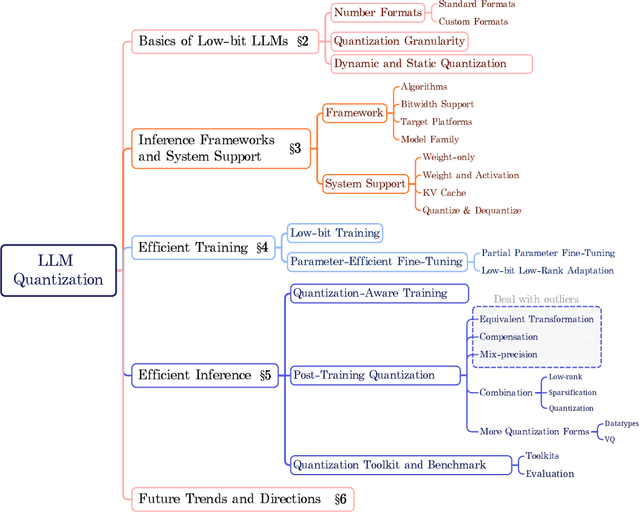
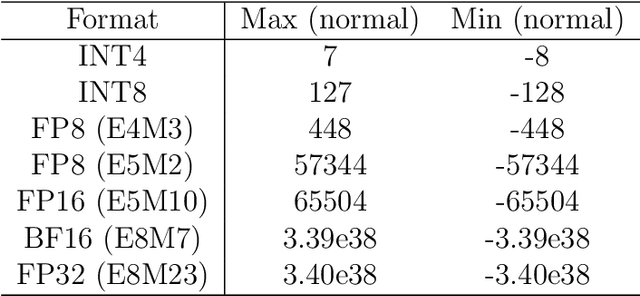


Large language models (LLMs) have achieved remarkable advancements in natural language processing, showcasing exceptional performance across various tasks. However, the expensive memory and computational requirements present significant challenges for their practical deployment. Low-bit quantization has emerged as a critical approach to mitigate these challenges by reducing the bit-width of model parameters, activations, and gradients, thus decreasing memory usage and computational demands. This paper presents a comprehensive survey of low-bit quantization methods tailored for LLMs, covering the fundamental principles, system implementations, and algorithmic strategies. An overview of basic concepts and new data formats specific to low-bit LLMs is first introduced, followed by a review of frameworks and systems that facilitate low-bit LLMs across various hardware platforms. Then, we categorize and analyze techniques and toolkits for efficient low-bit training and inference of LLMs. Finally, we conclude with a discussion of future trends and potential advancements of low-bit LLMs. Our systematic overview from basic, system, and algorithm perspectives can offer valuable insights and guidelines for future works to enhance the efficiency and applicability of LLMs through low-bit quantization.