 Add to Chrome
 Add to Firefox
 Add to Edge
LLM-PDESR: Robust PDE Discovery via Subdomain Weighted Residuals and LLM-Guided Symbolic Hypothesis Generation
Jul 12, 2026
Discovering governing partial differential equations (PDEs) from noisy observational data is a fundamental challenge in scientific machine learning. Traditional symbolic regression (SR) methods often struggle to identify accurate equations within vast combinatorial search spaces, largely due to their inability to incorporate essential domain-specific prior knowledge. Furthermore, reliance on pointwise evaluations and discrete finite differences inherently amplifies high-frequency noise, creating deceptive fitness landscapes that derail the optimization process. To resolve these bottlenecks, we propose LLM-PDESR, a framework that integrates the structural hypothesis generation of Large Language Models (LLMs) with a mathematically rigorous evaluation environment. By employing C^4-continuous quintic splines for robust differentiation and subdomain weighted residuals as natural low-pass filters, our approach effectively mitigates the fitness landscape distortion that plagues existing methods. A Pareto-driven feedback loop then enables the LLM to iteratively refine candidate equations, balancing predictive accuracy with structural parsimony. We evaluate LLM-PDESR on 23 canonical PDEs and five structurally novel equations (including a multivariate system) specifically designed to preclude dataset memorization and test true discovery capabilities. Demonstrating real-world applicability, the framework successfully extracts a consistent structural skeleton for an interpretable 1D dynamical surrogate (1D-CACE) directly from noisy ERA5 reanalysis data. Extensive experiments and out-of-distribution testing confirm that LLM-PDESR significantly outperforms state-of-the-art methodologies in structural recovery, noise resilience, and the avoidance of spurious complexity and equation bloat.

DP2FL: Dual Prompt Personalized Federated Learning in Foundation Models
Apr 23, 2025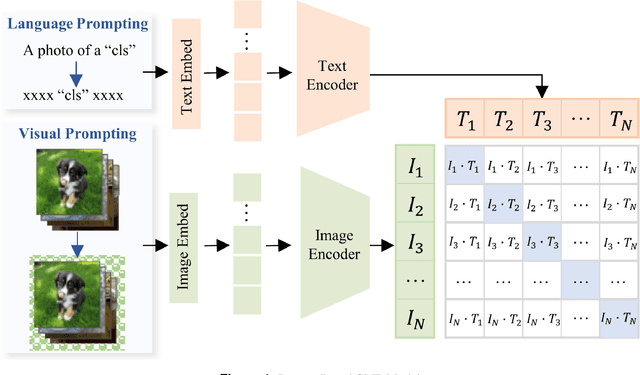
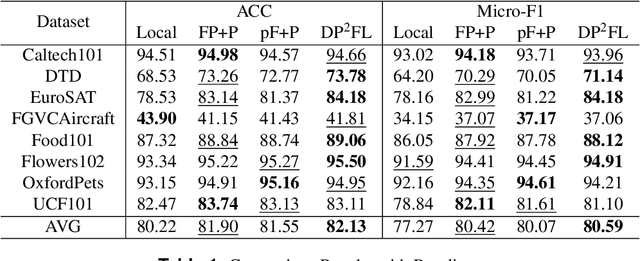
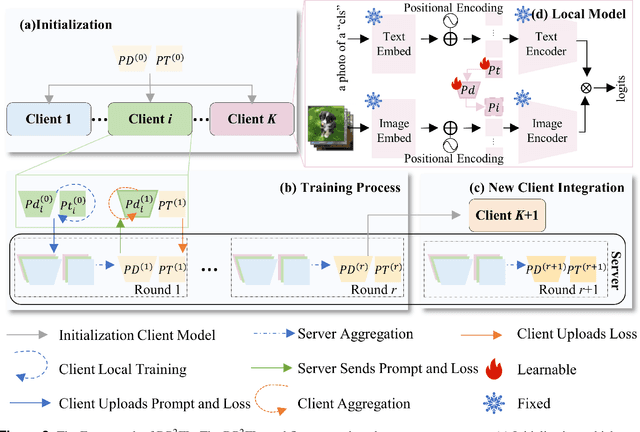
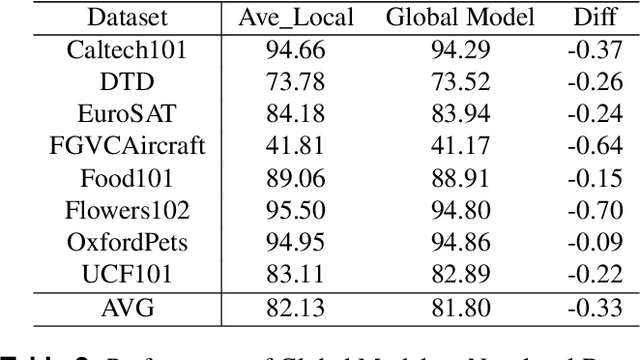
Personalized federated learning (PFL) has garnered significant attention for its ability to address heterogeneous client data distributions while preserving data privacy. However, when local client data is limited, deep learning models often suffer from insufficient training, leading to suboptimal performance. Foundation models, such as CLIP (Contrastive Language-Image Pretraining), exhibit strong feature extraction capabilities and can alleviate this issue by fine-tuning on limited local data. Despite their potential, foundation models are rarely utilized in federated learning scenarios, and challenges related to integrating new clients remain largely unresolved. To address these challenges, we propose the Dual Prompt Personalized Federated Learning (DP2FL) framework, which introduces dual prompts and an adaptive aggregation strategy. DP2FL combines global task awareness with local data-driven insights, enabling local models to achieve effective generalization while remaining adaptable to specific data distributions. Moreover, DP2FL introduces a global model that enables prediction on new data sources and seamlessly integrates newly added clients without requiring retraining. Experimental results in highly heterogeneous environments validate the effectiveness of DP2FL's prompt design and aggregation strategy, underscoring the advantages of prediction on novel data sources and demonstrating the seamless integration of new clients into the federated learning framework.