 Add to Chrome
 Add to Firefox
 Add to Edge
Curvature-Guided Mixing for MLLM Adaptation
Jun 23, 2026
Fine-tuning Multimodal Large Language Models (MLLMs) on specialized tasks often leads to catastrophic forgetting of their general capabilities. Existing model merging methods to combat this are often heuristic or use sub-optimal objectives. We propose CurvatureGuided Mixing (CGM), a theoretically grounded framework that merges pre-trained and fine-tuned models. CGM formulates a joint optimization objective and uses a second-order (Hessian) approximation of the loss landscapes to analytically derive an optimal, closed-form "soft mixing" ratio. This ratio intelligently blends parameters based on their relative task-specific curvatures. We also introduce CGM$\dagger$, a robust "hard mixing" variant that performs sparse parameter selection guided by a novel, curvature-aware score. Experiments on LLaVA-1.5 and Qwen2.5VL across multiple downstream tasks show that CGM and CGM$\dagger$ consistently improve the trade-off between task specialization and general knowledge retention over existing methods. Code is available at github.com/zzsyjl/CGM-ECCV-2026.

Continual Learning for Segment Anything Model Adaptation
Dec 09, 2024Although the current different types of SAM adaptation methods have achieved promising performance for various downstream tasks, such as prompt-based ones and adapter-based ones, most of them belong to the one-step adaptation paradigm. In real-world scenarios, we are generally confronted with the dynamic scenario where the data comes in a streaming manner. Driven by the practical need, in this paper, we first propose a novel Continual SAM adaptation (CoSAM) benchmark with 8 different task domains and carefully analyze the limitations of the existing SAM one-step adaptation methods in the continual segmentation scenario. Then we propose a novel simple-yet-effective Mixture of Domain Adapters (MoDA) algorithm which utilizes the Global Feature Tokens (GFT) and Global Assistant Tokens (GAT) modules to help the SAM encoder extract well-separated features for different task domains, and then provide the accurate task-specific information for continual learning. Extensive experiments demonstrate that our proposed MoDA obviously surpasses the existing classic continual learning methods, as well as prompt-based and adapter-based approaches for continual segmentation. Moreover, after sequential learning on the CoSAM benchmark with diverse data distributions, our MoDA maintains highly competitive results in the natural image domain, approaching the zero-shot performance of the original SAM, demonstrating its superior capability in knowledge preservation. Notably, the proposed MoDA can be seamlessly integrated into various one-step adaptation methods of SAM, which can consistently bring obvious performance gains. Code is available at \url{https://github.com/yangjl1215/CoSAM}
Using Left and Right Brains Together: Towards Vision and Language Planning
Feb 16, 2024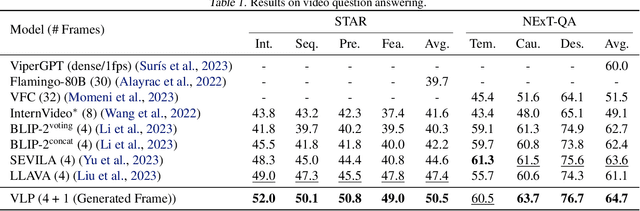
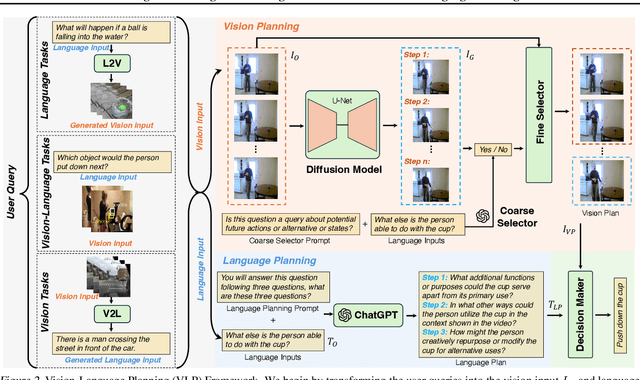
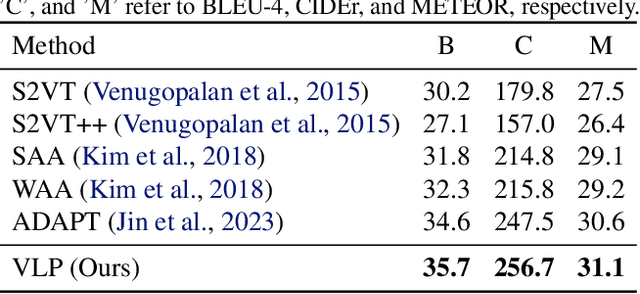
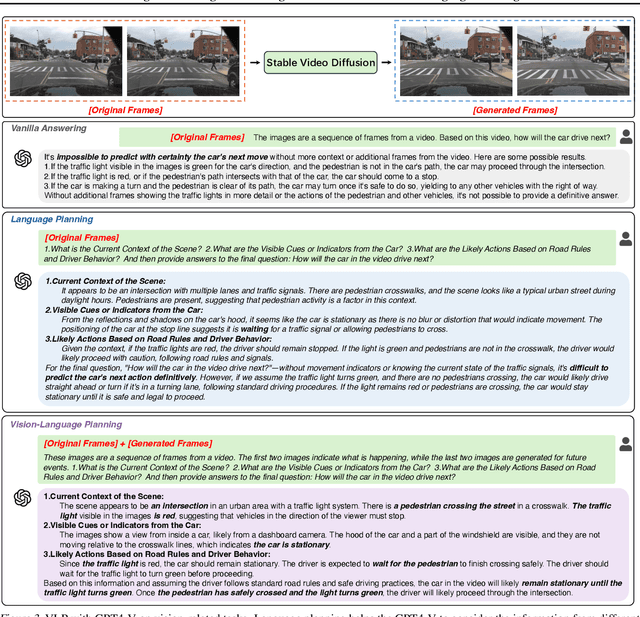
Large Language Models (LLMs) and Large Multi-modality Models (LMMs) have demonstrated remarkable decision masking capabilities on a variety of tasks. However, they inherently operate planning within the language space, lacking the vision and spatial imagination ability. In contrast, humans utilize both left and right hemispheres of the brain for language and visual planning during the thinking process. Therefore, we introduce a novel vision-language planning framework in this work to perform concurrent visual and language planning for tasks with inputs of any form. Our framework incorporates visual planning to capture intricate environmental details, while language planning enhances the logical coherence of the overall system. We evaluate the effectiveness of our framework across vision-language tasks, vision-only tasks, and language-only tasks. The results demonstrate the superior performance of our approach, indicating that the integration of visual and language planning yields better contextually aware task execution.