 Add to Chrome
 Add to Firefox
 Add to Edge
UMono: Physical Model Informed Hybrid CNN-Transformer Framework for Underwater Monocular Depth Estimation
Jul 25, 2024

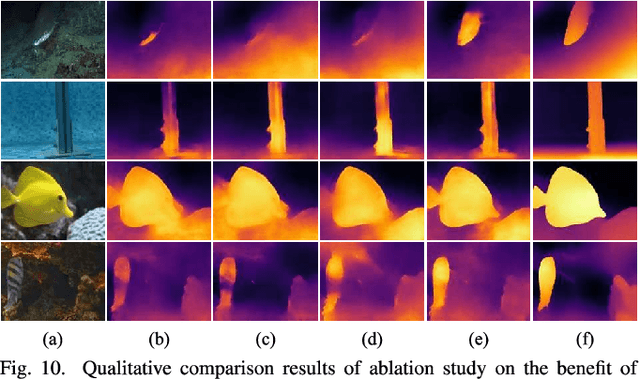
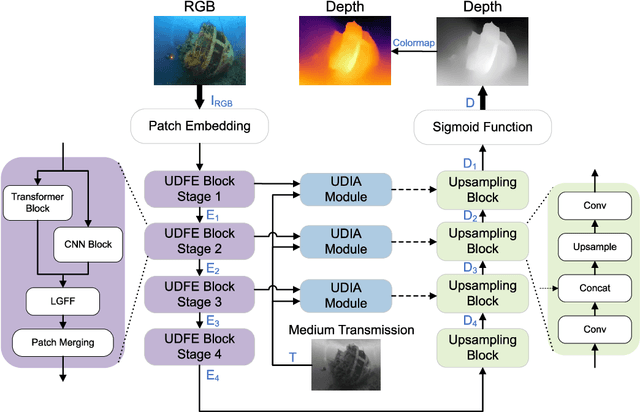

Underwater monocular depth estimation serves as the foundation for tasks such as 3D reconstruction of underwater scenes. However, due to the influence of light and medium, the underwater environment undergoes a distinctive imaging process, which presents challenges in accurately estimating depth from a single image. The existing methods fail to consider the unique characteristics of underwater environments, leading to inadequate estimation results and limited generalization performance. Furthermore, underwater depth estimation requires extracting and fusing both local and global features, which is not fully explored in existing methods. In this paper, an end-to-end learning framework for underwater monocular depth estimation called UMono is presented, which incorporates underwater image formation model characteristics into network architecture, and effectively utilize both local and global features of underwater image. Experimental results demonstrate that the proposed method is effective for underwater monocular depth estimation and outperforms the existing methods in both quantitative and qualitative analyses.

Static and multivariate-temporal attentive fusion transformer for readmission risk prediction
Jul 15, 2024
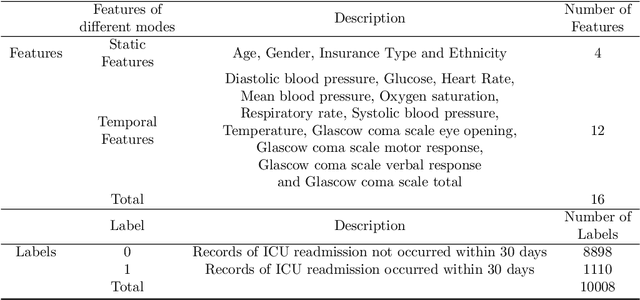


Background: Accurate short-term readmission prediction of ICU patients is significant in improving the efficiency of resource assignment by assisting physicians in making discharge decisions. Clinically, both individual static static and multivariate temporal data collected from ICU monitors play critical roles in short-term readmission prediction. Informative static and multivariate temporal feature representation capturing and fusion present challenges for accurate readmission prediction. Methods:We propose a novel static and multivariate-temporal attentive fusion transformer (SMTAFormer) to predict short-term readmission of ICU patients by fully leveraging the potential of demographic and dynamic temporal data. In SMTAFormer, we first apply an MLP network and a temporal transformer network to learn useful static and temporal feature representations, respectively. Then, the well-designed static and multivariate temporal feature fusion module is applied to fuse static and temporal feature representations by modeling intra-correlation among multivariate temporal features and constructing inter-correlation between static and multivariate temporal features. Results: We construct a readmission risk assessment (RRA) dataset based on the MIMIC-III dataset. The extensive experiments show that SMTAFormer outperforms advanced methods, in which the accuracy of our proposed method is up to 86.6%, and the area under the receiver operating characteristic curve (AUC) is up to 0.717. Conclusion: Our proposed SMTAFormer can efficiently capture and fuse static and multivariate temporal feature representations. The results show that SMTAFormer significantly improves the short-term readmission prediction performance of ICU patients through comparisons to strong baselines.
TVR-Ranking: A Dataset for Ranked Video Moment Retrieval with Imprecise Queries
Jul 09, 2024
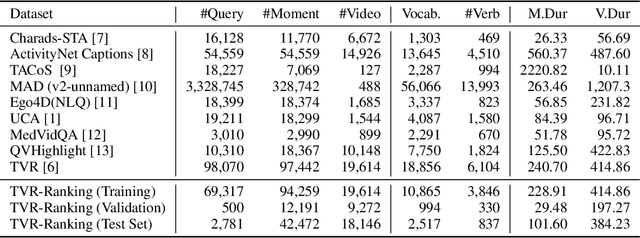


In this paper, we propose the task of \textit{Ranked Video Moment Retrieval} (RVMR) to locate a ranked list of matching moments from a collection of videos, through queries in natural language. Although a few related tasks have been proposed and studied by CV, NLP, and IR communities, RVMR is the task that best reflects the practical setting of moment search. To facilitate research in RVMR, we develop the TVR-Ranking dataset, based on the raw videos and existing moment annotations provided in the TVR dataset. Our key contribution is the manual annotation of relevance levels for 94,442 query-moment pairs. We then develop the $NDCG@K, IoU\geq \mu$ evaluation metric for this new task and conduct experiments to evaluate three baseline models. Our experiments show that the new RVMR task brings new challenges to existing models and we believe this new dataset contributes to the research on multi-modality search. The dataset is available at \url{https://github.com/Ranking-VMR/TVR-Ranking}
VideoEval: Comprehensive Benchmark Suite for Low-Cost Evaluation of Video Foundation Model
Jul 09, 2024With the growth of high-quality data and advancement in visual pre-training paradigms, Video Foundation Models (VFMs) have made significant progress recently, demonstrating their remarkable performance on traditional video understanding benchmarks. However, the existing benchmarks (e.g. Kinetics) and their evaluation protocols are often limited by relatively poor diversity, high evaluation costs, and saturated performance metrics. In this paper, we build a comprehensive benchmark suite to address these issues, namely VideoEval. Specifically, we establish the Video Task Adaption Benchmark (VidTAB) and the Video Embedding Benchmark (VidEB) from two perspectives: evaluating the task adaptability of VFMs under few-shot conditions and assessing their representation power by directly applying to downstream tasks. With VideoEval, we conduct a large-scale study on 20 popular open-source vision foundation models. Our study reveals some insightful findings on VFMs: 1) overall, current VFMs exhibit weak generalization across diverse tasks, 2) increasing video data, whether labeled or weakly-labeled video-text pairs, does not necessarily improve task performance, 3) the effectiveness of some pre-training paradigms may not be fully validated in previous benchmarks, and 4) combining different pre-training paradigms can help improve the generalization capabilities. We believe this study serves as an important complement to the current evaluation for VFMs and offers valuable insights for the future research.
Open-Event Procedure Planning in Instructional Videos
Jul 06, 2024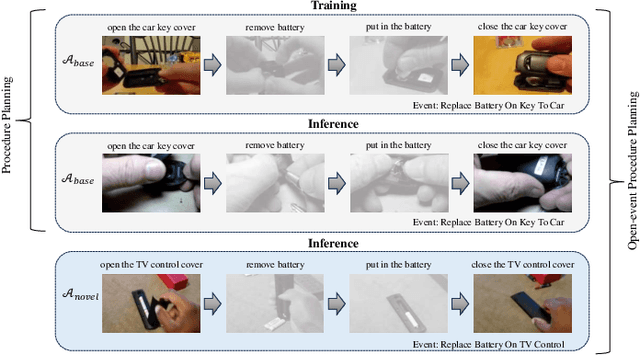
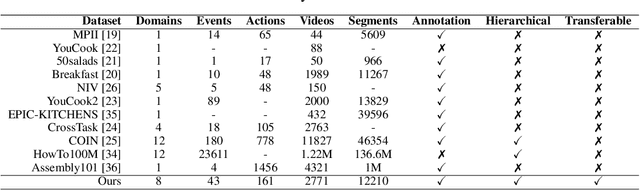
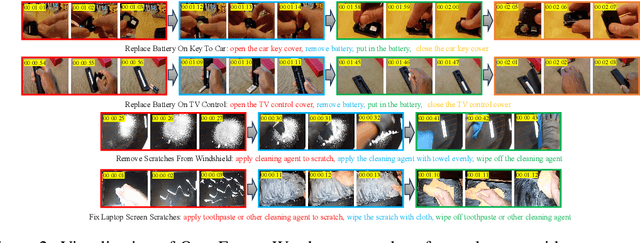
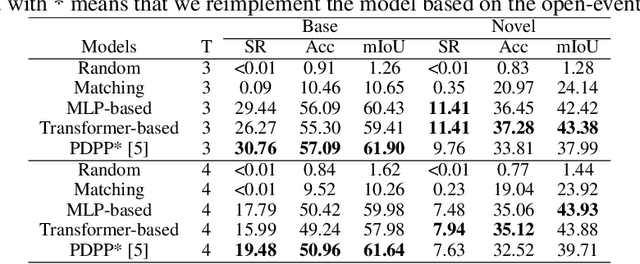
Given the current visual observations, the traditional procedure planning task in instructional videos requires a model to generate goal-directed plans within a given action space. All previous methods for this task conduct training and inference under the same action space, and they can only plan for pre-defined events in the training set. We argue this setting is not applicable for human assistance in real lives and aim to propose a more general and practical planning paradigm. Specifically, in this paper, we introduce a new task named Open-event Procedure Planning (OEPP), which extends the traditional procedure planning to the open-event setting. OEPP aims to verify whether a planner can transfer the learned knowledge to similar events that have not been seen during training. We rebuild a new benchmark of OpenEvent for this task based on existing datasets and divide the events involved into base and novel parts. During the data collection process, we carefully ensure the transfer ability of procedural knowledge for base and novel events by evaluating the similarity between the descriptions of different event steps with multiple stages. Based on the collected data, we further propose a simple and general framework specifically designed for OEPP, and conduct extensive study with various baseline methods, providing a detailed and insightful analysis on the results for this task.
LANE: Logic Alignment of Non-tuning Large Language Models and Online Recommendation Systems for Explainable Reason Generation
Jul 03, 2024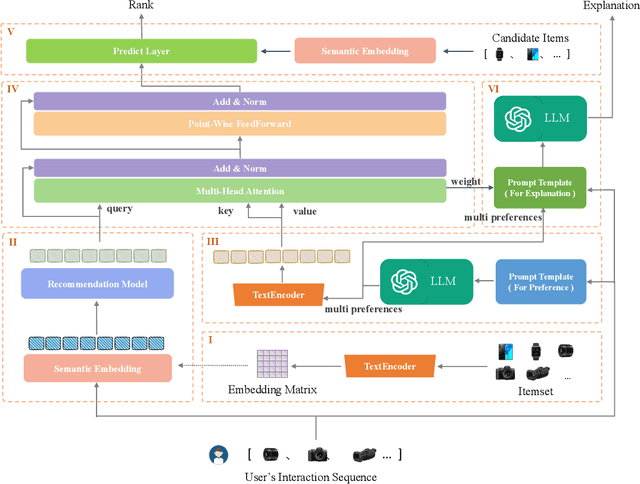
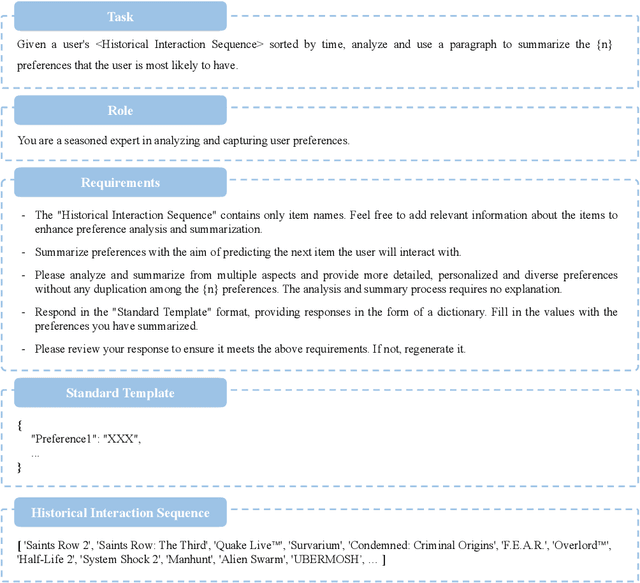

The explainability of recommendation systems is crucial for enhancing user trust and satisfaction. Leveraging large language models (LLMs) offers new opportunities for comprehensive recommendation logic generation. However, in existing related studies, fine-tuning LLM models for recommendation tasks incurs high computational costs and alignment issues with existing systems, limiting the application potential of proven proprietary/closed-source LLM models, such as GPT-4. In this work, our proposed effective strategy LANE aligns LLMs with online recommendation systems without additional LLMs tuning, reducing costs and improving explainability. This innovative approach addresses key challenges in integrating language models with recommendation systems while fully utilizing the capabilities of powerful proprietary models. Specifically, our strategy operates through several key components: semantic embedding, user multi-preference extraction using zero-shot prompting, semantic alignment, and explainable recommendation generation using Chain of Thought (CoT) prompting. By embedding item titles instead of IDs and utilizing multi-head attention mechanisms, our approach aligns the semantic features of user preferences with those of candidate items, ensuring coherent and user-aligned recommendations. Sufficient experimental results including performance comparison, questionnaire voting, and visualization cases prove that our method can not only ensure recommendation performance, but also provide easy-to-understand and reasonable recommendation logic.
WAVE: Weight Template for Adaptive Initialization of Variable-sized Models
Jun 25, 2024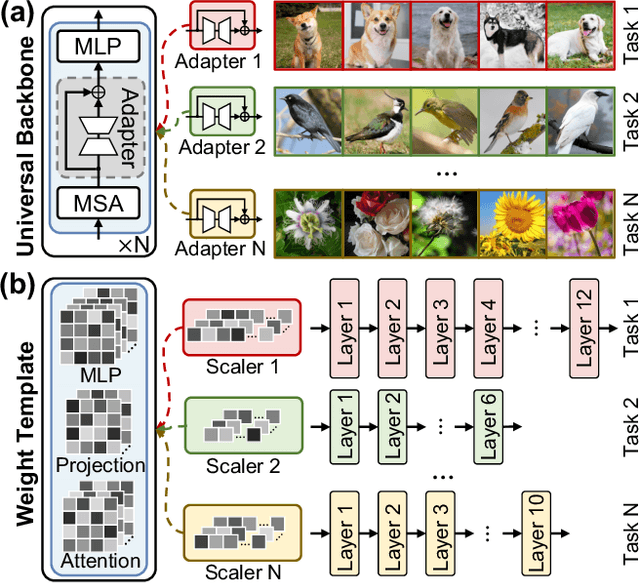
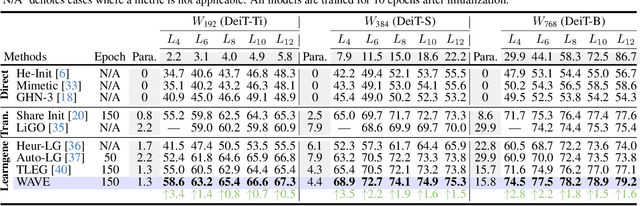
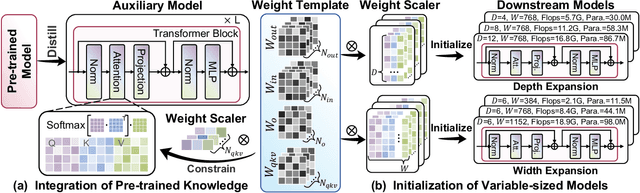
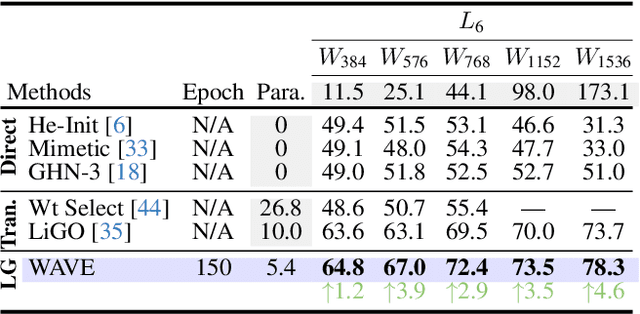
The expansion of model parameters underscores the significance of pre-trained models; however, the constraints encountered during model deployment necessitate models of variable sizes. Consequently, the traditional pre-training and fine-tuning paradigm fails to address the initialization problem when target models are incompatible with pre-trained models. We tackle this issue from a multitasking perspective and introduce \textbf{WAVE}, which incorporates a set of shared \textbf{W}eight templates for \textbf{A}daptive initialization of \textbf{V}ariable-siz\textbf{E}d Models. During initialization, target models will initialize the corresponding weight scalers tailored to their model size, which are sufficient to learn the connection rules of weight templates based on the Kronecker product from a limited amount of data. For the construction of the weight templates, WAVE utilizes the \textit{Learngene} framework, which structurally condenses common knowledge from ancestry models into weight templates as the learngenes through knowledge distillation. This process allows the integration of pre-trained models' knowledge into structured knowledge according to the rules of weight templates. We provide a comprehensive benchmark for the learngenes, and extensive experiments demonstrate the efficacy of WAVE. The results show that WAVE achieves state-of-the-art performance when initializing models with various depth and width, and even outperforms the direct pre-training of $n$ entire models, particularly for smaller models, saving approximately $n\times$ and $5\times$ in computational and storage resources, respectively. WAVE simultaneously achieves the most efficient knowledge transfer across a series of datasets, specifically achieving an average improvement of 1.8\% and 1.2\% on 7 downstream datasets.
Predicting Many Properties of Crystals by a Single Deep Learning Model
May 29, 2024The use of machine learning methods for predicting the properties of crystalline materials encounters significant challenges, primarily related to input encoding, output versatility, and interpretability. Here, we introduce CrystalBERT, an adaptable transformer-based framework with novel structure that integrates space group, elemental, and unit cell information. The method's adaptability lies not only in its ability to seamlessly combine diverse features but also in its capability to accurately predict a wide range of physically important properties, including topological properties, superconducting transition temperatures, dielectric constants, and more. CrystalBERT also provides insightful physical interpretations regarding the features that most significantly influence the target properties. Our findings indicate that space group and elemental information are more important for predicting topological and superconducting properties, in contrast to some properties that primarily depend on the unit cell information. This underscores the intricate nature of topological and superconducting properties. By incorporating all these features, we achieve a high accuracy of 91% in topological classification, surpassing prior studies and identifying previously misclassified topological materials, further demonstrating the effectiveness of our model.
Inaccurate Label Distribution Learning with Dependency Noise
May 26, 2024In this paper, we introduce the Dependent Noise-based Inaccurate Label Distribution Learning (DN-ILDL) framework to tackle the challenges posed by noise in label distribution learning, which arise from dependencies on instances and labels. We start by modeling the inaccurate label distribution matrix as a combination of the true label distribution and a noise matrix influenced by specific instances and labels. To address this, we develop a linear mapping from instances to their true label distributions, incorporating label correlations, and decompose the noise matrix using feature and label representations, applying group sparsity constraints to accurately capture the noise. Furthermore, we employ graph regularization to align the topological structures of the input and output spaces, ensuring accurate reconstruction of the true label distribution matrix. Utilizing the Alternating Direction Method of Multipliers (ADMM) for efficient optimization, we validate our method's capability to recover true labels accurately and establish a generalization error bound. Extensive experiments demonstrate that DN-ILDL effectively addresses the ILDL problem and outperforms existing LDL methods.
Talk to Parallel LiDARs: A Human-LiDAR Interaction Method Based on 3D Visual Grounding
May 24, 2024
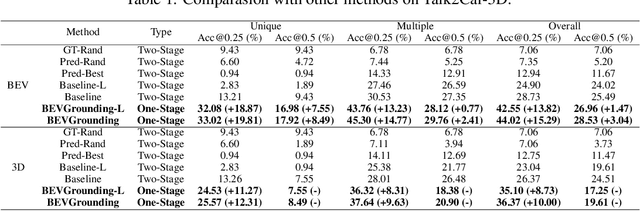

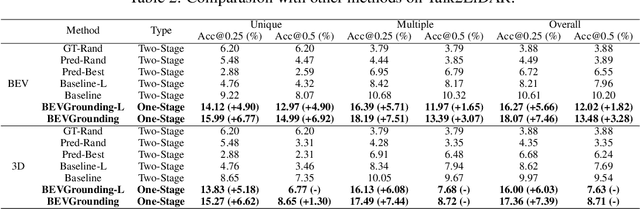
LiDAR sensors play a crucial role in various applications, especially in autonomous driving. Current research primarily focuses on optimizing perceptual models with point cloud data as input, while the exploration of deeper cognitive intelligence remains relatively limited. To address this challenge, parallel LiDARs have emerged as a novel theoretical framework for the next-generation intelligent LiDAR systems, which tightly integrate physical, digital, and social systems. To endow LiDAR systems with cognitive capabilities, we introduce the 3D visual grounding task into parallel LiDARs and present a novel human-computer interaction paradigm for LiDAR systems. We propose Talk2LiDAR, a large-scale benchmark dataset tailored for 3D visual grounding in autonomous driving. Additionally, we present a two-stage baseline approach and an efficient one-stage method named BEVGrounding, which significantly improves grounding accuracy by fusing coarse-grained sentence and fine-grained word embeddings with visual features. Our experiments on Talk2Car-3D and Talk2LiDAR datasets demonstrate the superior performance of BEVGrounding, laying a foundation for further research in this domain.