 Add to Chrome
 Add to Firefox
 Add to Edge
MambaDSF: Multi-Scale SSM with Dilated Feature Fusion for Sonar Small Target Detection
May 24, 2026
Sonar imaging is the primary modality for underwater target detection, yet small targets remain difficult to detect due to insufficient pixel coverage, low acoustic contrast, and scale ambiguity across imaging ranges. CNN-based detectors extract local features efficiently but cannot suppress noise-induced false alarms without global acoustic context. Transformer-based methods capture long-range dependencies at quadratic computational cost. Existing Mamba-based vision models offer efficient linear-cost scanning but lack multi-scale semantic alignment across pyramid levels, multi-receptive-field fusion, and small-target-aware training supervision needed for reliable sonar detection. This letter proposes Mamba Dilated-Scale Fusion (MambaDSF), a hybrid framework addressing these limitations through three contributions: a Mamba Enhanced Feature Pyramid (MambaEFP) backbone that jointly captures local echo cues and global acoustic context at linear complexity; a Dilate Fusion Mamba (DFMamba) encoder that enforces multi-scale feature alignment across pyramid levels; and Scale-Adaptive Weighted IoU (SA-WIoU) and Cross-Scale Coherence (CSC) losses that stabilize small-target training. MambaDSF achieves 91.5% mAP50 on the UATD forward-looking sonar benchmark with 28.7 million parameters, surpassing all compared detectors. On a small-target subset the gain reached +2.2 percentage points, and cross-domain evaluation on FLS and MD-FLS confirms the generalization of the proposed architecture. The codes are publicly available at https://github.com/IDontKnowAAA/MambaDSF.

UMono: Physical Model Informed Hybrid CNN-Transformer Framework for Underwater Monocular Depth Estimation
Jul 25, 2024
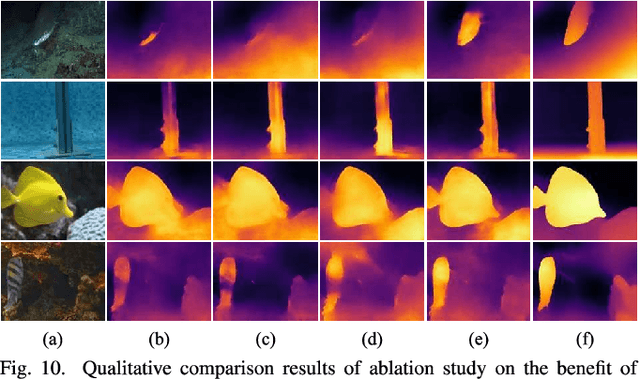
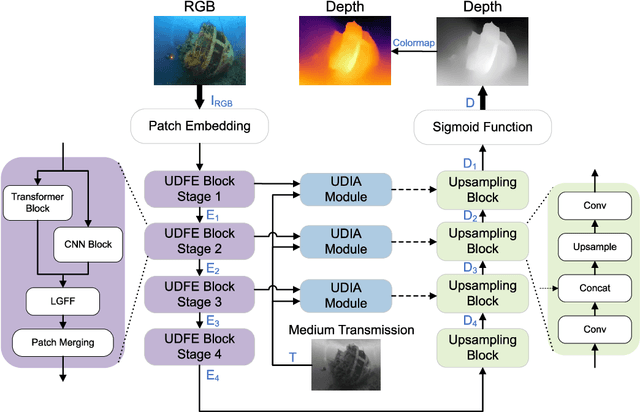

Underwater monocular depth estimation serves as the foundation for tasks such as 3D reconstruction of underwater scenes. However, due to the influence of light and medium, the underwater environment undergoes a distinctive imaging process, which presents challenges in accurately estimating depth from a single image. The existing methods fail to consider the unique characteristics of underwater environments, leading to inadequate estimation results and limited generalization performance. Furthermore, underwater depth estimation requires extracting and fusing both local and global features, which is not fully explored in existing methods. In this paper, an end-to-end learning framework for underwater monocular depth estimation called UMono is presented, which incorporates underwater image formation model characteristics into network architecture, and effectively utilize both local and global features of underwater image. Experimental results demonstrate that the proposed method is effective for underwater monocular depth estimation and outperforms the existing methods in both quantitative and qualitative analyses.