 Add to Chrome
 Add to Firefox
 Add to Edge
Lookaround Optimizer: $k$ steps around, 1 step average
Jun 13, 2023
Weight Average (WA) is an active research topic due to its simplicity in ensembling deep networks and the effectiveness in promoting generalization. Existing weight average approaches, however, are often carried out along only one training trajectory in a post-hoc manner (i.e., the weights are averaged after the entire training process is finished), which significantly degrades the diversity between networks and thus impairs the effectiveness in ensembling. In this paper, inspired by weight average, we propose Lookaround, a straightforward yet effective SGD-based optimizer leading to flatter minima with better generalization. Specifically, Lookaround iterates two steps during the whole training period: the around step and the average step. In each iteration, 1) the around step starts from a common point and trains multiple networks simultaneously, each on transformed data by a different data augmentation, and 2) the average step averages these trained networks to get the averaged network, which serves as the starting point for the next iteration. The around step improves the functionality diversity while the average step guarantees the weight locality of these networks during the whole training, which is essential for WA to work. We theoretically explain the superiority of Lookaround by convergence analysis, and make extensive experiments to evaluate Lookaround on popular benchmarks including CIFAR and ImageNet with both CNNs and ViTs, demonstrating clear superiority over state-of-the-arts. Our code is available at https://github.com/Ardcy/Lookaround.

Is Centralized Training with Decentralized Execution Framework Centralized Enough for MARL?
May 27, 2023
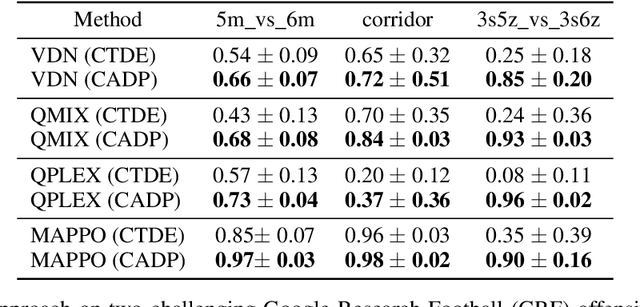

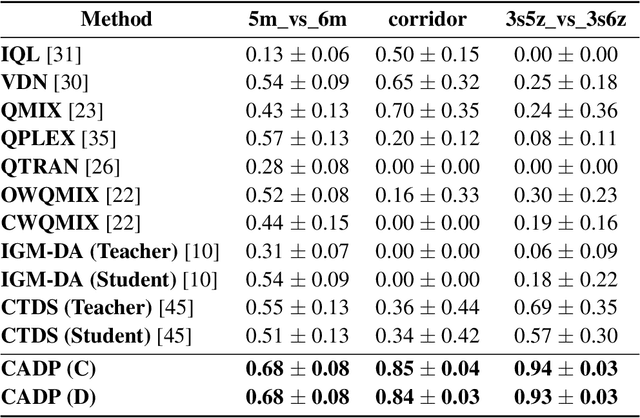
Centralized Training with Decentralized Execution (CTDE) has recently emerged as a popular framework for cooperative Multi-Agent Reinforcement Learning (MARL), where agents can use additional global state information to guide training in a centralized way and make their own decisions only based on decentralized local policies. Despite the encouraging results achieved, CTDE makes an independence assumption on agent policies, which limits agents to adopt global cooperative information from each other during centralized training. Therefore, we argue that existing CTDE methods cannot fully utilize global information for training, leading to an inefficient joint-policy exploration and even suboptimal results. In this paper, we introduce a novel Centralized Advising and Decentralized Pruning (CADP) framework for multi-agent reinforcement learning, that not only enables an efficacious message exchange among agents during training but also guarantees the independent policies for execution. Firstly, CADP endows agents the explicit communication channel to seek and take advices from different agents for more centralized training. To further ensure the decentralized execution, we propose a smooth model pruning mechanism to progressively constraint the agent communication into a closed one without degradation in agent cooperation capability. Empirical evaluations on StarCraft II micromanagement and Google Research Football benchmarks demonstrate that the proposed framework achieves superior performance compared with the state-of-the-art counterparts. Our code will be made publicly available.
Learning Locally Editable Virtual Humans
Apr 28, 2023In this paper, we propose a novel hybrid representation and end-to-end trainable network architecture to model fully editable and customizable neural avatars. At the core of our work lies a representation that combines the modeling power of neural fields with the ease of use and inherent 3D consistency of skinned meshes. To this end, we construct a trainable feature codebook to store local geometry and texture features on the vertices of a deformable body model, thus exploiting its consistent topology under articulation. This representation is then employed in a generative auto-decoder architecture that admits fitting to unseen scans and sampling of realistic avatars with varied appearances and geometries. Furthermore, our representation allows local editing by swapping local features between 3D assets. To verify our method for avatar creation and editing, we contribute a new high-quality dataset, dubbed CustomHumans, for training and evaluation. Our experiments quantitatively and qualitatively show that our method generates diverse detailed avatars and achieves better model fitting performance compared to state-of-the-art methods. Our code and dataset are available at https://custom-humans.github.io/.
Temporal Aggregation and Propagation Graph Neural Networks for Dynamic Representation
Apr 15, 2023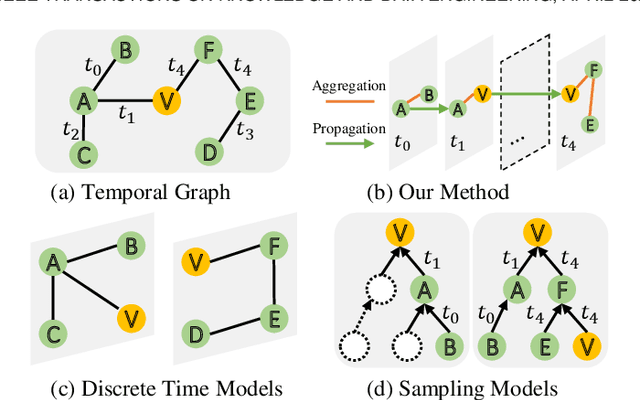
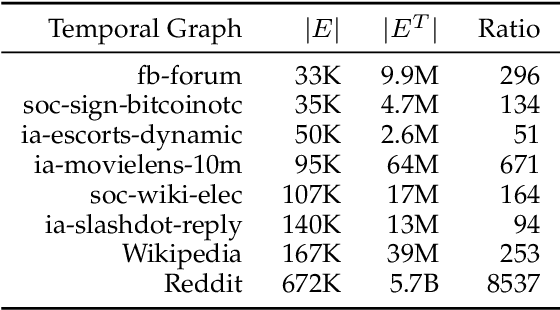
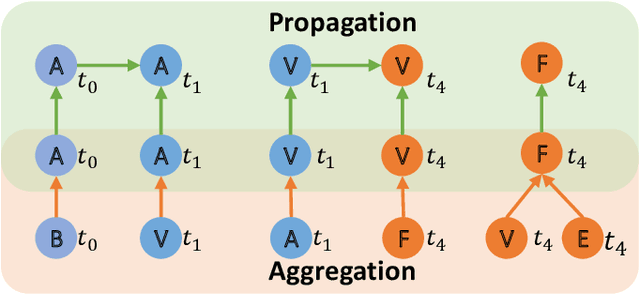
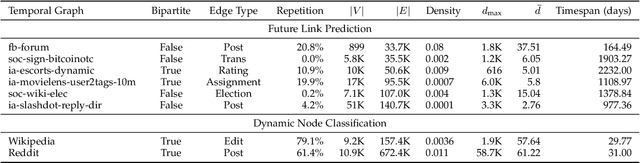
Temporal graphs exhibit dynamic interactions between nodes over continuous time, whose topologies evolve with time elapsing. The whole temporal neighborhood of nodes reveals the varying preferences of nodes. However, previous works usually generate dynamic representation with limited neighbors for simplicity, which results in both inferior performance and high latency of online inference. Therefore, in this paper, we propose a novel method of temporal graph convolution with the whole neighborhood, namely Temporal Aggregation and Propagation Graph Neural Networks (TAP-GNN). Specifically, we firstly analyze the computational complexity of the dynamic representation problem by unfolding the temporal graph in a message-passing paradigm. The expensive complexity motivates us to design the AP (aggregation and propagation) block, which significantly reduces the repeated computation of historical neighbors. The final TAP-GNN supports online inference in the graph stream scenario, which incorporates the temporal information into node embeddings with a temporal activation function and a projection layer besides several AP blocks. Experimental results on various real-life temporal networks show that our proposed TAP-GNN outperforms existing temporal graph methods by a large margin in terms of both predictive performance and online inference latency. Our code is available at \url{https://github.com/doujiang-zheng/TAP-GNN}.
Human from Blur: Human Pose Tracking from Blurry Images
Mar 30, 2023We propose a method to estimate 3D human poses from substantially blurred images. The key idea is to tackle the inverse problem of image deblurring by modeling the forward problem with a 3D human model, a texture map, and a sequence of poses to describe human motion. The blurring process is then modeled by a temporal image aggregation step. Using a differentiable renderer, we can solve the inverse problem by backpropagating the pixel-wise reprojection error to recover the best human motion representation that explains a single or multiple input images. Since the image reconstruction loss alone is insufficient, we present additional regularization terms. To the best of our knowledge, we present the first method to tackle this problem. Our method consistently outperforms other methods on significantly blurry inputs since they lack one or multiple key functionalities that our method unifies, i.e. image deblurring with sub-frame accuracy and explicit 3D modeling of non-rigid human motion.
Hi4D: 4D Instance Segmentation of Close Human Interaction
Mar 27, 2023

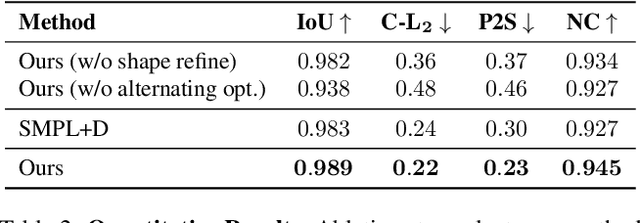

We propose Hi4D, a method and dataset for the automatic analysis of physically close human-human interaction under prolonged contact. Robustly disentangling several in-contact subjects is a challenging task due to occlusions and complex shapes. Hence, existing multi-view systems typically fuse 3D surfaces of close subjects into a single, connected mesh. To address this issue we leverage i) individually fitted neural implicit avatars; ii) an alternating optimization scheme that refines pose and surface through periods of close proximity; and iii) thus segment the fused raw scans into individual instances. From these instances we compile Hi4D dataset of 4D textured scans of 20 subject pairs, 100 sequences, and a total of more than 11K frames. Hi4D contains rich interaction-centric annotations in 2D and 3D alongside accurately registered parametric body models. We define varied human pose and shape estimation tasks on this dataset and provide results from state-of-the-art methods on these benchmarks.
Generalization Matters: Loss Minima Flattening via Parameter Hybridization for Efficient Online Knowledge Distillation
Mar 26, 2023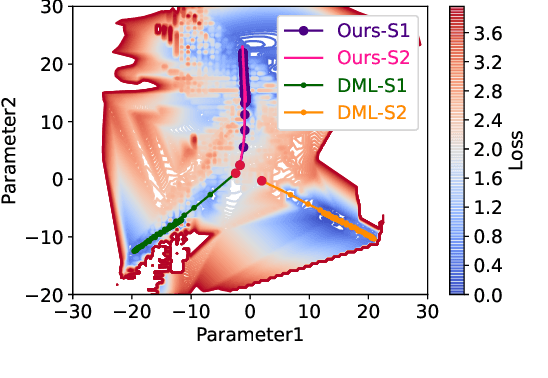
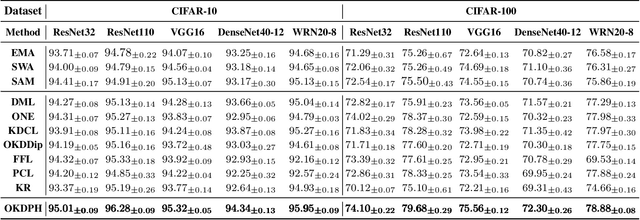
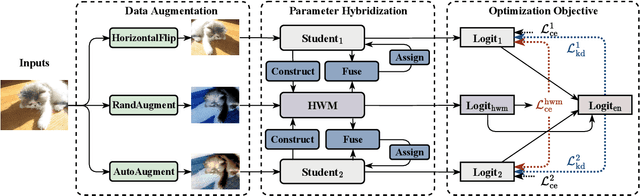
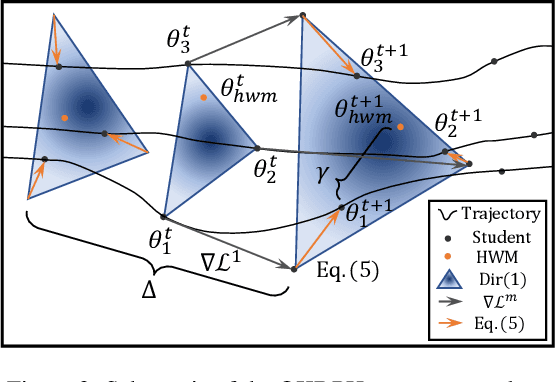
Most existing online knowledge distillation(OKD) techniques typically require sophisticated modules to produce diverse knowledge for improving students' generalization ability. In this paper, we strive to fully utilize multi-model settings instead of well-designed modules to achieve a distillation effect with excellent generalization performance. Generally, model generalization can be reflected in the flatness of the loss landscape. Since averaging parameters of multiple models can find flatter minima, we are inspired to extend the process to the sampled convex combinations of multi-student models in OKD. Specifically, by linearly weighting students' parameters in each training batch, we construct a Hybrid-Weight Model(HWM) to represent the parameters surrounding involved students. The supervision loss of HWM can estimate the landscape's curvature of the whole region around students to measure the generalization explicitly. Hence we integrate HWM's loss into students' training and propose a novel OKD framework via parameter hybridization(OKDPH) to promote flatter minima and obtain robust solutions. Considering the redundancy of parameters could lead to the collapse of HWM, we further introduce a fusion operation to keep the high similarity of students. Compared to the state-of-the-art(SOTA) OKD methods and SOTA methods of seeking flat minima, our OKDPH achieves higher performance with fewer parameters, benefiting OKD with lightweight and robust characteristics. Our code is publicly available at https://github.com/tianlizhang/OKDPH.
Schema Inference for Interpretable Image Classification
Mar 12, 2023In this paper, we study a novel inference paradigm, termed as schema inference, that learns to deductively infer the explainable predictions by rebuilding the prior deep neural network (DNN) forwarding scheme, guided by the prevalent philosophical cognitive concept of schema. We strive to reformulate the conventional model inference pipeline into a graph matching policy that associates the extracted visual concepts of an image with the pre-computed scene impression, by analogy with human reasoning mechanism via impression matching. To this end, we devise an elaborated architecture, termed as SchemaNet, as a dedicated instantiation of the proposed schema inference concept, that models both the visual semantics of input instances and the learned abstract imaginations of target categories as topological relational graphs. Meanwhile, to capture and leverage the compositional contributions of visual semantics in a global view, we also introduce a universal Feat2Graph scheme in SchemaNet to establish the relational graphs that contain abundant interaction information. Both the theoretical analysis and the experimental results on several benchmarks demonstrate that the proposed schema inference achieves encouraging performance and meanwhile yields a clear picture of the deductive process leading to the predictions. Our code is available at https://github.com/zhfeing/SchemaNet-PyTorch.
X-Avatar: Expressive Human Avatars
Mar 09, 2023We present X-Avatar, a novel avatar model that captures the full expressiveness of digital humans to bring about life-like experiences in telepresence, AR/VR and beyond. Our method models bodies, hands, facial expressions and appearance in a holistic fashion and can be learned from either full 3D scans or RGB-D data. To achieve this, we propose a part-aware learned forward skinning module that can be driven by the parameter space of SMPL-X, allowing for expressive animation of X-Avatars. To efficiently learn the neural shape and deformation fields, we propose novel part-aware sampling and initialization strategies. This leads to higher fidelity results, especially for smaller body parts while maintaining efficient training despite increased number of articulated bones. To capture the appearance of the avatar with high-frequency details, we extend the geometry and deformation fields with a texture network that is conditioned on pose, facial expression, geometry and the normals of the deformed surface. We show experimentally that our method outperforms strong baselines in both data domains both quantitatively and qualitatively on the animation task. To facilitate future research on expressive avatars we contribute a new dataset, called X-Humans, containing 233 sequences of high-quality textured scans from 20 participants, totalling 35,500 data frames.
Vid2Avatar: 3D Avatar Reconstruction from Videos in the Wild via Self-supervised Scene Decomposition
Feb 22, 2023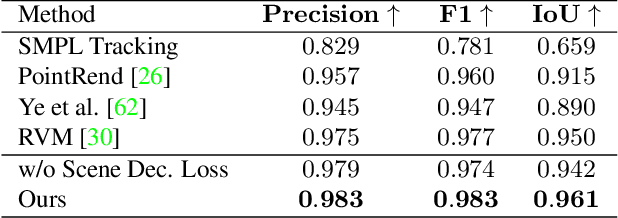
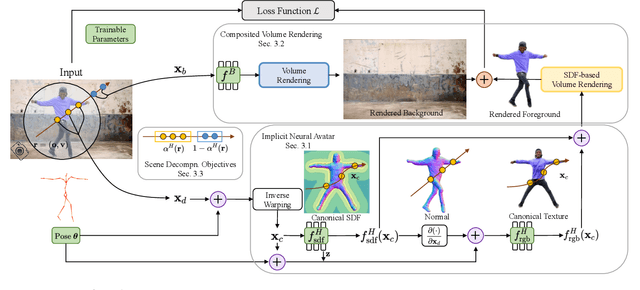
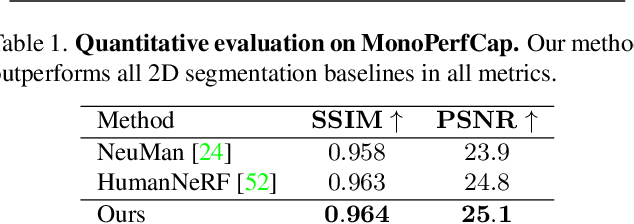
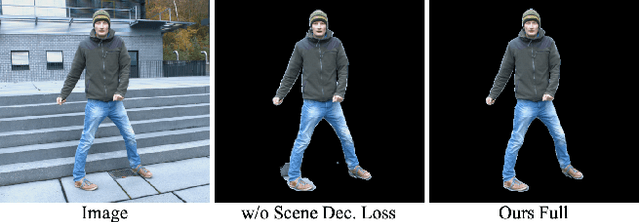
We present Vid2Avatar, a method to learn human avatars from monocular in-the-wild videos. Reconstructing humans that move naturally from monocular in-the-wild videos is difficult. Solving it requires accurately separating humans from arbitrary backgrounds. Moreover, it requires reconstructing detailed 3D surface from short video sequences, making it even more challenging. Despite these challenges, our method does not require any groundtruth supervision or priors extracted from large datasets of clothed human scans, nor do we rely on any external segmentation modules. Instead, it solves the tasks of scene decomposition and surface reconstruction directly in 3D by modeling both the human and the background in the scene jointly, parameterized via two separate neural fields. Specifically, we define a temporally consistent human representation in canonical space and formulate a global optimization over the background model, the canonical human shape and texture, and per-frame human pose parameters. A coarse-to-fine sampling strategy for volume rendering and novel objectives are introduced for a clean separation of dynamic human and static background, yielding detailed and robust 3D human geometry reconstructions. We evaluate our methods on publicly available datasets and show improvements over prior art.