 Add to Chrome
 Add to Firefox
 Add to Edge
Topology-Unified 2D Pose Estimation across Intact, Residual and Prosthetic Limbs
Aug 13, 2026
Driven by the availability of large-scale datasets, Human Pose Estimation (HPE) plays a critical role in numerous downstream tasks. However, mainstream benchmarks exhibit severe representation bias, predominantly featuring able-bodied individuals. While a few pioneering datasets have attempted to address limb differences, their annotation protocols fail to generalize, struggling to represent specialized mechanical structures like running blades or unprosthetized residual limbs. To bridge this gap, we introduce ProPose, a large-scale benchmark featuring a novel annotation protocol that unifies the topological representation of biological limbs, diverse prostheses, and physical absences within a single framework. Because real-world prosthetic images are inherently scarce and exhibit extreme long-tail distributions, we design a Real-to-Synthetic data expansion pipeline to explicitly synthesize and expand the underrepresented cases. However, simply training existing models on this enriched dataset often leads to suboptimal solutions, as they estimate each keypoint independently and might hallucinate non-existent joints on mechanical structures. To resolve this, we propose ProLoss, a structure-aware objective that enforces keypoint dependencies within a single limb to prevent unrealistic limb predictions. Extensive experiments demonstrate that our approach improves the classification accuracy of long-tail prosthetic joints by 2% to 6% without compromising spatial coordinate localization performance. This work sets a foundation for inclusive pose estimation, unlocking new possibilities for understanding the interactions between human bodies and assistive devices.

MM-WLAuslan: Multi-View Multi-Modal Word-Level Australian Sign Language Recognition Dataset
Oct 25, 2024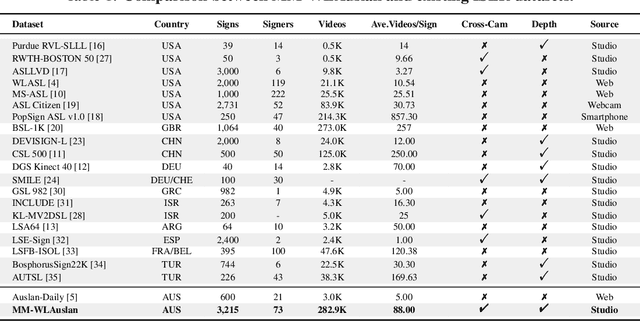
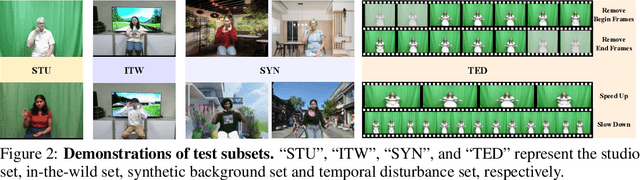

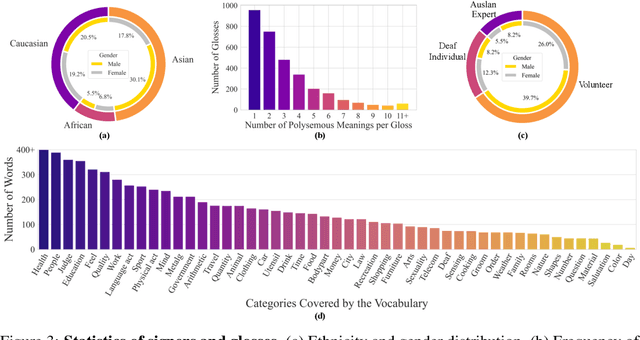
Isolated Sign Language Recognition (ISLR) focuses on identifying individual sign language glosses. Considering the diversity of sign languages across geographical regions, developing region-specific ISLR datasets is crucial for supporting communication and research. Auslan, as a sign language specific to Australia, still lacks a dedicated large-scale word-level dataset for the ISLR task. To fill this gap, we curate \underline{\textbf{the first}} large-scale Multi-view Multi-modal Word-Level Australian Sign Language recognition dataset, dubbed MM-WLAuslan. Compared to other publicly available datasets, MM-WLAuslan exhibits three significant advantages: (1) the largest amount of data, (2) the most extensive vocabulary, and (3) the most diverse of multi-modal camera views. Specifically, we record 282K+ sign videos covering 3,215 commonly used Auslan glosses presented by 73 signers in a studio environment. Moreover, our filming system includes two different types of cameras, i.e., three Kinect-V2 cameras and a RealSense camera. We position cameras hemispherically around the front half of the model and simultaneously record videos using all four cameras. Furthermore, we benchmark results with state-of-the-art methods for various multi-modal ISLR settings on MM-WLAuslan, including multi-view, cross-camera, and cross-view. Experiment results indicate that MM-WLAuslan is a challenging ISLR dataset, and we hope this dataset will contribute to the development of Auslan and the advancement of sign languages worldwide. All datasets and benchmarks are available at MM-WLAuslan.
3DRealCar: An In-the-wild RGB-D Car Dataset with 360-degree Views
Jun 07, 2024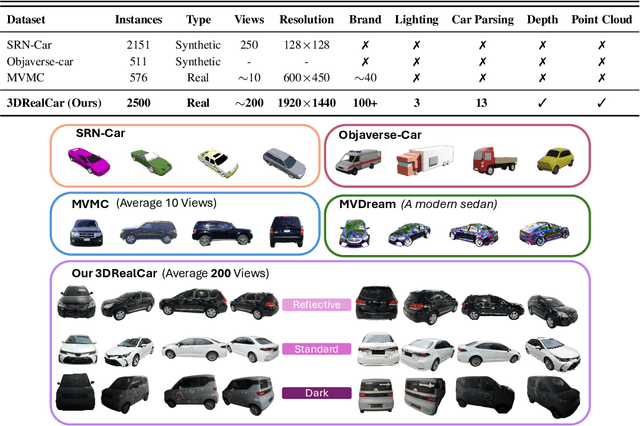

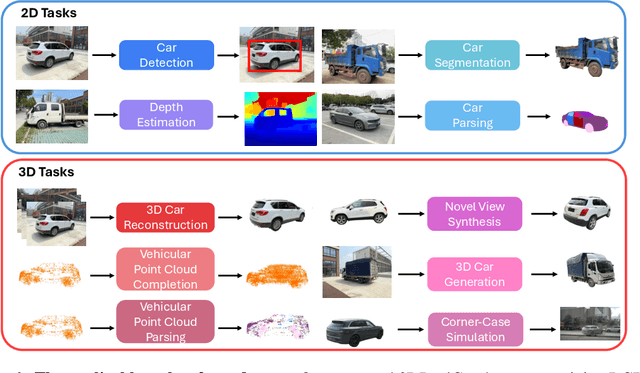
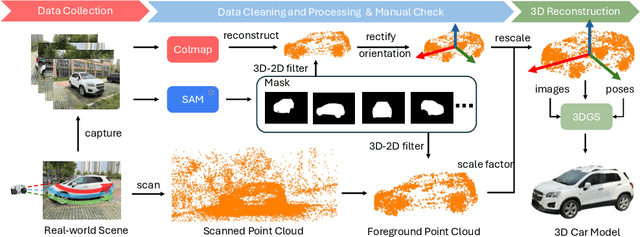
3D cars are commonly used in self-driving systems, virtual/augmented reality, and games. However, existing 3D car datasets are either synthetic or low-quality, presenting a significant gap toward the high-quality real-world 3D car datasets and limiting their applications in practical scenarios. In this paper, we propose the first large-scale 3D real car dataset, termed 3DRealCar, offering three distinctive features. (1) \textbf{High-Volume}: 2,500 cars are meticulously scanned by 3D scanners, obtaining car images and point clouds with real-world dimensions; (2) \textbf{High-Quality}: Each car is captured in an average of 200 dense, high-resolution 360-degree RGB-D views, enabling high-fidelity 3D reconstruction; (3) \textbf{High-Diversity}: The dataset contains various cars from over 100 brands, collected under three distinct lighting conditions, including reflective, standard, and dark. Additionally, we offer detailed car parsing maps for each instance to promote research in car parsing tasks. Moreover, we remove background point clouds and standardize the car orientation to a unified axis for the reconstruction only on cars without background and controllable rendering. We benchmark 3D reconstruction results with state-of-the-art methods across each lighting condition in 3DRealCar. Extensive experiments demonstrate that the standard lighting condition part of 3DRealCar can be used to produce a large number of high-quality 3D cars, improving various 2D and 3D tasks related to cars. Notably, our dataset brings insight into the fact that recent 3D reconstruction methods face challenges in reconstructing high-quality 3D cars under reflective and dark lighting conditions. \textcolor{red}{\href{https://xiaobiaodu.github.io/3drealcar/}{Our dataset is available here.}}