 Add to Chrome
 Add to Firefox
 Add to Edge
Topology-Unified 2D Pose Estimation across Intact, Residual and Prosthetic Limbs
Aug 13, 2026
Driven by the availability of large-scale datasets, Human Pose Estimation (HPE) plays a critical role in numerous downstream tasks. However, mainstream benchmarks exhibit severe representation bias, predominantly featuring able-bodied individuals. While a few pioneering datasets have attempted to address limb differences, their annotation protocols fail to generalize, struggling to represent specialized mechanical structures like running blades or unprosthetized residual limbs. To bridge this gap, we introduce ProPose, a large-scale benchmark featuring a novel annotation protocol that unifies the topological representation of biological limbs, diverse prostheses, and physical absences within a single framework. Because real-world prosthetic images are inherently scarce and exhibit extreme long-tail distributions, we design a Real-to-Synthetic data expansion pipeline to explicitly synthesize and expand the underrepresented cases. However, simply training existing models on this enriched dataset often leads to suboptimal solutions, as they estimate each keypoint independently and might hallucinate non-existent joints on mechanical structures. To resolve this, we propose ProLoss, a structure-aware objective that enforces keypoint dependencies within a single limb to prevent unrealistic limb predictions. Extensive experiments demonstrate that our approach improves the classification accuracy of long-tail prosthetic joints by 2% to 6% without compromising spatial coordinate localization performance. This work sets a foundation for inclusive pose estimation, unlocking new possibilities for understanding the interactions between human bodies and assistive devices.

SmokeBench: Evaluating Multimodal Large Language Models for Wildfire Smoke Detection
Dec 12, 2025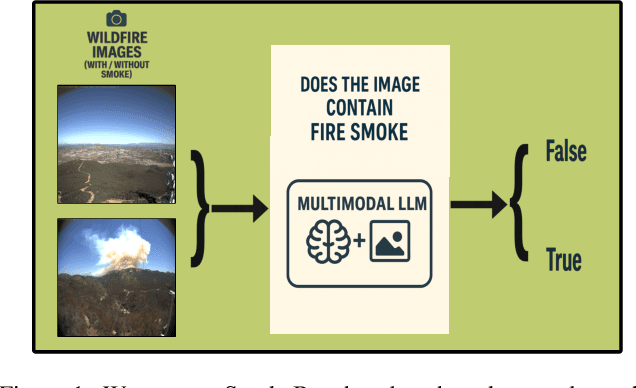
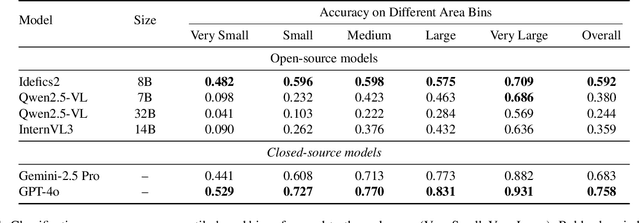
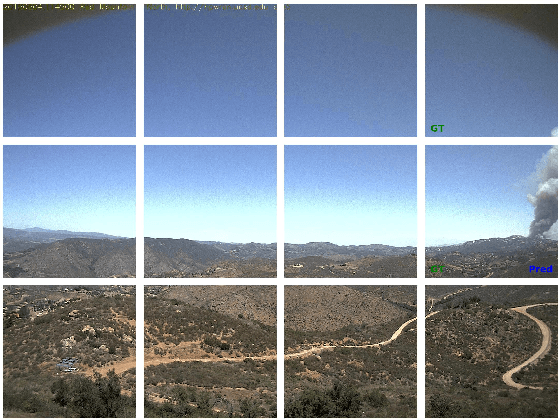
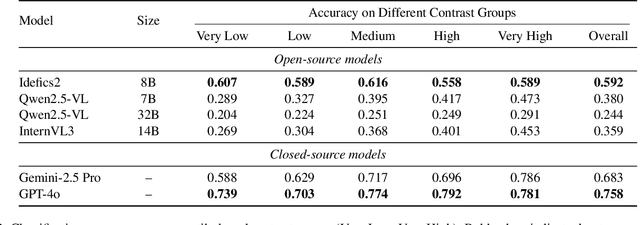
Wildfire smoke is transparent, amorphous, and often visually confounded with clouds, making early-stage detection particularly challenging. In this work, we introduce a benchmark, called SmokeBench, to evaluate the ability of multimodal large language models (MLLMs) to recognize and localize wildfire smoke in images. The benchmark consists of four tasks: (1) smoke classification, (2) tile-based smoke localization, (3) grid-based smoke localization, and (4) smoke detection. We evaluate several MLLMs, including Idefics2, Qwen2.5-VL, InternVL3, Unified-IO 2, Grounding DINO, GPT-4o, and Gemini-2.5 Pro. Our results show that while some models can classify the presence of smoke when it covers a large area, all models struggle with accurate localization, especially in the early stages. Further analysis reveals that smoke volume is strongly correlated with model performance, whereas contrast plays a comparatively minor role. These findings highlight critical limitations of current MLLMs for safety-critical wildfire monitoring and underscore the need for methods that improve early-stage smoke localization.