 Add to Chrome
 Add to Firefox
 Add to Edge
EvoScene-VLA: Evolving Scene Beliefs Inside the Action Decoder for Chunked Robot Control
May 21, 2026
Chunked vision-language-action (VLA) policies predict multi-step robot controls, conditioning each update on the current visual observation alone. Yet robot actions cause contact, occlusion, and object motion, and the geometry that later decisions depend on can change before the next visual update arrives. Spatial VLAs improve current-frame geometry. Temporal VLAs aggregate past frames. Neither maintains an action-updated scene prior across chunks. We argue for a persistent action-updated scene state across control calls, and introduce EvoScene-VLA. Its recurrent scene prefix carries a geometry-aware scene state across chunks. At each vision-language model (VLM) call, the VLM combines scene information from the current observation with the action-updated prior from the previous chunk; the action decoder outputs both the next action chunk and a compact scene update. This update becomes the next prior, which the VLM corrects against the new observation when the next call arrives. Each control call therefore starts from a scene prior that reflects both recent actions and fresh visual evidence. During training, \textbf{Scene Predictor} supplies future scene-token targets, and Geometric Anchor aligns scene slots with frozen depth and 3D teachers. We discard both modules at deployment. On 31 RoboTwin tasks, EvoScene-VLA raises average success from 87.2% to 89.1% in fixed evaluation and from 86.1% to 88.5% in randomized evaluation. On the Galaxea R1-Lite real robot, EvoScene-VLA outperforms all baselines.

MM-WLAuslan: Multi-View Multi-Modal Word-Level Australian Sign Language Recognition Dataset
Oct 25, 2024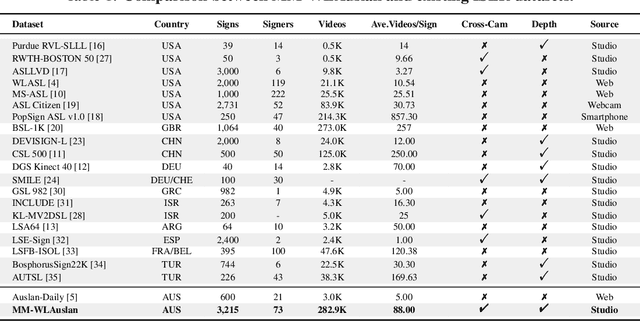
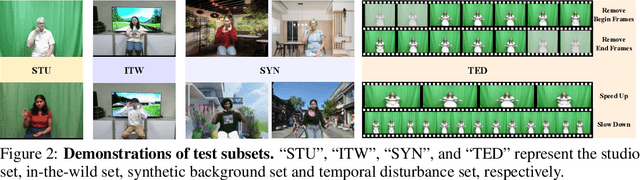

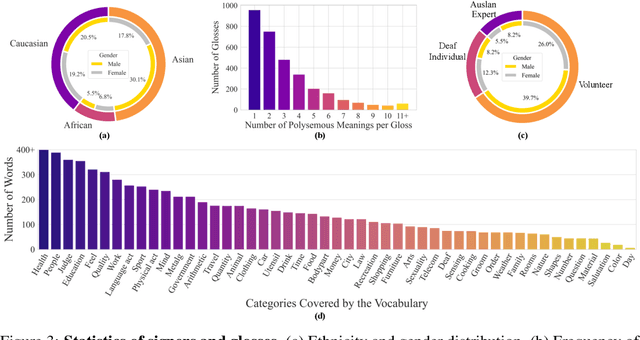
Isolated Sign Language Recognition (ISLR) focuses on identifying individual sign language glosses. Considering the diversity of sign languages across geographical regions, developing region-specific ISLR datasets is crucial for supporting communication and research. Auslan, as a sign language specific to Australia, still lacks a dedicated large-scale word-level dataset for the ISLR task. To fill this gap, we curate \underline{\textbf{the first}} large-scale Multi-view Multi-modal Word-Level Australian Sign Language recognition dataset, dubbed MM-WLAuslan. Compared to other publicly available datasets, MM-WLAuslan exhibits three significant advantages: (1) the largest amount of data, (2) the most extensive vocabulary, and (3) the most diverse of multi-modal camera views. Specifically, we record 282K+ sign videos covering 3,215 commonly used Auslan glosses presented by 73 signers in a studio environment. Moreover, our filming system includes two different types of cameras, i.e., three Kinect-V2 cameras and a RealSense camera. We position cameras hemispherically around the front half of the model and simultaneously record videos using all four cameras. Furthermore, we benchmark results with state-of-the-art methods for various multi-modal ISLR settings on MM-WLAuslan, including multi-view, cross-camera, and cross-view. Experiment results indicate that MM-WLAuslan is a challenging ISLR dataset, and we hope this dataset will contribute to the development of Auslan and the advancement of sign languages worldwide. All datasets and benchmarks are available at MM-WLAuslan.