 Add to Chrome
 Add to Firefox
 Add to Edge
C-PTQ: Fisher-weighted Channel-wise Sensitivity for Post-training Quantization of MLLMs
Jul 23, 2026
Multimodal large language models (MLLMs) require huge memory and computational costs, which limits their practical deployment. Post-training quantization (PTQ) techniques offer an efficient solution for model compression and inference acceleration. Yet, the quantized model faces performance degradation due to outlier channels, which are highly sensitive to quantization and substantially impair activation fidelity and task accuracy. To protect these salient channels during quantization, existing PTQ methods leverage modality- or token-level metrics to guide channel-wise scaling (CWS) of LLM decoders. However, these orthogonal measurements fail to capture channel-wise impacts on task-specific loss, and the misalignment between importance and scaling factors ultimately leads to suboptimal performance. To address this issue, we propose C-PTQ, a unified channel-wise PTQ method that harmonizes task-specific loss perturbation and quantization error. Motivated by second-order derivatives, we design a Fisher-weighted objective as a tractable Hessian approximation, seamlessly injecting task sensitivity into the scaling process. Notably, we achieve state-of-the-art performance without auxiliary modules like LoRA, thereby maintaining high efficiency. Experiments on Qwen2.5VL, InternVL2 and LLaVA-OV across 8 benchmarks demonstrate our effectiveness in both weight-only and weight-activation settings.

EchoPrune: Interpreting Redundancy as Temporal Echoes for Efficient VideoLLMs
May 11, 2026Long-form video understanding remains challenging for Video Large Language Models (VideoLLMs), as the dense frame sampling introduces massive visual tokens while sparse sampling risks missing critical temporal evidence and leading to LLM hallucination. Existing training-free token reduction methods either treat videos equally as static images or rely on segment-level merging heuristics, which weaken fine-grained spatiotemporal modeling and introduce additional overhead. In this paper, we propose EchoPrune, a lightweight and training-free token pruning method that improves temporal resolution under a fixed LLM-side visual token budget. Our core idea is to interpret redundant video tokens as temporal echoes: if a token is well reconstructed from the previous frame, it is merely a temporally redundant echo; otherwise, it may capture new events, motion, or query-relevant visual evidence. Based on this insight, EchoPrune scores visual tokens by (i) query-guided crossmodal relevance and (ii) temporal reconstruction error, measured by correspondence matching and echo matching across consecutive frames. The selected tokens preserve task-relevant cues and temporal novelty while suppressing predictable redundancy, allowing VideoLLMs to observe more frames without increasing the decoding budget. Extensive experiments on LLaVA-OV, Qwen2.5VL, and Qwen3VL across six video understanding benchmarks show that EchoPrune enables VideoLLMs to process up to 20x frames under the same token budget, yielding improved performance (+8.6%) and inference speedup (5.6x for prefilling) on Qwen2.5VL-7B.
MI-Pruner: Crossmodal Mutual Information-guided Token Pruner for Efficient MLLMs
Apr 03, 2026For multimodal large language models (MLLMs), visual information is relatively sparse compared with text. As a result, research on visual pruning emerges for efficient inference. Current approaches typically measure token importance based on the attention scores in the visual encoder or in the LLM decoder, then select visual tokens with high attention scores while pruning others. In this paper, we pursue a different and more surgical approach. Instead of relying on mechanism-specific signals, we directly compute Mutual Information (MI) between visual and textual features themselves, prior to their interaction. This allows us to explicitly measure crossmodal dependency at the feature levels. Our MI-Pruner is simple, efficient and non-intrusive, requiring no access to internal attention maps or architectural modifications. Experimental results demonstrate that our approach outperforms previous attention-based pruning methods with minimal latency.
Beyond Segmentation: Confidence-Aware and Debiased Estimation of Ratio-based Biomarkers
May 26, 2025Ratio-based biomarkers -- such as the proportion of necrotic tissue within a tumor -- are widely used in clinical practice to support diagnosis, prognosis and treatment planning. These biomarkers are typically estimated from soft segmentation outputs by computing region-wise ratios. Despite the high-stakes nature of clinical decision making, existing methods provide only point estimates, offering no measure of uncertainty. In this work, we propose a unified \textit{confidence-aware} framework for estimating ratio-based biomarkers. We conduct a systematic analysis of error propagation in the segmentation-to-biomarker pipeline and identify model miscalibration as the dominant source of uncertainty. To mitigate this, we incorporate a lightweight, post-hoc calibration module that can be applied using internal hospital data without retraining. We leverage a tunable parameter $Q$ to control the confidence level of the derived bounds, allowing adaptation towards clinical practice. Extensive experiments show that our method produces statistically sound confidence intervals, with tunable confidence levels, enabling more trustworthy application of predictive biomarkers in clinical workflows.
Mipmap-GS: Let Gaussians Deform with Scale-specific Mipmap for Anti-aliasing Rendering
Aug 12, 20243D Gaussian Splatting (3DGS) has attracted great attention in novel view synthesis because of its superior rendering efficiency and high fidelity. However, the trained Gaussians suffer from severe zooming degradation due to non-adjustable representation derived from single-scale training. Though some methods attempt to tackle this problem via post-processing techniques such as selective rendering or filtering techniques towards primitives, the scale-specific information is not involved in Gaussians. In this paper, we propose a unified optimization method to make Gaussians adaptive for arbitrary scales by self-adjusting the primitive properties (e.g., color, shape and size) and distribution (e.g., position). Inspired by the mipmap technique, we design pseudo ground-truth for the target scale and propose a scale-consistency guidance loss to inject scale information into 3D Gaussians. Our method is a plug-in module, applicable for any 3DGS models to solve the zoom-in and zoom-out aliasing. Extensive experiments demonstrate the effectiveness of our method. Notably, our method outperforms 3DGS in PSNR by an average of 9.25 dB for zoom-in and 10.40 dB for zoom-out on the NeRF Synthetic dataset.
Unveiling Incomplete Modality Brain Tumor Segmentation: Leveraging Masked Predicted Auto-Encoder and Divergence Learning
Jun 12, 2024

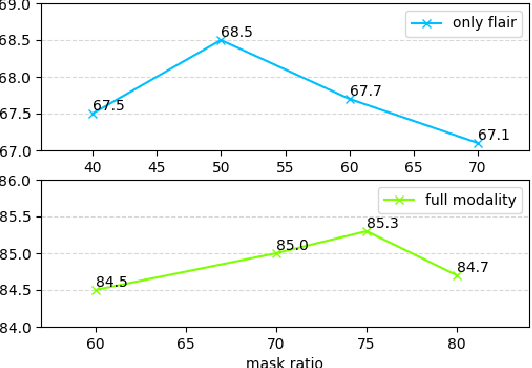

Brain tumor segmentation remains a significant challenge, particularly in the context of multi-modal magnetic resonance imaging (MRI) where missing modality images are common in clinical settings, leading to reduced segmentation accuracy. To address this issue, we propose a novel strategy, which is called masked predicted pre-training, enabling robust feature learning from incomplete modality data. Additionally, in the fine-tuning phase, we utilize a knowledge distillation technique to align features between complete and missing modality data, simultaneously enhancing model robustness. Notably, we leverage the Holder pseudo-divergence instead of the KLD for distillation loss, offering improve mathematical interpretability and properties. Extensive experiments on the BRATS2018 and BRATS2020 datasets demonstrate significant performance enhancements compared to existing state-of-the-art methods.