 Add to Chrome
 Add to Firefox
 Add to Edge
NTIRE 2025 Challenge on Day and Night Raindrop Removal for Dual-Focused Images: Methods and Results
Apr 19, 2025
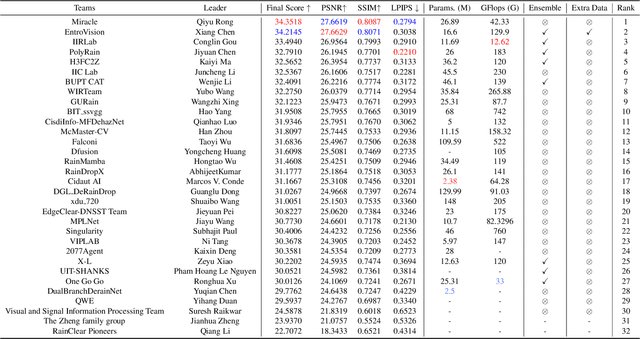
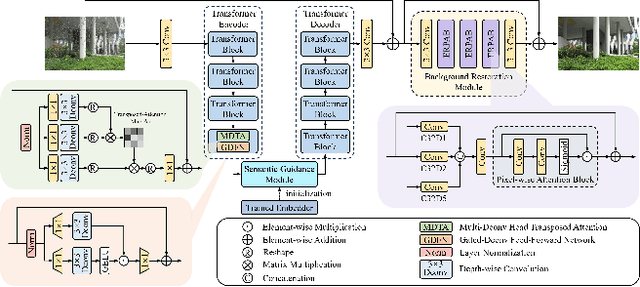
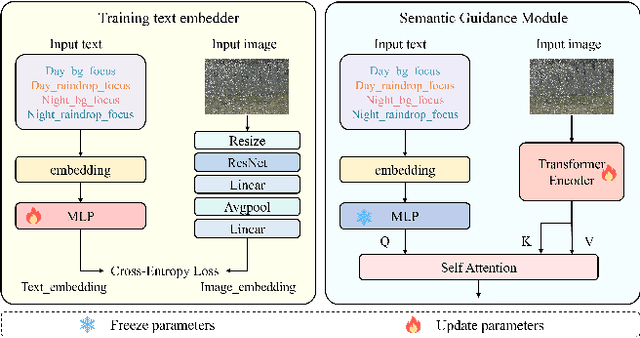
This paper reviews the NTIRE 2025 Challenge on Day and Night Raindrop Removal for Dual-Focused Images. This challenge received a wide range of impressive solutions, which are developed and evaluated using our collected real-world Raindrop Clarity dataset. Unlike existing deraining datasets, our Raindrop Clarity dataset is more diverse and challenging in degradation types and contents, which includes day raindrop-focused, day background-focused, night raindrop-focused, and night background-focused degradations. This dataset is divided into three subsets for competition: 14,139 images for training, 240 images for validation, and 731 images for testing. The primary objective of this challenge is to establish a new and powerful benchmark for the task of removing raindrops under varying lighting and focus conditions. There are a total of 361 participants in the competition, and 32 teams submitting valid solutions and fact sheets for the final testing phase. These submissions achieved state-of-the-art (SOTA) performance on the Raindrop Clarity dataset. The project can be found at https://lixinustc.github.io/CVPR-NTIRE2025-RainDrop-Competition.github.io/.

Neural Architecture Search For Fault Diagnosis
Feb 19, 2020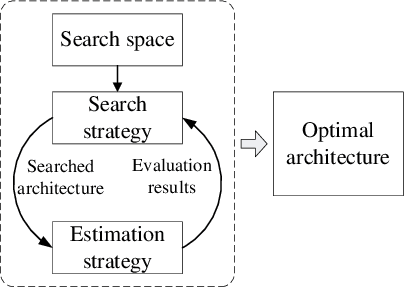
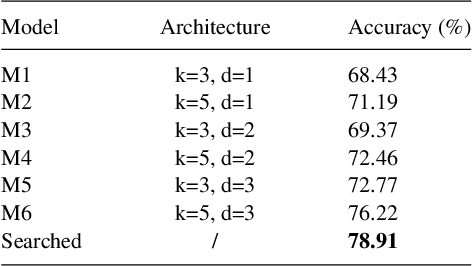
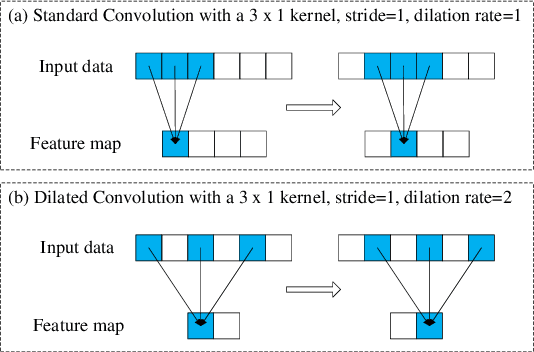
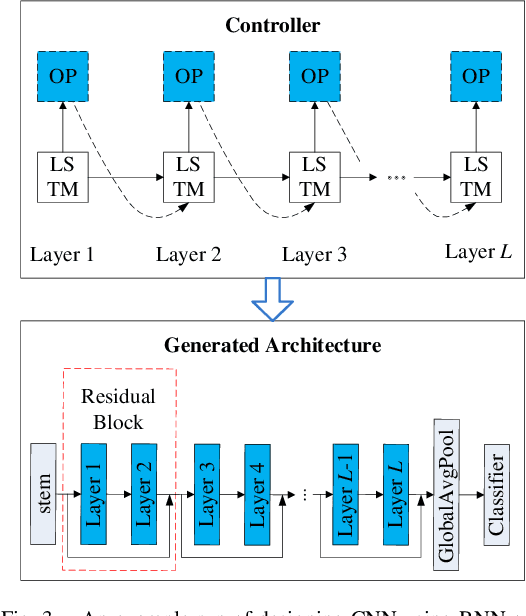
Data-driven methods have made great progress in fault diagnosis, especially deep learning method. Deep learning is suitable for processing big data, and has a strong feature extraction ability to realize end-to-end fault diagnosis systems. However, designing neural network architecture requires rich professional knowledge and debugging experience, and a lot of experiments are needed to screen models and hyperparameters, increasing the difficulty of developing deep learning models. Frortunately, neural architecture search (NAS) is developing rapidly, and is becoming one of the next directions for deep learning. In this paper, we proposed a NAS method for fault diagnosis using reinforcement learning. A recurrent neural network is used as an agent to generate network architecture. The accuracy of the generated network on the validation dataset is fed back to the agent as a reward, and the parameters of the agent are updated through the strategy gradient algorithm. We use PHM 2009 Data Challenge gearbox dataset to prove the effectiveness of proposed method, and obtain state-of-the-art results compared with other artificial designed network structures. To author's best knowledge, it's the first time that NAS has been applied in fault diagnosis.