 Add to Chrome
 Add to Firefox
 Add to Edge
From General Actions to Domain-Specific Monitoring: Prior-Adaptive Transfer for Skeleton-Based Action Recognition
Jul 03, 2026
Skeleton-based action recognition models have recently shown strong performance on large-scale benchmarks with general actions. However, directly transferring them to domain-specific tasks e.g., healthcare monitoring, is often suboptimal, as such tasks are narrow in scope and may be relevant to only a subset of general motion priors. Moreover, not all pretrained motion patterns are equally useful for a specific task, and retaining less relevant components may hinder adaptation and increase computational cost. To address these challenges, we propose Prior-Adaptive Transfer of Skeletons (PATS), a framework that adapts general skeleton-based models by selectively retaining task-relevant motion priors while filtering redundant ones during transfer. PATS follows a standard pipeline that extracts skeleton signals from videos and employs a spatio-temporal backbone pre-trained on general actions. The key contribution lies in a novel Adaptive Prior Transfer module, which performs model compression as a prior selection mechanism through iterative pruning and refinement. Experiments on two specific action recognition tasks, Alzheimer's detection and fall detection, show consistent improvements in both performance and efficiency over competitive baselines. The code will be released upon acceptance.

Automated jailbreak attack targeting multiple defense strategies
Jun 15, 2026Large language models (LLMs) have demonstrated remarkable capabilities across a wide range of tasks. However, their safety remains a critical concern due to their susceptibility to adversarial prompt-based attacks. In this paper, we present UNIATTACK, an adversarial testing framework designed from a defense-oriented perspective to systematically construct effective black-box attack prompts. Unlike prior approaches that rely on static templates or iterative model-specific tuning, UNIATTACK extracts minimal but high-impact attack features from diverse existing attacks, optimizes them via a specialized attacker LLM, and composes them into flexible templates through automated refinement process. This feature-centric construction enables one-shot attacks that generalize across multiple models and safety categories, providing a practical tool for assessing LLM robustness. Our evaluation results shows that compared to the baselines, UNIATTACK achieves an average attack success rate (ASR) improvement of 64.63\%-248.82\% on models deployed with multi-layered defense mechanisms and it only takes 0.03\%-4.96\% cost of the baselines. UNIATTACK artifact is available at https://anonymous.4open.science/r/UniAttack-Artifact-30F1.
FlowCoMotion: Text-to-Motion Generation via Token-Latent Flow Modeling
Apr 13, 2026Text-to-motion generation is driven by learning motion representations for semantic alignment with language. Existing methods rely on either continuous or discrete motion representations. However, continuous representations entangle semantics with dynamics, while discrete representations lose fine-grained motion details. In this context, we propose FlowCoMotion, a novel motion generation framework that unifies both treatments from a modeling perspective. Specifically, FlowCoMotion employs token-latent coupling to capture both semantic content and high-fidelity motion details. In the latent branch, we apply multi-view distillation to regularize the continuous latent space, while in the token branch we use discrete temporal resolution quantization to extract high-level semantic cues. The motion latent is then obtained by combining the representations from the two branches through a token-latent coupling network. Subsequently, a velocity field is predicted based on the textual conditions. An ODE solver integrates this velocity field from a simple prior, thereby guiding the sample to the potential state of the target motion. Extensive experiments show that FlowCoMotion achieves competitive performance on text-to-motion benchmarks, including HumanML3D and SnapMoGen.
Virtual Biopsy for Intracranial Tumors Diagnosis on MRI
Feb 25, 2026Deep intracranial tumors situated in eloquent brain regions controlling vital functions present critical diagnostic challenges. Clinical practice has shifted toward stereotactic biopsy for pathological confirmation before treatment. Yet biopsy carries inherent risks of hemorrhage and neurological deficits and struggles with sampling bias due to tumor spatial heterogeneity, because pathological changes are typically region-selective rather than tumor-wide. Therefore, advancing non-invasive MRI-based pathology prediction is essential for holistic tumor assessment and modern clinical decision-making. The primary challenge lies in data scarcity: low tumor incidence requires long collection cycles, and annotation demands biopsy-verified pathology from neurosurgical experts. Additionally, tiny lesion volumes lacking segmentation masks cause critical features to be overwhelmed by background noise. To address these challenges, we construct the ICT-MRI dataset - the first public biopsy-verified benchmark with 249 cases across four categories. We propose a Virtual Biopsy framework comprising: MRI-Processor for standardization; Tumor-Localizer employing vision-language models for coarse-to-fine localization via weak supervision; and Adaptive-Diagnoser with a Masked Channel Attention mechanism fusing local discriminative features with global contexts. Experiments demonstrate over 90% accuracy, outperforming baselines by more than 20%.
ReBA-Pred-Net: Weakly-Supervised Regional Brain Age Prediction on MRI
Feb 13, 2026Brain age has become a prominent biomarker of brain health. Yet most prior work targets whole brain age (WBA), a coarse paradigm that struggles to support tasks such as disease characterization and research on development and aging patterns, because relevant changes are typically region-selective rather than brain-wide. Therefore, robust regional brain age (ReBA) estimation is critical, yet a widely generalizable model has yet to be established. In this paper, we propose the Regional Brain Age Prediction Network (ReBA-Pred-Net), a Teacher-Student framework designed for fine-grained brain age estimation. The Teacher produces soft ReBA to guide the Student to yield reliable ReBA estimates with a clinical-prior consistency constraint (regions within the same function should change similarly). For rigorous evaluation, we introduce two indirect metrics: Healthy Control Similarity (HCS), which assesses statistical consistency by testing whether regional brain-age-gap (ReBA minus chronological age) distributions align between training and unseen HC; and Neuro Disease Correlation (NDC), which assesses factual consistency by checking whether clinically confirmed patients show elevated brain-age-gap in disease-associated regions. Experiments across multiple backbones demonstrate the statistical and factual validity of our method.
FFT-Free PAPR Reduction Methods for OFDM Signals
Sep 17, 2025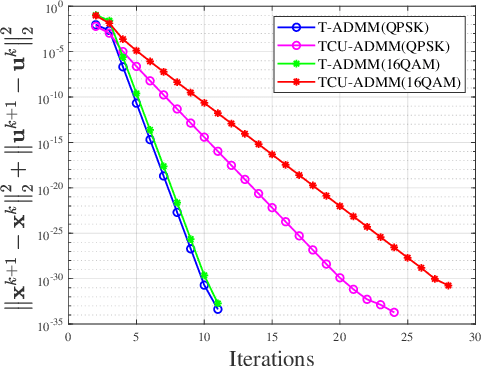
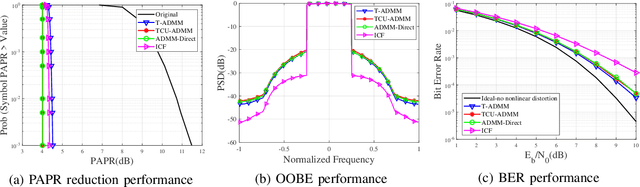
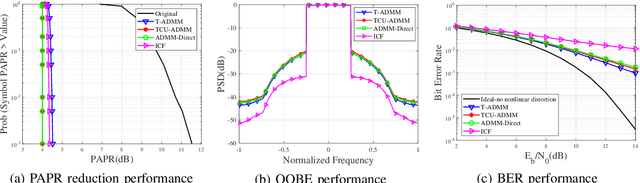
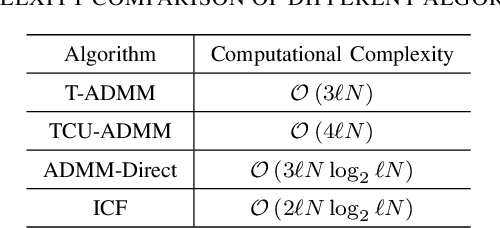
In this paper, we propose two low-complexity peak to average power ratio(PAPR) reduction algorithms for orthogonal frequency division multiplexing(OFDM) signals. The main content is as follows: First, a non-convex optimization model is established by minimizing the signal distortion power. Then, a customized alternating direction method of multipliers(ADMM) algorithm is proposed to solve the problem, named time domain ADMM(T-ADMM) along with an improved version called T-ADMM with constrain update(TCU-ADMM). In the algorithms, all subproblems can be solved analytically, and each iteration has linear computational complexity. These algorithms circumvents the challenges posed by repeated fast Fourier transform(FFT) and inverse FFT(IFFT) operations in traditional PAPR reduction algorithms. Additionally, we prove that the T-ADMM algorithm is theoretically guaranteed convergent if proper parameter is chosen. Finally, simulation results demonstrate the effectiveness of the proposed methods.
Unimodular Waveform Design for Integrated Sensing and Communication MIMO System via Manifold Optimization
Apr 08, 2025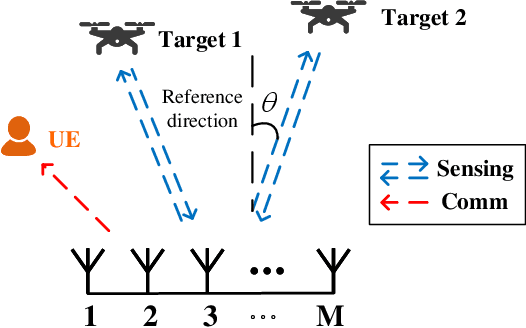

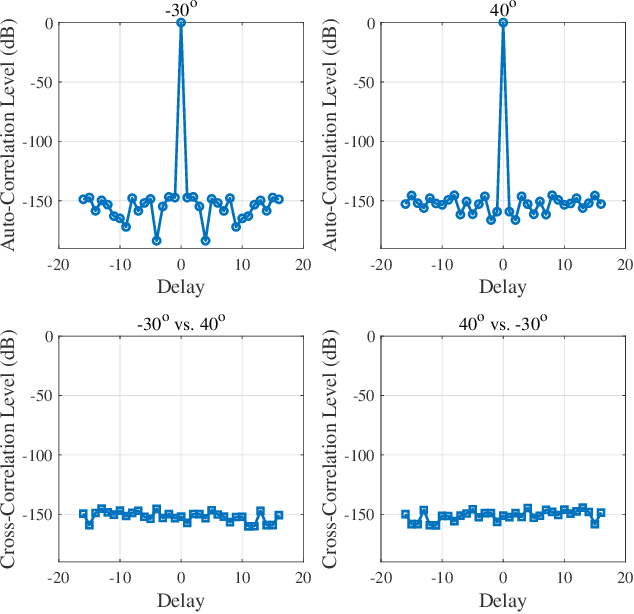
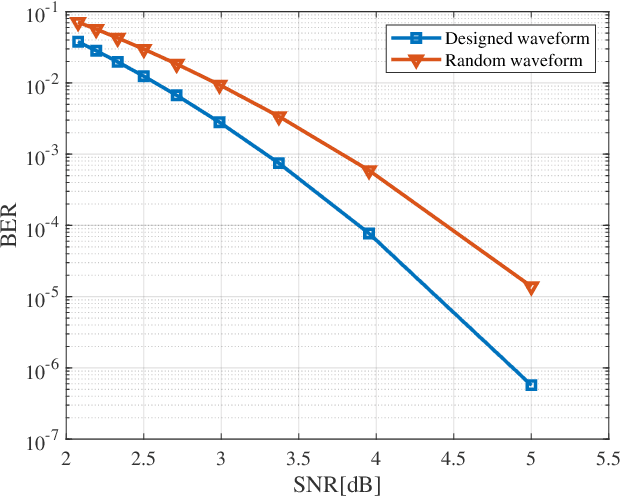
Integrated sensing and communication (ISAC) has been widely recognized as one of the key technologies for 6G wireless networks. In this paper, we focus on the waveform design of ISAC system, which can realize radar sensing while also facilitate information transmission. The main content is as follows: first, we formulate the waveform design problem as a nonconvex and non-smooth model with a unimodulus constraint based on the measurement metric of the radar and communication system. Second, we transform the model into an unconstrained problem on the Riemannian manifold and construct the corresponding operators by analyzing the unimodulus constraint. Third, to achieve the solution efficiently, we propose a low-complexity non-smooth unimodulus manifold gradient descent (N-UMGD) algorithm with theoretical convergence guarantee. The simulation results show that the proposed algorithm can concentrate the energy of the sensing signal in the desired direction and realize information transmission with a low bit error rate.
Scaling Image Tokenizers with Grouped Spherical Quantization
Dec 03, 2024

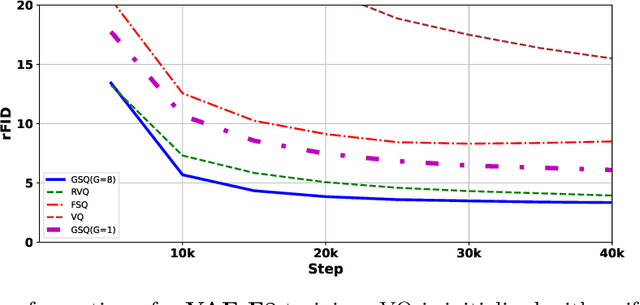

Vision tokenizers have gained a lot of attraction due to their scalability and compactness; previous works depend on old-school GAN-based hyperparameters, biased comparisons, and a lack of comprehensive analysis of the scaling behaviours. To tackle those issues, we introduce Grouped Spherical Quantization (GSQ), featuring spherical codebook initialization and lookup regularization to constrain codebook latent to a spherical surface. Our empirical analysis of image tokenizer training strategies demonstrates that GSQ-GAN achieves superior reconstruction quality over state-of-the-art methods with fewer training iterations, providing a solid foundation for scaling studies. Building on this, we systematically examine the scaling behaviours of GSQ, specifically in latent dimensionality, codebook size, and compression ratios, and their impact on model performance. Our findings reveal distinct behaviours at high and low spatial compression levels, underscoring challenges in representing high-dimensional latent spaces. We show that GSQ can restructure high-dimensional latent into compact, low-dimensional spaces, thus enabling efficient scaling with improved quality. As a result, GSQ-GAN achieves a 16x down-sampling with a reconstruction FID (rFID) of 0.50.
Data Pruning in Generative Diffusion Models
Nov 19, 2024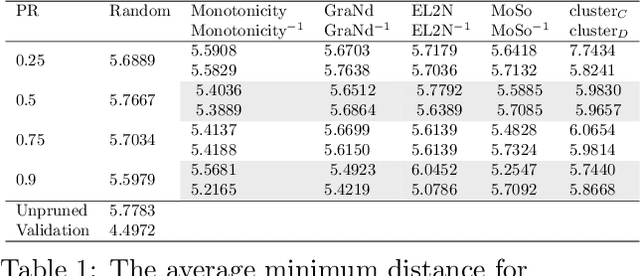

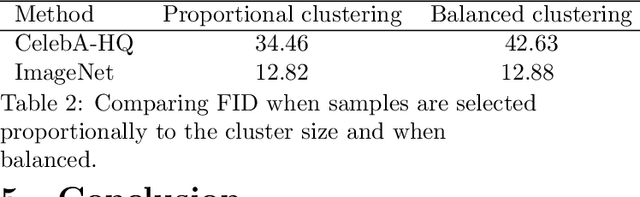

Data pruning is the problem of identifying a core subset that is most beneficial to training and discarding the remainder. While pruning strategies are well studied for discriminative models like those used in classification, little research has gone into their application to generative models. Generative models aim to estimate the underlying distribution of the data, so presumably they should benefit from larger datasets. In this work we aim to shed light on the accuracy of this statement, specifically answer the question of whether data pruning for generative diffusion models could have a positive impact. Contrary to intuition, we show that eliminating redundant or noisy data in large datasets is beneficial particularly when done strategically. We experiment with several pruning methods including recent-state-of-art methods, and evaluate over CelebA-HQ and ImageNet datasets. We demonstrate that a simple clustering method outperforms other sophisticated and computationally demanding methods. We further exhibit how we can leverage clustering to balance skewed datasets in an unsupervised manner to allow fair sampling for underrepresented populations in the data distribution, which is a crucial problem in generative models.
Designing Unimodular Waveforms with Good Correlation Properties for Large-Scale MIMO Radar via Manifold Optimization Method
Oct 10, 2024
In this paper, we design constant modulus probing waveforms with good correlation properties for large-scale collocated multi-input multi-output (MIMO) radar systems. The main content is as follows: First, we formulate the design problem as a fourth-order polynomial minimization problem with unimodulus constraints. Then, by analyzing the geometric properties of the unimodulus constraints through Riemannian geometry theory and embedding them into the search space, we transform the original non-convex optimization problem into an unconstrained problem on a Riemannian manifold for solution. Second, we convert the objective function into the form of a large but finite number of loss functions and employ a customized R-SVRG algorithm to solve it. Third, we prove that the customized R-SVRG algorithm is theoretically guaranteed to converge if appropriate parameters are chosen. Numerical examples demonstrate the effectiveness of the proposed R-SVRG algorithm.