 Add to Chrome
 Add to Firefox
 Add to Edge
Patched Flow Matching: Generative Wall-Pressure Reconstruction Beyond Training-Domain Scales from Sparse Sensors
Jun 20, 2026
Characterizing the complete wall-pressure spectrum in turbulent wall-bounded flows requires simultaneous access to the viscous-scale high-wavenumber content and the outer-layer low-wavenumber content -- a requirement that neither short-domain direct numerical simulation (DNS) nor sparse experimental measurements alone can satisfy. We propose Patched Flow Matching (Patched FM), a generative framework that fuses these two complementary sources by learning a patch-local prior over inner-scaled wall-pressure statistics from short-domain DNS and assimilating sparse sensor measurements at inference time through training-free posterior sampling. The patch-additive decomposition of the flow matching vector field decouples the generative prior from the global domain size, enabling reconstruction on domains arbitrarily larger than the training configuration. By expressing the patch prior in inner-scaled coordinates, where high-wavenumber wall-pressure statistics are approximately Reynolds-number invariant, the framework extends to higher Reynolds numbers through hierarchical transfer learning with as few as $500$ short-domain snapshots ($2.5\%$ of the base training data) at a fraction of the scratch-training cost. Applied to compressible channel-flow DNS at $Re_τ= 180$, $500$, and $1000$, Patched FM reconstructs full-resolution wall-pressure fields on a domain four times larger than the training configuration ($L_x^L = 16πδ$ versus $L_x^S = 4πδ$) from sensor coverage as low as $0.25\%$, recovering the low-wavenumber spectral content inaccessible to short-domain DNS with high fidelity in both streamwise and spanwise directions. Zero-shot generalization to unseen Reynolds numbers and ablation studies further confirm the role of inner scaling as a physical prerequisite for data-efficient Reynolds-number transfer.

D-Flow SGLD: Source-Space Posterior Sampling for Scientific Inverse Problems with Flow Matching
Feb 25, 2026Data assimilation and scientific inverse problems require reconstructing high-dimensional physical states from sparse and noisy observations, ideally with uncertainty-aware posterior samples that remain faithful to learned priors and governing physics. While training-free conditional generation is well developed for diffusion models, corresponding conditioning and posterior sampling strategies for Flow Matching (FM) priors remain comparatively under-explored, especially on scientific benchmarks where fidelity must be assessed beyond measurement misfit. In this work, we study training-free conditional generation for scientific inverse problems under FM priors and organize existing inference-time strategies by where measurement information is injected: (i) guided transport dynamics that perturb sampling trajectories using likelihood information, and (ii) source-distribution inference that performs posterior inference over the source variable while keeping the learned transport fixed. Building on the latter, we propose D-Flow SGLD, a source-space posterior sampling method that augments differentiable source inference with preconditioned stochastic gradient Langevin dynamics, enabling scalable exploration of the source posterior induced by new measurement operators without retraining the prior or modifying the learned FM dynamics. We benchmark representative methods from both families on a hierarchy of problems: 2D toy posteriors, chaotic Kuramoto-Sivashinsky trajectories, and wall-bounded turbulence reconstruction. Across these settings, we quantify trade-offs among measurement assimilation, posterior diversity, and physics/statistics fidelity, and establish D-Flow SGLD as a practical FM-compatible posterior sampler for scientific inverse problems.
CoNFiLD-inlet: Synthetic Turbulence Inflow Using Generative Latent Diffusion Models with Neural Fields
Nov 21, 2024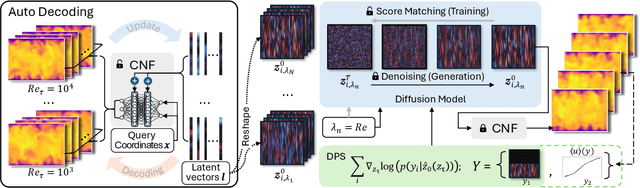
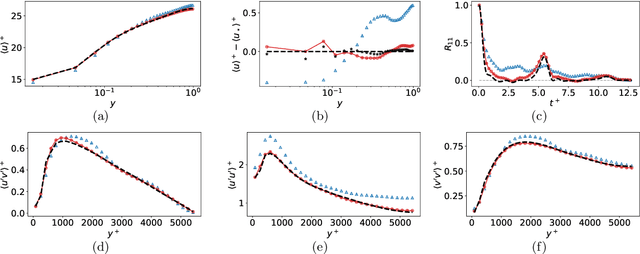
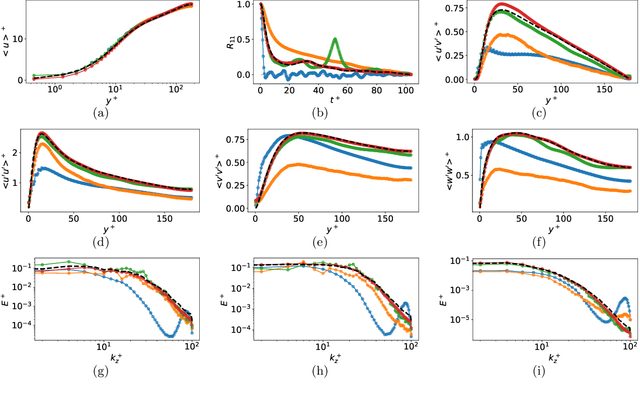
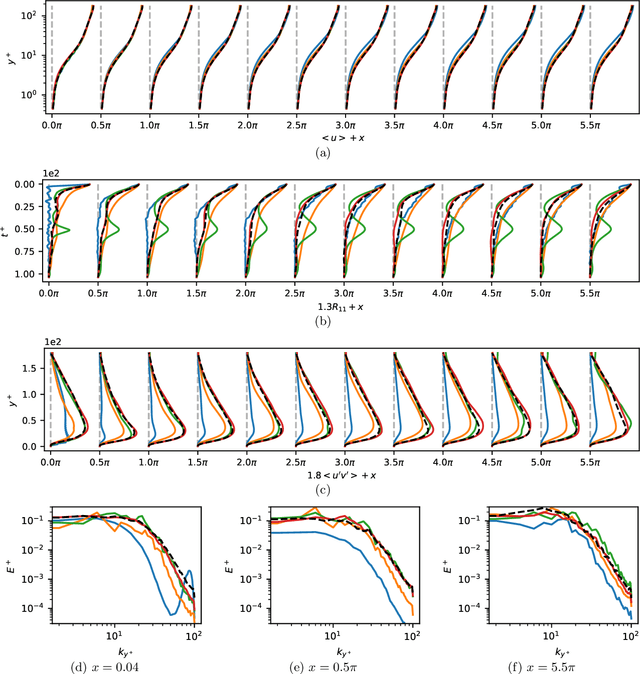
Eddy-resolving turbulence simulations require stochastic inflow conditions that accurately replicate the complex, multi-scale structures of turbulence. Traditional recycling-based methods rely on computationally expensive precursor simulations, while existing synthetic inflow generators often fail to reproduce realistic coherent structures of turbulence. Recent advances in deep learning (DL) have opened new possibilities for inflow turbulence generation, yet many DL-based methods rely on deterministic, autoregressive frameworks prone to error accumulation, resulting in poor robustness for long-term predictions. In this work, we present CoNFiLD-inlet, a novel DL-based inflow turbulence generator that integrates diffusion models with a conditional neural field (CNF)-encoded latent space to produce realistic, stochastic inflow turbulence. By parameterizing inflow conditions using Reynolds numbers, CoNFiLD-inlet generalizes effectively across a wide range of Reynolds numbers ($Re_\tau$ between $10^3$ and $10^4$) without requiring retraining or parameter tuning. Comprehensive validation through a priori and a posteriori tests in Direct Numerical Simulation (DNS) and Wall-Modeled Large Eddy Simulation (WMLES) demonstrates its high fidelity, robustness, and scalability, positioning it as an efficient and versatile solution for inflow turbulence synthesis.