 Add to Chrome
 Add to Firefox
 Add to Edge
EvoCause: LLM-Guided Evolution of Causal Graphs for Root Cause Analysis
Jul 29, 2026
Modern telecommunication, cloud, and microservice systems emit correlated alarm cascades when components fail. Root cause analysis (RCA) aims to identify the small set of alarms that initiate each cascade. A common approach learns a causal graph from observational logs and predicts all zero-in-degree alarms in each incident-induced subgraph. However, the learned graph remains fixed and cannot benefit from expert diagnoses of historical incidents. We close this loop with EvoCause. Expert labels constrain which alarms should be source nodes but do not specify the edge edits needed to satisfy those constraints. EvoCause uses a large language model (LLM) to propose semantically plausible graph edits, while deterministic code validates node identities and acyclicity and retains the best graph on a labeled alignment set. At test time, the refined graph alone produces transparent predictions without an LLM call. We also release TeleRCA, an expert-annotated benchmark from a production telecommunication network containing $485{,}681$ alarm events spanning $194$ alarm types over $5{,}621$ resources. On synthetic data, EvoCause initialized with the PC causal discovery algorithm outperforms the unrefined PC baseline, raising Node F1, Case EM, and Graph F1 by $11.59$, $9.40$, and $4.59$ percentage points, respectively, while reducing nSHD by $0.2379$. On TeleRCA, replacing human-readable alarm titles with anonymous identifiers lowers Node F1 and Case EM by $6.12$ and $8.04$ percentage points, respectively, indicating that alarm-name information contributes to graph refinement.

Post-Training in Time Series Foundation Models: A Unifying Framework
Jul 24, 2026Time series foundation models (TSFMs) have emerged as general-purpose models for time series analysis, but pretraining alone is often insufficient for reliable downstream deployment. Bridging this gap requires further intervention to handle domain shift, task heterogeneity, limited supervision, and computational constraints, which motivates post-training as a broad class of methods to adapt, augment, compose, calibrate, or specialize pretrained TSFMs for downstream tasks. In this work, we analyze TSFM post-training methods based on their locus of intervention in the prediction pipeline, yielding five categories: parameter adaptation, context augmentation, model composition, output processing and uncertainty control, and compression and specialization. Within each category, we study main representative methods and discuss their current limitations. We further identify future directions toward controlled adaptation, reliable context construction, uncertainty-aware model composition, calibrated output processing, and deployment-aware specialization. Overall, by providing a unifying framework for the emerging TSFM post-training landscape, this work aims to support future research to navigate the design space between a pretrained TSFM and its reliable downstream deployment.
On the Fly Detection of Root Causes from Observed Data with Application to IT Systems
Feb 09, 2024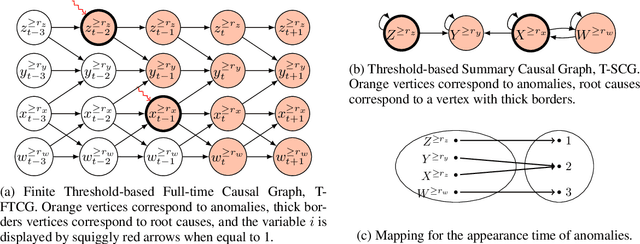
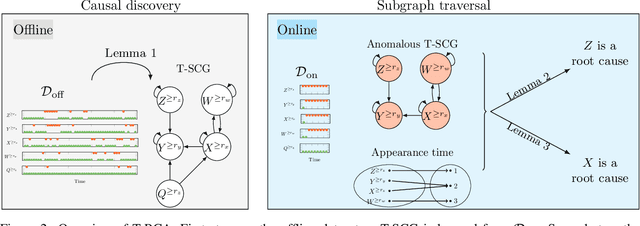
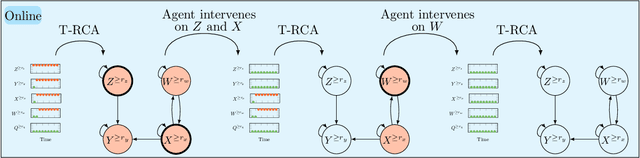
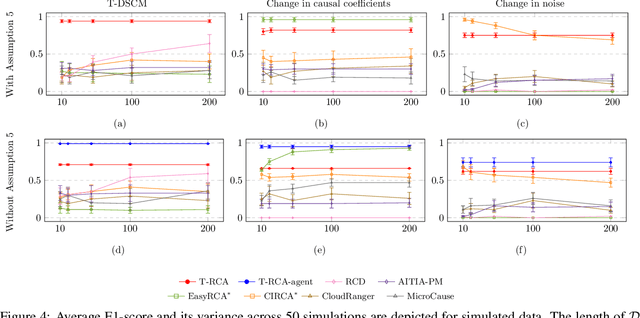
This paper introduces a new structural causal model tailored for representing threshold-based IT systems and presents a new algorithm designed to rapidly detect root causes of anomalies in such systems. When root causes are not causally related, the method is proven to be correct; while an extension is proposed based on the intervention of an agent to relax this assumption. Our algorithm and its agent-based extension leverage causal discovery from offline data and engage in subgraph traversal when encountering new anomalies in online data. Our extensive experiments demonstrate the superior performance of our methods, even when applied to data generated from alternative structural causal models or real IT monitoring data.
Case Studies of Causal Discovery from IT Monitoring Time Series
Jul 28, 2023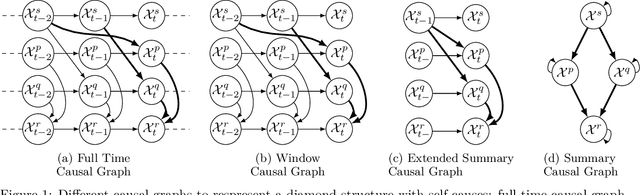
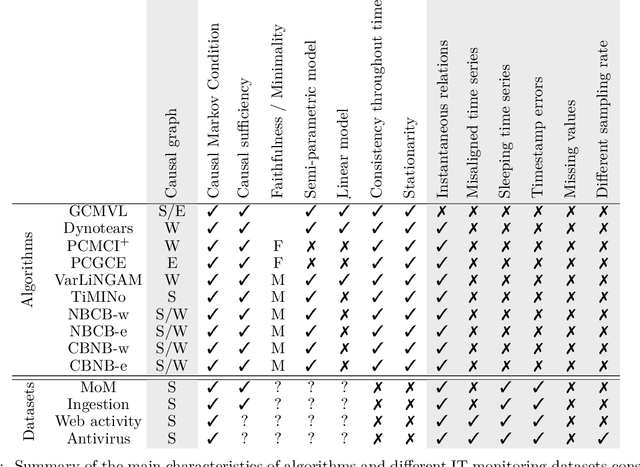
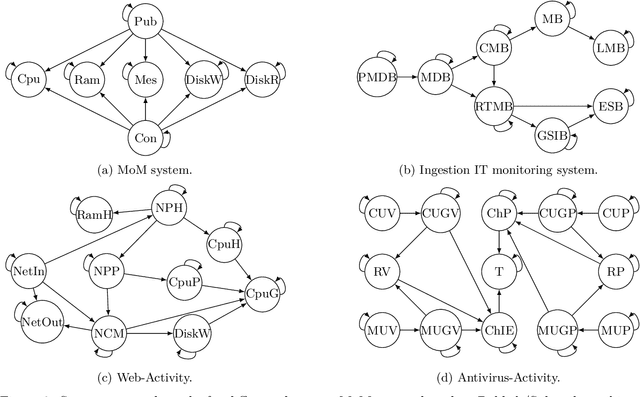

Information technology (IT) systems are vital for modern businesses, handling data storage, communication, and process automation. Monitoring these systems is crucial for their proper functioning and efficiency, as it allows collecting extensive observational time series data for analysis. The interest in causal discovery is growing in IT monitoring systems as knowing causal relations between different components of the IT system helps in reducing downtime, enhancing system performance and identifying root causes of anomalies and incidents. It also allows proactive prediction of future issues through historical data analysis. Despite its potential benefits, applying causal discovery algorithms on IT monitoring data poses challenges, due to the complexity of the data. For instance, IT monitoring data often contains misaligned time series, sleeping time series, timestamp errors and missing values. This paper presents case studies on applying causal discovery algorithms to different IT monitoring datasets, highlighting benefits and ongoing challenges.
Root Cause Identification for Collective Anomalies in Time Series given an Acyclic Summary Causal Graph with Loops
Mar 07, 2023This paper presents an approach for identifying the root causes of collective anomalies given observational time series and an acyclic summary causal graph which depicts an abstraction of causal relations present in a dynamic system at its normal regime. The paper first shows how the problem of root cause identification can be divided into many independent subproblems by grouping related anomalies using d-separation. Further, it shows how, under this setting, some root causes can be found directly from the graph and from the time of appearance of anomalies. Finally, it shows, how the rest of the root causes can be found by comparing direct causal effects in the normal and in the anomalous regime. To this end, temporal adaptations of the back-door and the single-door criterions are introduced. Extensive experiments conducted on both simulated and real-world datasets demonstrate the effectiveness of the proposed method.