 Add to Chrome
 Add to Firefox
 Add to Edge
TDD-Agent: Test-Driven Reasoning for Code Generation
Aug 17, 2026
Large Language Models (LLMs) have achieved remarkable progress in code generation, yet ensuring correctness in complex, repository-level tasks remains challenging. Existing approaches often use generated tests as static post-hoc validators, which limits their ability to guide implementation and may introduce misleading feedback when the tests themselves are incomplete or incorrect. In this paper, we introduce TDD-Agent, which operationalizes the test-driven development paradigm for code generation. TDD-Agent first prompts the model to generate executable tests, encouraging it to clarify expected behaviors before implementation, and then performs iterative dual-track refinement over both the generated code and tests using execution feedback. We first isolate the effect of test-first reasoning through a prompt variant TDD-prompt on LiveCodeBench, where it consistently improves upon reasoning-based prompting baselines. Building on this finding, we evaluate the full TDD-Agent framework on RepoEval, a repository-level benchmark, and show that it consistently outperforms retrieval-based and agent-based baselines. Additional analyses show that iterative refinement improves not only code correctness but also the effectiveness of the generated tests, yielding higher pass rates, coverage, and mutation scores, suggesting that tests can serve as evolving reasoning artifacts rather than fixed validators. Our source code is available at https://anonymous.4open.science/r/TDD-Agent-Framework-6370/.

DeSeG: Decoupling Semantic Intent and Geometric Constraints for Physically Plausible Human-Scene Interaction
Jul 07, 2026Synthesizing physically plausible human-scene interactions (HSI) remains a critical challenge in computer vision and the development of human avatars. Although recent generative models enable diverse motion synthesis, they suffer from an inductive bias referred to as semantic-geometric entanglement. Because spatial constraints often strongly correlate with specific actions in training data, monolithic models will learn the shortcut bias, aggressively overriding the semantic intent when faced with strict geometric cues. Furthermore, this entanglement exacerbates physical hallucinations, such as body-scene penetrations. To address these limitations, we propose DeSeG, a hierarchical framework that explicitly decouples semantic intent from geometric constraints. First, we introduce a Residual Semantic Planner that encodes textual instructions and canonicalized goal voxels into a compact latent space, enabling fine-grained semantic control independent of spatial trajectories. Second, we propose a physics regularized diffusion executor that incorporates differentiable repulsive potential fields directly into the diffusion objective, enforcing collision-aware motion generation. Extensive experiments on the Lingo dataset demonstrate that DeSeG achieves state-of-the-art performance, reducing mean scene penetration by 47% and improving semantic alignment by 29% over the SOTA baselines.
MLPHand: Real Time Multi-View 3D Hand Mesh Reconstruction via MLP Modeling
Jun 23, 2024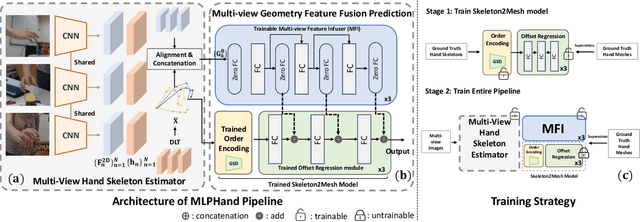
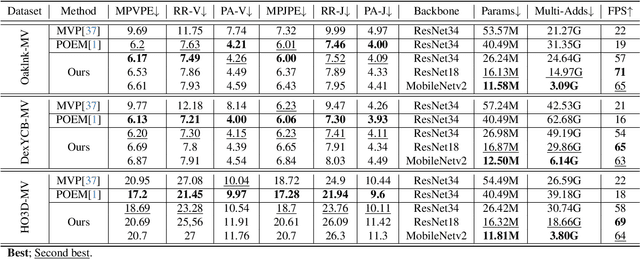

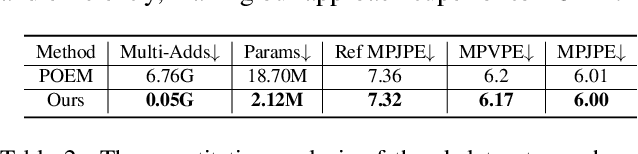
Multi-view hand mesh reconstruction is a critical task for applications in virtual reality and human-computer interaction, but it remains a formidable challenge. Although existing multi-view hand reconstruction methods achieve remarkable accuracy, they typically come with an intensive computational burden that hinders real-time inference. To this end, we propose MLPHand, a novel method designed for real-time multi-view single hand reconstruction. MLP Hand consists of two primary modules: (1) a lightweight MLP-based Skeleton2Mesh model that efficiently recovers hand meshes from hand skeletons, and (2) a multi-view geometry feature fusion prediction module that enhances the Skeleton2Mesh model with detailed geometric information from multiple views. Experiments on three widely used datasets demonstrate that MLPHand can reduce computational complexity by 90% while achieving comparable reconstruction accuracy to existing state-of-the-art baselines.
Advancing Biomedical Text Mining with Community Challenges
Mar 07, 2024The field of biomedical research has witnessed a significant increase in the accumulation of vast amounts of textual data from various sources such as scientific literatures, electronic health records, clinical trial reports, and social media. However, manually processing and analyzing these extensive and complex resources is time-consuming and inefficient. To address this challenge, biomedical text mining, also known as biomedical natural language processing, has garnered great attention. Community challenge evaluation competitions have played an important role in promoting technology innovation and interdisciplinary collaboration in biomedical text mining research. These challenges provide platforms for researchers to develop state-of-the-art solutions for data mining and information processing in biomedical research. In this article, we review the recent advances in community challenges specific to Chinese biomedical text mining. Firstly, we collect the information of these evaluation tasks, such as data sources and task types. Secondly, we conduct systematic summary and comparative analysis, including named entity recognition, entity normalization, attribute extraction, relation extraction, event extraction, text classification, text similarity, knowledge graph construction, question answering, text generation, and large language model evaluation. Then, we summarize the potential clinical applications of these community challenge tasks from translational informatics perspective. Finally, we discuss the contributions and limitations of these community challenges, while highlighting future directions in the era of large language models.