 Add to Chrome
 Add to Firefox
 Add to Edge
Bridging Scene Generation and Planning: Driving with World Model via Unifying Vision and Motion Representation
Mar 16, 2026
End-to-end autonomous driving aims to generate safe and plausible planning policies from raw sensor input. Driving world models have shown great potential in learning rich representations by predicting the future evolution of a driving scene. However, existing driving world models primarily focus on visual scene representation, and motion representation is not explicitly designed to be planner-shared and inheritable, leaving a schism between the optimization of visual scene generation and the requirements of precise motion planning. We present WorldDrive, a holistic framework that couples scene generation and real-time planning via unifying vision and motion representation. We first introduce a Trajectory-aware Driving World Model, which conditions on a trajectory vocabulary to enforce consistency between visual dynamics and motion intentions, enabling the generation of diverse and plausible future scenes conditioned on a specific trajectory. We transfer the vision and motion encoders to a downstream Multi-modal Planner, ensuring the driving policy operates on mature representations pre-optimized by scene generation. A simple interaction between motion representation, visual representation, and ego status can generate high-quality, multi-modal trajectories. Furthermore, to exploit the world model's foresight, we propose a Future-aware Rewarder, which distills future latent representation from the frozen world model to evaluate and select optimal trajectories in real-time. Extensive experiments on the NAVSIM, NAVSIM-v2, and nuScenes benchmarks demonstrate that WorldDrive achieves leading planning performance among vision-only methods while maintaining high-fidelity action-controlled video generation capabilities, providing strong evidence for the effectiveness of unifying vision and motion representation for robust autonomous driving.

Step-Audio-AQAA: a Fully End-to-End Expressive Large Audio Language Model
Jun 10, 2025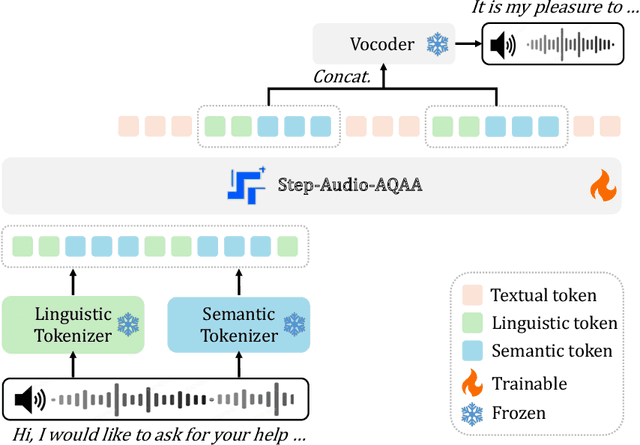
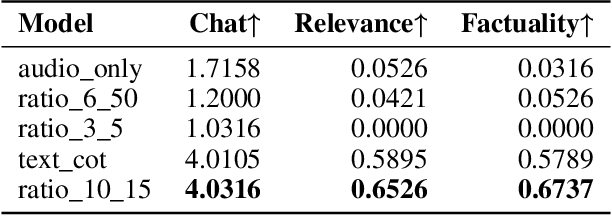
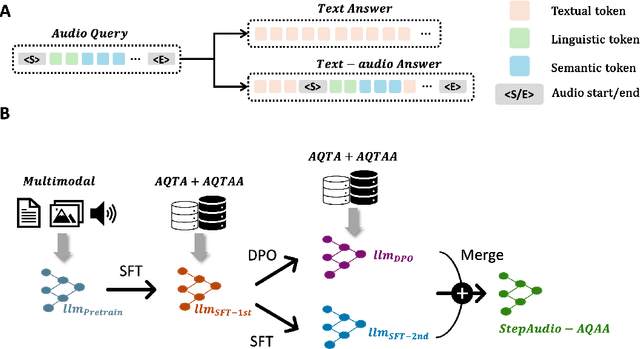

Large Audio-Language Models (LALMs) have significantly advanced intelligent human-computer interaction, yet their reliance on text-based outputs limits their ability to generate natural speech responses directly, hindering seamless audio interactions. To address this, we introduce Step-Audio-AQAA, a fully end-to-end LALM designed for Audio Query-Audio Answer (AQAA) tasks. The model integrates a dual-codebook audio tokenizer for linguistic and semantic feature extraction, a 130-billion-parameter backbone LLM and a neural vocoder for high-fidelity speech synthesis. Our post-training approach employs interleaved token-output of text and audio to enhance semantic coherence and combines Direct Preference Optimization (DPO) with model merge to improve performance. Evaluations on the StepEval-Audio-360 benchmark demonstrate that Step-Audio-AQAA excels especially in speech control, outperforming the state-of-art LALMs in key areas. This work contributes a promising solution for end-to-end LALMs and highlights the critical role of token-based vocoder in enhancing overall performance for AQAA tasks.
Step-Audio: Unified Understanding and Generation in Intelligent Speech Interaction
Feb 18, 2025Real-time speech interaction, serving as a fundamental interface for human-machine collaboration, holds immense potential. However, current open-source models face limitations such as high costs in voice data collection, weakness in dynamic control, and limited intelligence. To address these challenges, this paper introduces Step-Audio, the first production-ready open-source solution. Key contributions include: 1) a 130B-parameter unified speech-text multi-modal model that achieves unified understanding and generation, with the Step-Audio-Chat version open-sourced; 2) a generative speech data engine that establishes an affordable voice cloning framework and produces the open-sourced lightweight Step-Audio-TTS-3B model through distillation; 3) an instruction-driven fine control system enabling dynamic adjustments across dialects, emotions, singing, and RAP; 4) an enhanced cognitive architecture augmented with tool calling and role-playing abilities to manage complex tasks effectively. Based on our new StepEval-Audio-360 evaluation benchmark, Step-Audio achieves state-of-the-art performance in human evaluations, especially in terms of instruction following. On open-source benchmarks like LLaMA Question, shows 9.3% average performance improvement, demonstrating our commitment to advancing the development of open-source multi-modal language technologies. Our code and models are available at https://github.com/stepfun-ai/Step-Audio.
SparseAD: Sparse Query-Centric Paradigm for Efficient End-to-End Autonomous Driving
Apr 10, 2024

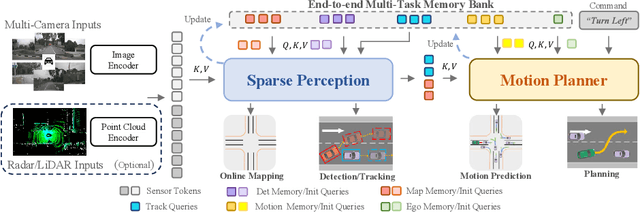
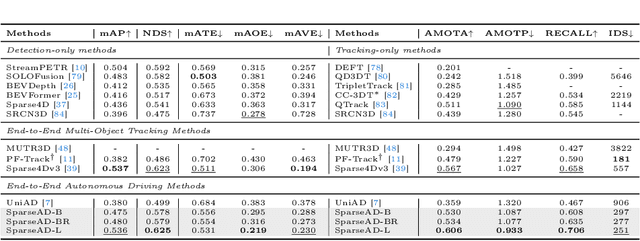
End-to-End paradigms use a unified framework to implement multi-tasks in an autonomous driving system. Despite simplicity and clarity, the performance of end-to-end autonomous driving methods on sub-tasks is still far behind the single-task methods. Meanwhile, the widely used dense BEV features in previous end-to-end methods make it costly to extend to more modalities or tasks. In this paper, we propose a Sparse query-centric paradigm for end-to-end Autonomous Driving (SparseAD), where the sparse queries completely represent the whole driving scenario across space, time and tasks without any dense BEV representation. Concretely, we design a unified sparse architecture for perception tasks including detection, tracking, and online mapping. Moreover, we revisit motion prediction and planning, and devise a more justifiable motion planner framework. On the challenging nuScenes dataset, SparseAD achieves SOTA full-task performance among end-to-end methods and significantly narrows the performance gap between end-to-end paradigms and single-task methods. Codes will be released soon.
Self-Learning with Rectification Strategy for Human Parsing
Apr 17, 2020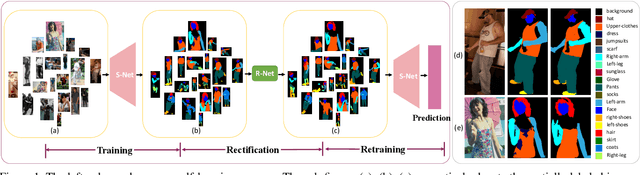
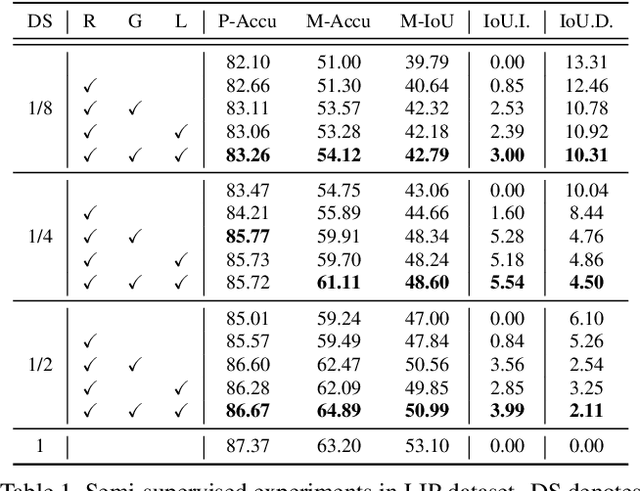
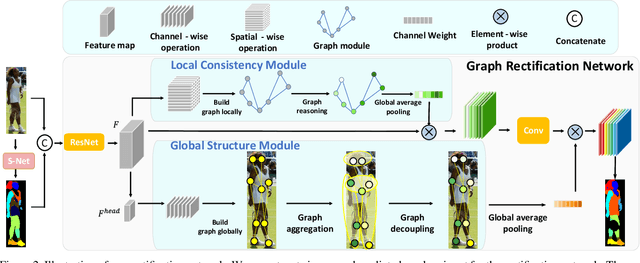
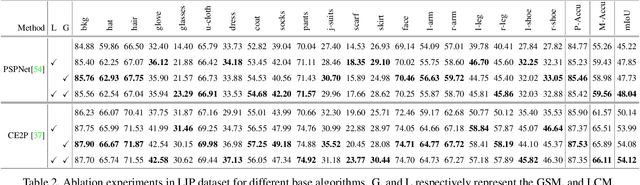
In this paper, we solve the sample shortage problem in the human parsing task. We begin with the self-learning strategy, which generates pseudo-labels for unlabeled data to retrain the model. However, directly using noisy pseudo-labels will cause error amplification and accumulation. Considering the topology structure of human body, we propose a trainable graph reasoning method that establishes internal structural connections between graph nodes to correct two typical errors in the pseudo-labels, i.e., the global structural error and the local consistency error. For the global error, we first transform category-wise features into a high-level graph model with coarse-grained structural information, and then decouple the high-level graph to reconstruct the category features. The reconstructed features have a stronger ability to represent the topology structure of the human body. Enlarging the receptive field of features can effectively reducing the local error. We first project feature pixels into a local graph model to capture pixel-wise relations in a hierarchical graph manner, then reverse the relation information back to the pixels. With the global structural and local consistency modules, these errors are rectified and confident pseudo-labels are generated for retraining. Extensive experiments on the LIP and the ATR datasets demonstrate the effectiveness of our global and local rectification modules. Our method outperforms other state-of-the-art methods in supervised human parsing tasks.