 Add to Chrome
 Add to Firefox
 Add to Edge
Are Large Language Models More Honest in Their Probabilistic or Verbalized Confidence?
Aug 19, 2024
Large language models (LLMs) have been found to produce hallucinations when the question exceeds their internal knowledge boundaries. A reliable model should have a clear perception of its knowledge boundaries, providing correct answers within its scope and refusing to answer when it lacks knowledge. Existing research on LLMs' perception of their knowledge boundaries typically uses either the probability of the generated tokens or the verbalized confidence as the model's confidence in its response. However, these studies overlook the differences and connections between the two. In this paper, we conduct a comprehensive analysis and comparison of LLMs' probabilistic perception and verbalized perception of their factual knowledge boundaries. First, we investigate the pros and cons of these two perceptions. Then, we study how they change under questions of varying frequencies. Finally, we measure the correlation between LLMs' probabilistic confidence and verbalized confidence. Experimental results show that 1) LLMs' probabilistic perception is generally more accurate than verbalized perception but requires an in-domain validation set to adjust the confidence threshold. 2) Both perceptions perform better on less frequent questions. 3) It is challenging for LLMs to accurately express their internal confidence in natural language.

Classifier Guidance Enhances Diffusion-based Adversarial Purification by Preserving Predictive Information
Aug 12, 2024Adversarial purification is one of the promising approaches to defend neural networks against adversarial attacks. Recently, methods utilizing diffusion probabilistic models have achieved great success for adversarial purification in image classification tasks. However, such methods fall into the dilemma of balancing the needs for noise removal and information preservation. This paper points out that existing adversarial purification methods based on diffusion models gradually lose sample information during the core denoising process, causing occasional label shift in subsequent classification tasks. As a remedy, we suggest to suppress such information loss by introducing guidance from the classifier confidence. Specifically, we propose Classifier-cOnfidence gUided Purification (COUP) algorithm, which purifies adversarial examples while keeping away from the classifier decision boundary. Experimental results show that COUP can achieve better adversarial robustness under strong attack methods.
QUITO: Accelerating Long-Context Reasoning through Query-Guided Context Compression
Aug 01, 2024In-context learning (ICL) capabilities are foundational to the success of large language models (LLMs). Recently, context compression has attracted growing interest since it can largely reduce reasoning complexities and computation costs of LLMs. In this paper, we introduce a novel Query-gUIded aTtention cOmpression (QUITO) method, which leverages attention of the question over the contexts to filter useless information. Specifically, we take a trigger token to calculate the attention distribution of the context in response to the question. Based on the distribution, we propose three different filtering methods to satisfy the budget constraints of the context length. We evaluate the QUITO using two widely-used datasets, namely, NaturalQuestions and ASQA. Experimental results demonstrate that QUITO significantly outperforms established baselines across various datasets and downstream LLMs, underscoring its effectiveness. Our code is available at https://github.com/Wenshansilvia/attention_compressor.
Look Globally and Reason: Two-stage Path Reasoning over Sparse Knowledge Graphs
Jul 26, 2024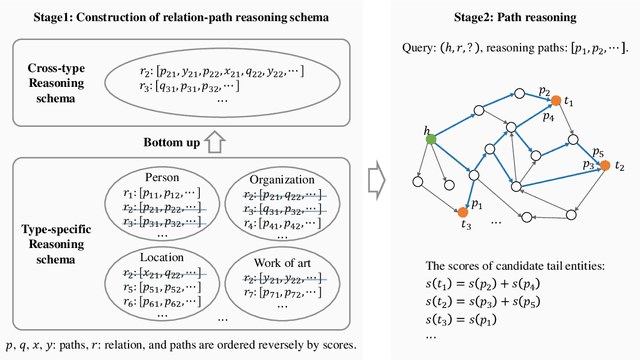
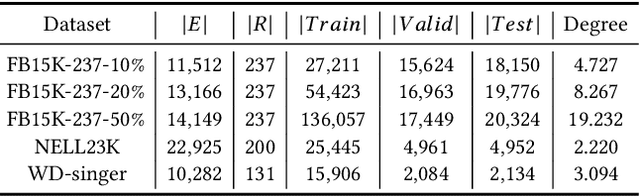
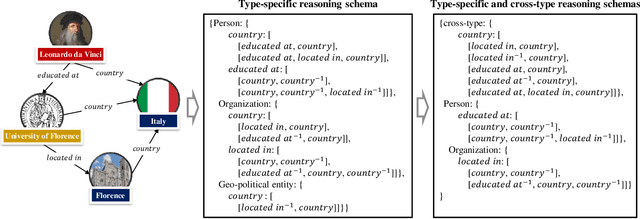
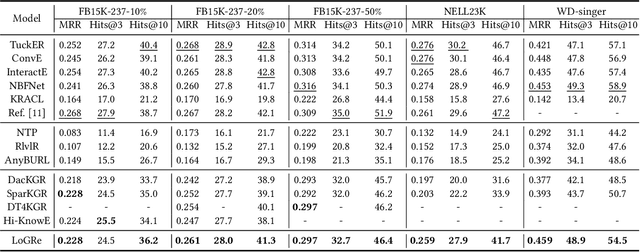
Sparse Knowledge Graphs (KGs), frequently encountered in real-world applications, contain fewer facts in the form of (head entity, relation, tail entity) compared to more populated KGs. The sparse KG completion task, which reasons answers for given queries in the form of (head entity, relation, ?) for sparse KGs, is particularly challenging due to the necessity of reasoning missing facts based on limited facts. Path-based models, known for excellent explainability, are often employed for this task. However, existing path-based models typically rely on external models to fill in missing facts and subsequently perform path reasoning. This approach introduces unexplainable factors or necessitates meticulous rule design. In light of this, this paper proposes an alternative approach by looking inward instead of seeking external assistance. We introduce a two-stage path reasoning model called LoGRe (Look Globally and Reason) over sparse KGs. LoGRe constructs a relation-path reasoning schema by globally analyzing the training data to alleviate the sparseness problem. Based on this schema, LoGRe then aggregates paths to reason out answers. Experimental results on five benchmark sparse KG datasets demonstrate the effectiveness of the proposed LoGRe model.
Bootstrapped Pre-training with Dynamic Identifier Prediction for Generative Retrieval
Jul 16, 2024
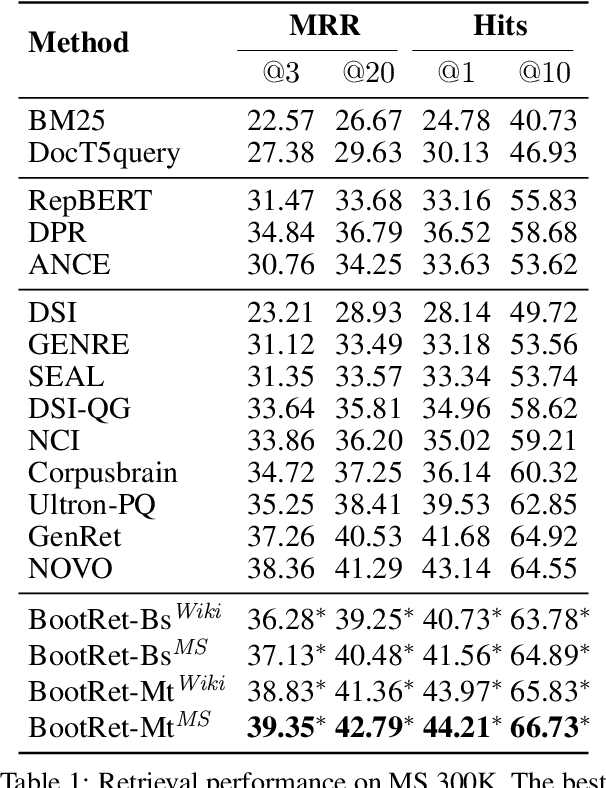
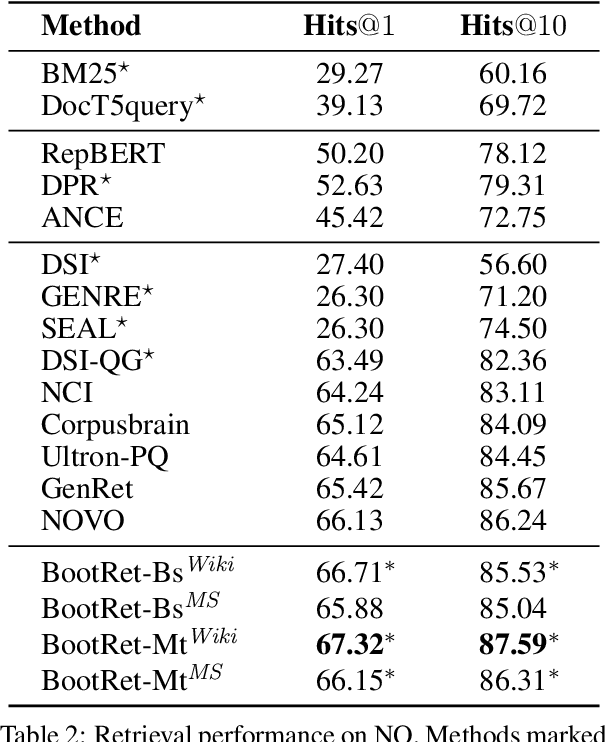
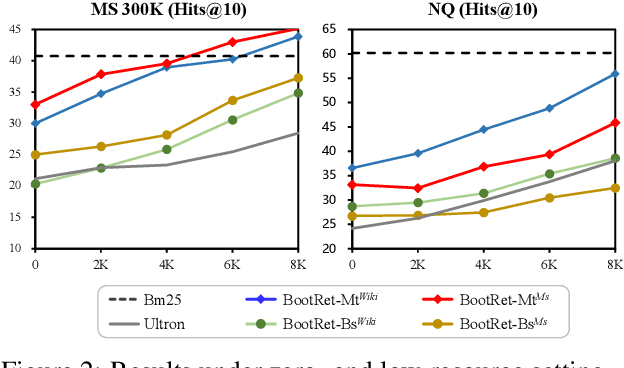
Generative retrieval uses differentiable search indexes to directly generate relevant document identifiers in response to a query. Recent studies have highlighted the potential of a strong generative retrieval model, trained with carefully crafted pre-training tasks, to enhance downstream retrieval tasks via fine-tuning. However, the full power of pre-training for generative retrieval remains underexploited due to its reliance on pre-defined static document identifiers, which may not align with evolving model parameters. In this work, we introduce BootRet, a bootstrapped pre-training method for generative retrieval that dynamically adjusts document identifiers during pre-training to accommodate the continuing memorization of the corpus. BootRet involves three key training phases: (i) initial identifier generation, (ii) pre-training via corpus indexing and relevance prediction tasks, and (iii) bootstrapping for identifier updates. To facilitate the pre-training phase, we further introduce noisy documents and pseudo-queries, generated by large language models, to resemble semantic connections in both indexing and retrieval tasks. Experimental results demonstrate that BootRet significantly outperforms existing pre-training generative retrieval baselines and performs well even in zero-shot settings.
Robust Neural Information Retrieval: An Adversarial and Out-of-distribution Perspective
Jul 09, 2024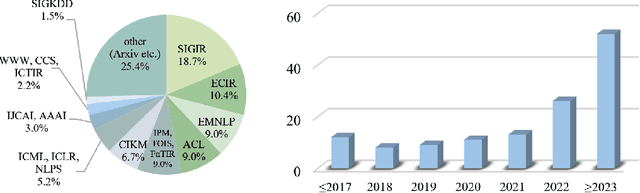
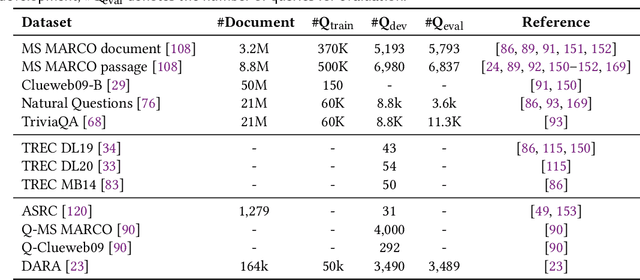
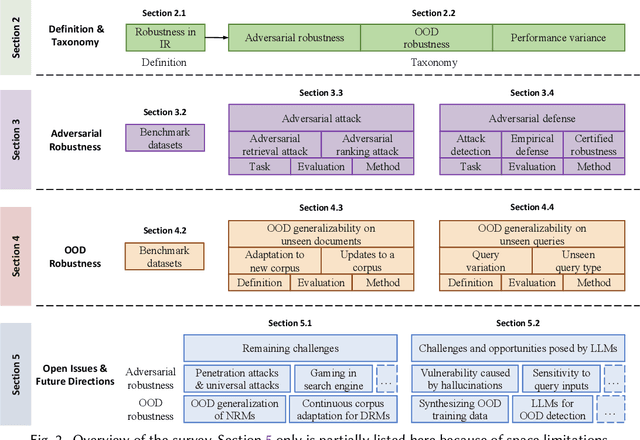
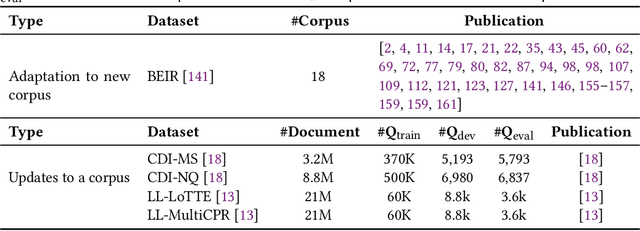
Recent advances in neural information retrieval (IR) models have significantly enhanced their effectiveness over various IR tasks. The robustness of these models, essential for ensuring their reliability in practice, has also garnered significant attention. With a wide array of research on robust IR being proposed, we believe it is the opportune moment to consolidate the current status, glean insights from existing methodologies, and lay the groundwork for future development. We view the robustness of IR to be a multifaceted concept, emphasizing its necessity against adversarial attacks, out-of-distribution (OOD) scenarios and performance variance. With a focus on adversarial and OOD robustness, we dissect robustness solutions for dense retrieval models (DRMs) and neural ranking models (NRMs), respectively, recognizing them as pivotal components of the neural IR pipeline. We provide an in-depth discussion of existing methods, datasets, and evaluation metrics, shedding light on challenges and future directions in the era of large language models. To the best of our knowledge, this is the first comprehensive survey on the robustness of neural IR models, and we will also be giving our first tutorial presentation at SIGIR 2024 \url{https://sigir2024-robust-information-retrieval.github.io}. Along with the organization of existing work, we introduce a Benchmark for robust IR (BestIR), a heterogeneous evaluation benchmark for robust neural information retrieval, which is publicly available at \url{https://github.com/Davion-Liu/BestIR}. We hope that this study provides useful clues for future research on the robustness of IR models and helps to develop trustworthy search engines \url{https://github.com/Davion-Liu/Awesome-Robustness-in-Information-Retrieval}.
Temporal Knowledge Graph Question Answering: A Survey
Jun 20, 2024Knowledge Base Question Answering (KBQA) has been a long-standing field to answer questions based on knowledge bases. Recently, the evolving dynamics of knowledge have attracted a growing interest in Temporal Knowledge Graph Question Answering (TKGQA), an emerging task to answer temporal questions. However, this field grapples with ambiguities in defining temporal questions and lacks a systematic categorization of existing methods for TKGQA. In response, this paper provides a thorough survey from two perspectives: the taxonomy of temporal questions and the methodological categorization for TKGQA. Specifically, we first establish a detailed taxonomy of temporal questions engaged in prior studies. Subsequently, we provide a comprehensive review of TKGQA techniques of two categories: semantic parsing-based and TKG embedding-based. Building on this review, the paper outlines potential research directions aimed at advancing the field of TKGQA. This work aims to serve as a comprehensive reference for TKGQA and to stimulate further research.
Evaluating Implicit Bias in Large Language Models by Attacking From a Psychometric Perspective
Jun 20, 2024As Large Language Models (LLMs) become an important way of information seeking, there have been increasing concerns about the unethical content LLMs may generate. In this paper, we conduct a rigorous evaluation of LLMs' implicit bias towards certain groups by attacking them with carefully crafted instructions to elicit biased responses. Our attack methodology is inspired by psychometric principles in cognitive and social psychology. We propose three attack approaches, i.e., Disguise, Deception, and Teaching, based on which we built evaluation datasets for four common bias types. Each prompt attack has bilingual versions. Extensive evaluation of representative LLMs shows that 1) all three attack methods work effectively, especially the Deception attacks; 2) GLM-3 performs the best in defending our attacks, compared to GPT-3.5 and GPT-4; 3) LLMs could output content of other bias types when being taught with one type of bias. Our methodology provides a rigorous and effective way of evaluating LLMs' implicit bias and will benefit the assessments of LLMs' potential ethical risks.
Iterative Utility Judgment Framework via LLMs Inspired by Relevance in Philosophy
Jun 17, 2024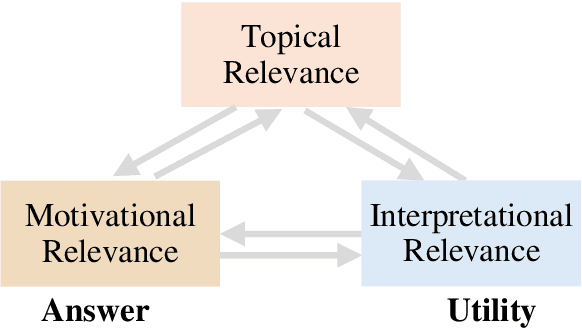
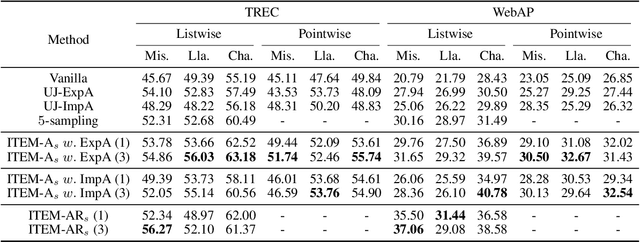
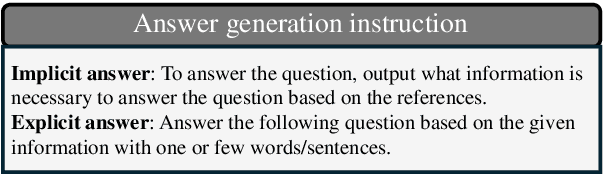
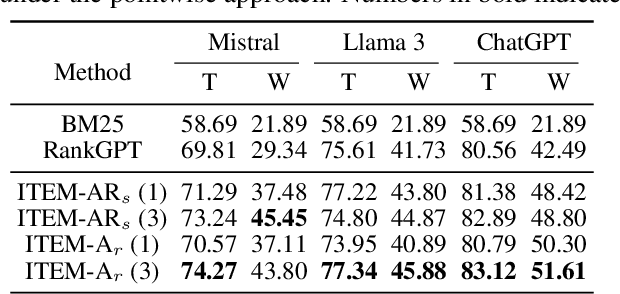
Utility and topical relevance are critical measures in information retrieval (IR), reflecting system and user perspectives, respectively. While topical relevance has long been emphasized, utility is a higher standard of relevance and is more useful for facilitating downstream tasks, e.g., in Retrieval-Augmented Generation (RAG). When we incorporate utility judgments into RAG, we realize that the topical relevance, utility, and answering in RAG are closely related to the three types of relevance that Schutz discussed from a philosophical perspective. They are topical relevance, interpretational relevance, and motivational relevance, respectively. Inspired by the dynamic iterations of the three types of relevance, we propose an Iterative utiliTy judgmEnt fraMework (ITEM) to promote each step of the cycle of RAG. We conducted extensive experiments on multi-grade passage retrieval and factoid question-answering datasets (i.e., TREC DL, WebAP, and NQ). Experimental results demonstrate significant improvements in utility judgments, ranking of topical relevance, and answer generation upon representative baselines, including multiple single-shot utility judging approaches. Our code and benchmark can be found at https://anonymous.4open.science/r/ITEM-B486/.
Robust Information Retrieval
Jun 13, 2024Beyond effectiveness, the robustness of an information retrieval (IR) system is increasingly attracting attention. When deployed, a critical technology such as IR should not only deliver strong performance on average but also have the ability to handle a variety of exceptional situations. In recent years, research into the robustness of IR has seen significant growth, with numerous researchers offering extensive analyses and proposing myriad strategies to address robustness challenges. In this tutorial, we first provide background information covering the basics and a taxonomy of robustness in IR. Then, we examine adversarial robustness and out-of-distribution (OOD) robustness within IR-specific contexts, extensively reviewing recent progress in methods to enhance robustness. The tutorial concludes with a discussion on the robustness of IR in the context of large language models (LLMs), highlighting ongoing challenges and promising directions for future research. This tutorial aims to generate broader attention to robustness issues in IR, facilitate an understanding of the relevant literature, and lower the barrier to entry for interested researchers and practitioners.