 Add to Chrome
 Add to Firefox
 Add to Edge
Tri-Subspaces Disentanglement for Multimodal Sentiment Analysis
Feb 23, 2026
Multimodal Sentiment Analysis (MSA) integrates language, visual, and acoustic modalities to infer human sentiment. Most existing methods either focus on globally shared representations or modality-specific features, while overlooking signals that are shared only by certain modality pairs. This limits the expressiveness and discriminative power of multimodal representations. To address this limitation, we propose a Tri-Subspace Disentanglement (TSD) framework that explicitly factorizes features into three complementary subspaces: a common subspace capturing global consistency, submodally-shared subspaces modeling pairwise cross-modal synergies, and private subspaces preserving modality-specific cues. To keep these subspaces pure and independent, we introduce a decoupling supervisor together with structured regularization losses. We further design a Subspace-Aware Cross-Attention (SACA) fusion module that adaptively models and integrates information from the three subspaces to obtain richer and more robust representations. Experiments on CMU-MOSI and CMU-MOSEI demonstrate that TSD achieves state-of-the-art performance across all key metrics, reaching 0.691 MAE on CMU-MOSI and 54.9% ACC-7 on CMU-MOSEI, and also transfers well to multimodal intent recognition tasks. Ablation studies confirm that tri-subspace disentanglement and SACA jointly enhance the modeling of multi-granular cross-modal sentiment cues.

Beyond Visual Realism: Toward Reliable Financial Time Series Generation
Jan 19, 2026Generative models for financial time series often create data that look realistic and even reproduce stylized facts such as fat tails or volatility clustering. However, these apparent successes break down under trading backtests: models like GANs or WGAN-GP frequently collapse, yielding extreme and unrealistic results that make the synthetic data unusable in practice. We identify the root cause in the neglect of financial asymmetry and rare tail events, which strongly affect market risk but are often overlooked by objectives focusing on distribution matching. To address this, we introduce the Stylized Facts Alignment GAN (SFAG), which converts key stylized facts into differentiable structural constraints and jointly optimizes them with adversarial loss. This multi-constraint design ensures that generated series remain aligned with market dynamics not only in plots but also in backtesting. Experiments on the Shanghai Composite Index (2004--2024) show that while baseline GANs produce unstable and implausible trading outcomes, SFAG generates synthetic data that preserve stylized facts and support robust momentum strategy performance. Our results highlight that structure-preserving objectives are essential to bridge the gap between superficial realism and practical usability in financial generative modeling.
DP-MGTD: Privacy-Preserving Machine-Generated Text Detection via Adaptive Differentially Private Entity Sanitization
Jan 08, 2026The deployment of Machine-Generated Text (MGT) detection systems necessitates processing sensitive user data, creating a fundamental conflict between authorship verification and privacy preservation. Standard anonymization techniques often disrupt linguistic fluency, while rigorous Differential Privacy (DP) mechanisms typically degrade the statistical signals required for accurate detection. To resolve this dilemma, we propose \textbf{DP-MGTD}, a framework incorporating an Adaptive Differentially Private Entity Sanitization algorithm. Our approach utilizes a two-stage mechanism that performs noisy frequency estimation and dynamically calibrates privacy budgets, applying Laplace and Exponential mechanisms to numerical and textual entities respectively. Crucially, we identify a counter-intuitive phenomenon where the application of DP noise amplifies the distinguishability between human and machine text by exposing distinct sensitivity patterns to perturbation. Extensive experiments on the MGTBench-2.0 dataset show that our method achieves near-perfect detection accuracy, significantly outperforming non-private baselines while satisfying strict privacy guarantees.
Fair Bayesian Data Selection via Generalized Discrepancy Measures
Nov 10, 2025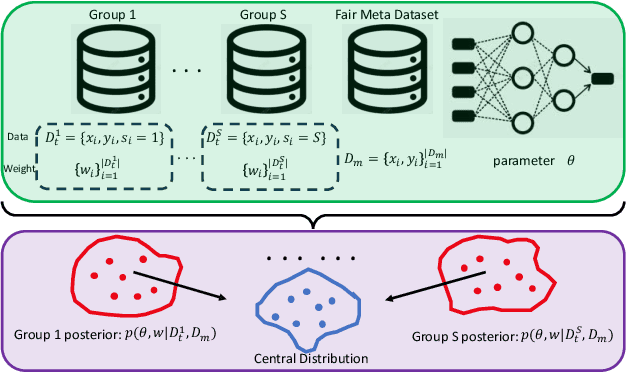
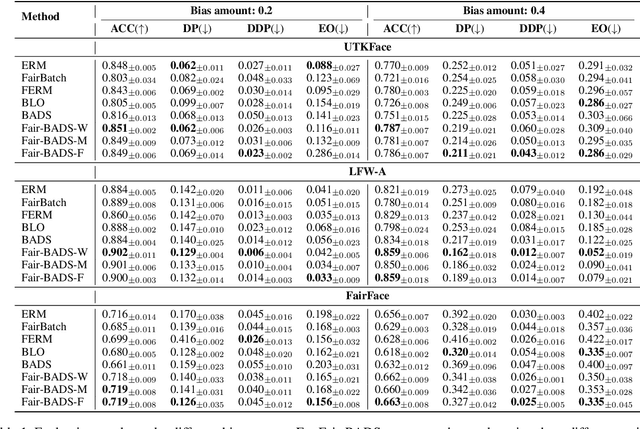

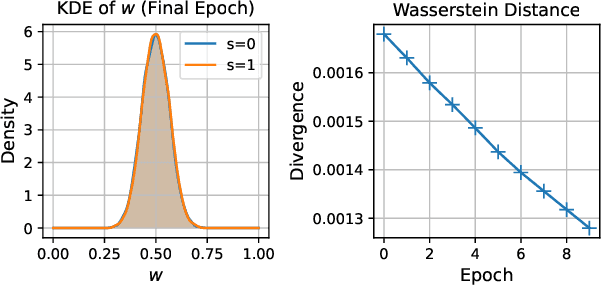
Fairness concerns are increasingly critical as machine learning models are deployed in high-stakes applications. While existing fairness-aware methods typically intervene at the model level, they often suffer from high computational costs, limited scalability, and poor generalization. To address these challenges, we propose a Bayesian data selection framework that ensures fairness by aligning group-specific posterior distributions of model parameters and sample weights with a shared central distribution. Our framework supports flexible alignment via various distributional discrepancy measures, including Wasserstein distance, maximum mean discrepancy, and $f$-divergence, allowing geometry-aware control without imposing explicit fairness constraints. This data-centric approach mitigates group-specific biases in training data and improves fairness in downstream tasks, with theoretical guarantees. Experiments on benchmark datasets show that our method consistently outperforms existing data selection and model-based fairness methods in both fairness and accuracy.
aiXiv: A Next-Generation Open Access Ecosystem for Scientific Discovery Generated by AI Scientists
Aug 20, 2025Recent advances in large language models (LLMs) have enabled AI agents to autonomously generate scientific proposals, conduct experiments, author papers, and perform peer reviews. Yet this flood of AI-generated research content collides with a fragmented and largely closed publication ecosystem. Traditional journals and conferences rely on human peer review, making them difficult to scale and often reluctant to accept AI-generated research content; existing preprint servers (e.g. arXiv) lack rigorous quality-control mechanisms. Consequently, a significant amount of high-quality AI-generated research lacks appropriate venues for dissemination, hindering its potential to advance scientific progress. To address these challenges, we introduce aiXiv, a next-generation open-access platform for human and AI scientists. Its multi-agent architecture allows research proposals and papers to be submitted, reviewed, and iteratively refined by both human and AI scientists. It also provides API and MCP interfaces that enable seamless integration of heterogeneous human and AI scientists, creating a scalable and extensible ecosystem for autonomous scientific discovery. Through extensive experiments, we demonstrate that aiXiv is a reliable and robust platform that significantly enhances the quality of AI-generated research proposals and papers after iterative revising and reviewing on aiXiv. Our work lays the groundwork for a next-generation open-access ecosystem for AI scientists, accelerating the publication and dissemination of high-quality AI-generated research content. Code is available at https://github.com/aixiv-org. Website is available at https://forms.gle/DxQgCtXFsJ4paMtn8.