 Add to Chrome
 Add to Firefox
 Add to Edge
FIFA World Cup 2026 as a Contamination-Free Benchmark for LLM Forecasting Agents: Four Models, a Bookmaker, and 104 Matches
Jul 20, 2026
We introduce WC2026-Agents, a benchmark and dataset for evaluating large language models (LLMs) as autonomous forecasting agents on real, future events. For every one of the 104 matches of the 2026 FIFA World Cup, four frontier models -- Claude Opus 4.8, ChatGPT (GPT-5.5, high reasoning), Gemini 3.1 Pro, and Grok (Expert Mode) -- ran an identical search-act-reflect loop: gather evidence with a web tool, commit to a 1X2 (team-A win / draw / team-B win) distribution and a virtual 100-USD bet, and, after the match, reflect given only the final score. Because every match kicked off after the models' training cutoffs, the benchmark is contamination-free by construction. Crucially, we pair the four agents with a fifth competitor drawn from the same information environment -- the pre-match betting market -- collected as per-match 1X2 odds, giving an economically grounded baseline and letting us score not just what an agent predicts but what it does with money. The release contains 416 forecasts and 414 reflections with verbatim reasoning, ground truth (including penalty shootouts), odds, and a reproducible evaluation suite. A reference evaluation surfaces findings that raw accuracy hides: the four agents issue an identical top pick in 92% of matches and none beats the market's Brier score; indeed, a naive flat stake on the market favorite out-earns all four agents. Yet the agents diverge sharply as decision-makers: betting return-on-investment ranges from -18% to +10%, fading the market is unprofitable for all four, the share of forecasts that cite the market ranges from 12% to 100%, and self-reported error rates on wrong picks range from 36% to 86%. The benchmark thus measures calibration, decision quality, and self-knowledge -- axes on which frontier models differ even when their predictions do not. Data and code: https://github.com/graphuofm/FIFA2026LLM

Affinity Graph Connectivity in Convex Clustering
May 23, 2026We generalize finite-sample bounds for convex clustering to the setting where affinity weights appearing in the objective correspond to a general connected graph. These bounds and their analysis lead to a better understanding of clustering behavior under various implied connectivity structures behind the data and to new rates of convergence for centroid recovery. The new theoretical framework is based on random walks, which allow application of concentration inequalities related to random graph models, and formalizes the relationship between the clustering performance and the connectivity of the graph structures. Through the form of the bound and empirical results, we argue proper tuning of hyperparameters to convex clustering problems should also include tuning of input affinity weights.
Biconvex Biclustering
Apr 05, 2026This article proposes a biconvex modification to convex biclustering in order to improve its performance in high-dimensional settings. In contrast to heuristics that discard a subset of noisy features a priori, our method jointly learns and accordingly weighs informative features while discovering biclusters. Moreover, the method is adaptive to the data, and is accompanied by an efficient algorithm based on proximal alternating minimization, complete with detailed guidance on hyperparameter tuning and efficient solutions to optimization subproblems. These contributions are theoretically grounded; we establish finite-sample bounds on the objective function under sub-Gaussian errors, and generalize these guarantees to cases where input affinities need not be uniform. Extensive simulation results reveal our method consistently recovers underlying biclusters while weighing and selecting features appropriately, outperforming peer methods. An application to a gene microarray dataset of lymphoma samples recovers biclusters matching an underlying classification, while giving additional interpretation to the mRNA samples via the column groupings and fitted weights.
Robust Multi-Source Covid-19 Detection in CT Images
Apr 02, 2026Deep learning models for COVID-19 detection from chest CT scans generally perform well when the training and test data originate from the same institution, but they often struggle when scans are drawn from multiple centres with differing scanners, imaging protocols, and patient populations. One key reason is that existing methods treat COVID-19 classification as the sole training objective, without accounting for the data source of each scan. As a result, the learned representations tend to be biased toward centres that contribute more training data. To address this, we propose a multi-task learning approach in which the model is trained to predict both the COVID-19 diagnosis and the originating data centre. The two tasks share an EfficientNet-B7 backbone, which encourages the feature extractor to learn representations that hold across all four participating centres. Since the training data is not evenly distributed across sources, we apply a logit-adjusted cross-entropy loss [1] to the source classification head to prevent underrepresented centres from being overlooked. Our pre-processing follows the SSFL framework with KDS [2], selecting eight representative slices per scan. Our method achieves an F1 score of 0.9098 and an AUC-ROC of 0.9647 on a validation set of 308 scans. The code is publicly available at https://github.com/Purdue-M2/-multisource-covid-ct.
Bayesian Transfer Learning
Dec 20, 2023Transfer learning is a burgeoning concept in statistical machine learning that seeks to improve inference and/or predictive accuracy on a domain of interest by leveraging data from related domains. While the term "transfer learning" has garnered much recent interest, its foundational principles have existed for years under various guises. Prior literature reviews in computer science and electrical engineering have sought to bring these ideas into focus, primarily surveying general methodologies and works from these disciplines. This article highlights Bayesian approaches to transfer learning, which have received relatively limited attention despite their innate compatibility with the notion of drawing upon prior knowledge to guide new learning tasks. Our survey encompasses a wide range of Bayesian transfer learning frameworks applicable to a variety of practical settings. We discuss how these methods address the problem of finding the optimal information to transfer between domains, which is a central question in transfer learning. We illustrate the utility of Bayesian transfer learning methods via a simulation study where we compare performance against frequentist competitors.
Bregman Power k-Means for Clustering Exponential Family Data
Jun 22, 2022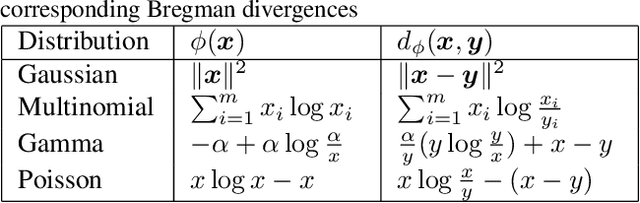
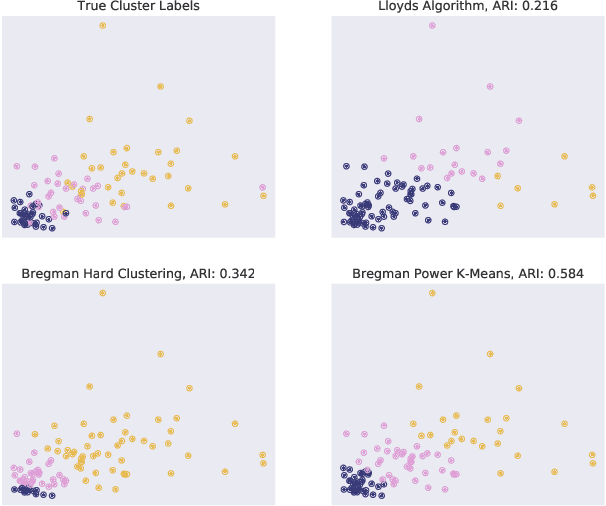
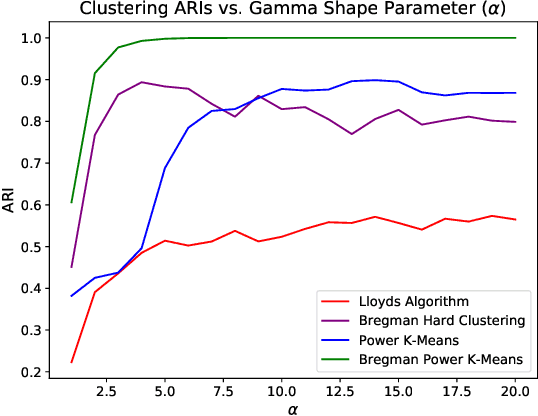
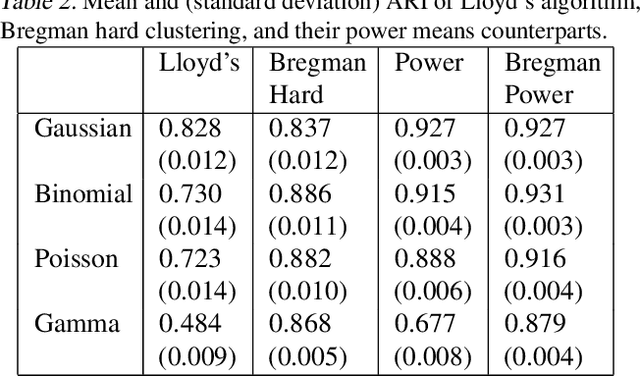
Recent progress in center-based clustering algorithms combats poor local minima by implicit annealing, using a family of generalized means. These methods are variations of Lloyd's celebrated $k$-means algorithm, and are most appropriate for spherical clusters such as those arising from Gaussian data. In this paper, we bridge these algorithmic advances to classical work on hard clustering under Bregman divergences, which enjoy a bijection to exponential family distributions and are thus well-suited for clustering objects arising from a breadth of data generating mechanisms. The elegant properties of Bregman divergences allow us to maintain closed form updates in a simple and transparent algorithm, and moreover lead to new theoretical arguments for establishing finite sample bounds that relax the bounded support assumption made in the existing state of the art. Additionally, we consider thorough empirical analyses on simulated experiments and a case study on rainfall data, finding that the proposed method outperforms existing peer methods in a variety of non-Gaussian data settings.
Wi-Fi and Bluetooth Contact Tracing Without User Intervention
Mar 31, 2022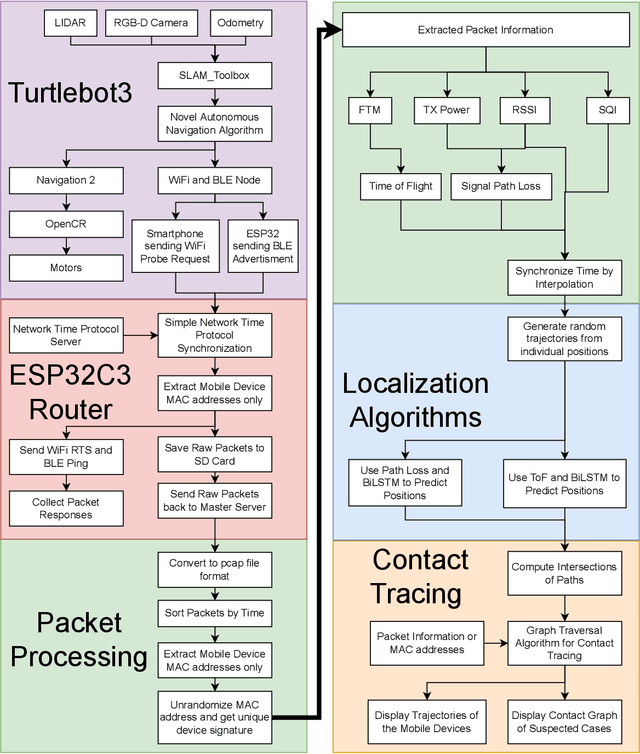
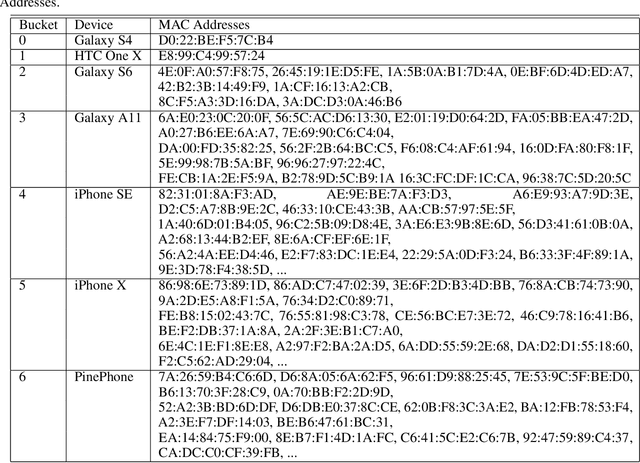
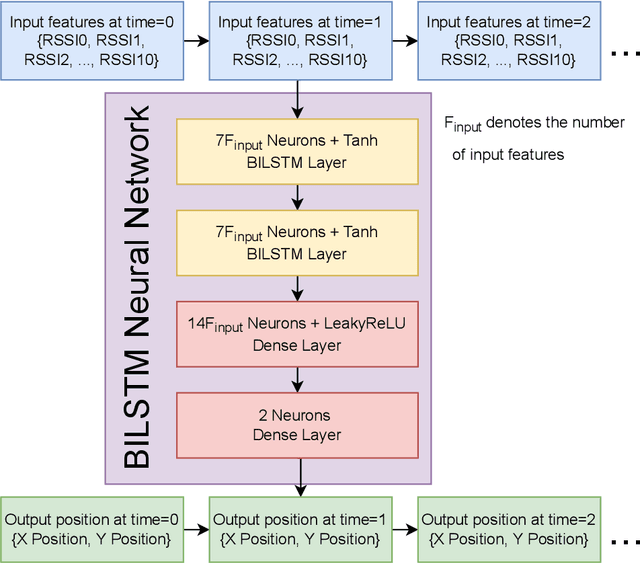
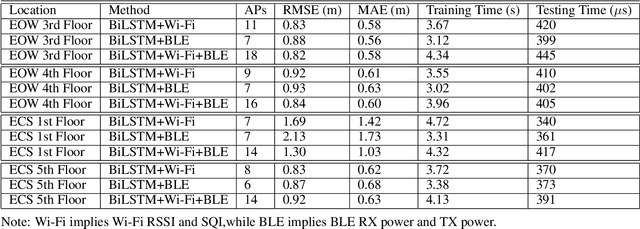
A custom Wi-Fi and Bluetooth indoor contact tracing system is created to find detailed paths of infected individuals without any user intervention. The system tracks smartphones, but it does not require smartphone applications, connecting to the routers, or any other extraneous devices on the users. A custom Turtlebot3 is used for site surveying, where it simulates mobile device movement and packet transmission. Transmit power, receive power, and round trip time are collected by a custom ESP32C3 router. MAC randomization is defeated to identify unique smartphones. Subsequently, the wireless parameters above are converted to signal path loss and time of flight. Bidirectional long short term memory takes the wireless parameters and predicts the detailed paths of the users within 1 m. Public health authorities can use the contact tracing website to find the detailed paths of the suspected cases using the smartphone models and initial positions of confirm cases. The system can also track indirect contact transmissions originating from surfaces and droplets due to having absolute positions of users.
Uniform Concentration Bounds toward a Unified Framework for Robust Clustering
Oct 27, 2021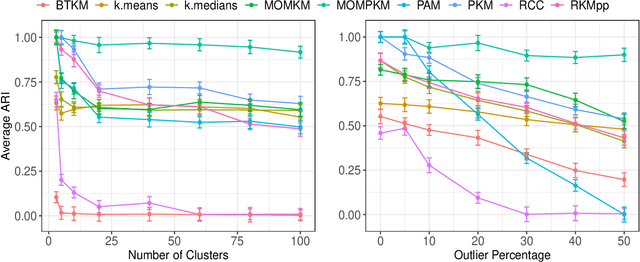

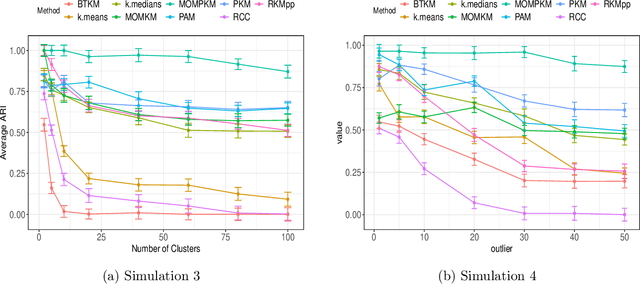
Recent advances in center-based clustering continue to improve upon the drawbacks of Lloyd's celebrated $k$-means algorithm over $60$ years after its introduction. Various methods seek to address poor local minima, sensitivity to outliers, and data that are not well-suited to Euclidean measures of fit, but many are supported largely empirically. Moreover, combining such approaches in a piecemeal manner can result in ad hoc methods, and the limited theoretical results supporting each individual contribution may no longer hold. Toward addressing these issues in a principled way, this paper proposes a cohesive robust framework for center-based clustering under a general class of dissimilarity measures. In particular, we present a rigorous theoretical treatment within a Median-of-Means (MoM) estimation framework, showing that it subsumes several popular $k$-means variants. In addition to unifying existing methods, we derive uniform concentration bounds that complete their analyses, and bridge these results to the MoM framework via Dudley's chaining arguments. Importantly, we neither require any assumptions on the distribution of the outlying observations nor on the relative number of observations $n$ to features $p$. We establish strong consistency and an error rate of $O(n^{-1/2})$ under mild conditions, surpassing the best-known results in the literature. The methods are empirically validated thoroughly on real and synthetic datasets.
Community Detection in Weighted Multilayer Networks with Ambient Noise
Mar 02, 2021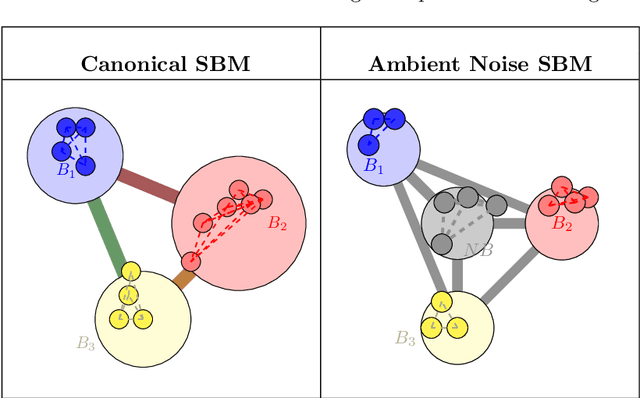
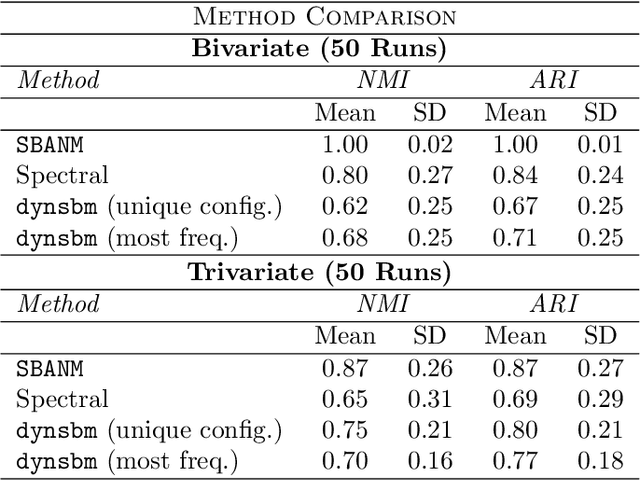
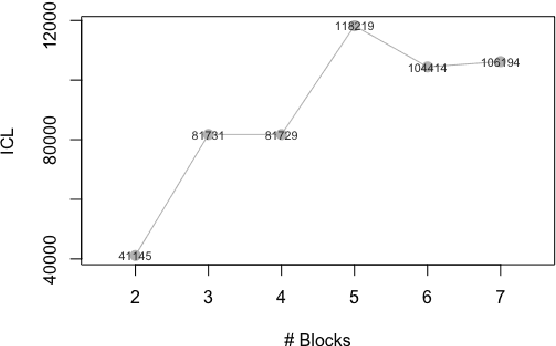

We introduce a novel class of stochastic blockmodel for multilayer weighted networks that accounts for the presence of a global ambient noise that governs between-block interactions. We induce a hierarchy of classifications in weighted multilayer networks by assuming that all but one cluster (block) are governed by unique local signals, while a single block is classified as ambient noise, which behaves identically as interactions across differing blocks. Hierarchical variational inference is employed to jointly detect and typologize block-structures as local signals or global noise. These principles are incorporated into novel community detection algorithm called Stochastic Block (with) Ambient Noise Model (SBANM) for multilayer weighted networks. We apply this method to several different domains. We focus on the Philadelphia Neurodevelopmental Cohort to discover communities of subjects that form diagnostic categories relating psychopathological symptoms to psychosis.
Kernel k-Means, By All Means: Algorithms and Strong Consistency
Nov 12, 2020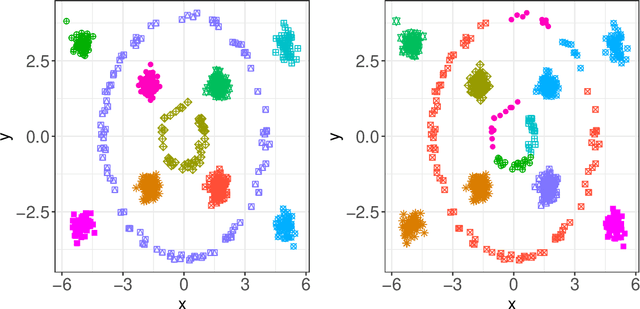
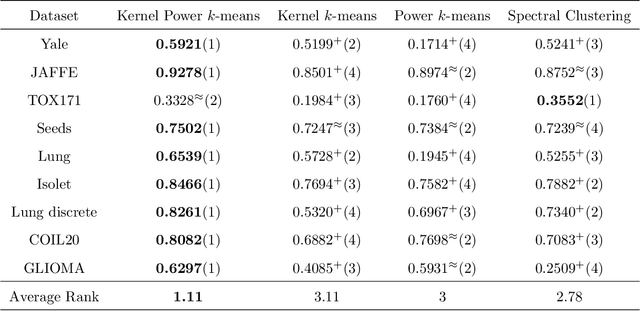
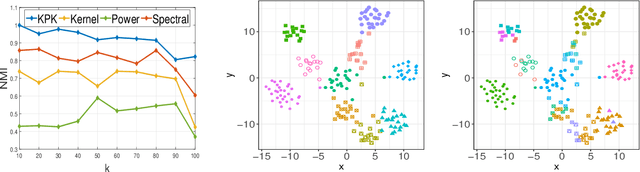
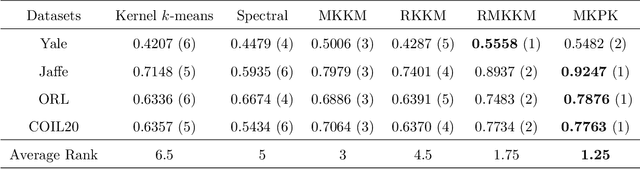
Kernel $k$-means clustering is a powerful tool for unsupervised learning of non-linearly separable data. Since the earliest attempts, researchers have noted that such algorithms often become trapped by local minima arising from non-convexity of the underlying objective function. In this paper, we generalize recent results leveraging a general family of means to combat sub-optimal local solutions to the kernel and multi-kernel settings. Called Kernel Power $k$-Means, our algorithm makes use of majorization-minimization (MM) to better solve this non-convex problem. We show the method implicitly performs annealing in kernel feature space while retaining efficient, closed-form updates, and we rigorously characterize its convergence properties both from computational and statistical points of view. In particular, we characterize the large sample behavior of the proposed method by establishing strong consistency guarantees. Its merits are thoroughly validated on a suite of simulated datasets and real data benchmarks that feature non-linear and multi-view separation.