 Add to Chrome
 Add to Firefox
 Add to Edge
Affinity Graph Connectivity in Convex Clustering
May 23, 2026
We generalize finite-sample bounds for convex clustering to the setting where affinity weights appearing in the objective correspond to a general connected graph. These bounds and their analysis lead to a better understanding of clustering behavior under various implied connectivity structures behind the data and to new rates of convergence for centroid recovery. The new theoretical framework is based on random walks, which allow application of concentration inequalities related to random graph models, and formalizes the relationship between the clustering performance and the connectivity of the graph structures. Through the form of the bound and empirical results, we argue proper tuning of hyperparameters to convex clustering problems should also include tuning of input affinity weights.

Biconvex Biclustering
Apr 05, 2026This article proposes a biconvex modification to convex biclustering in order to improve its performance in high-dimensional settings. In contrast to heuristics that discard a subset of noisy features a priori, our method jointly learns and accordingly weighs informative features while discovering biclusters. Moreover, the method is adaptive to the data, and is accompanied by an efficient algorithm based on proximal alternating minimization, complete with detailed guidance on hyperparameter tuning and efficient solutions to optimization subproblems. These contributions are theoretically grounded; we establish finite-sample bounds on the objective function under sub-Gaussian errors, and generalize these guarantees to cases where input affinities need not be uniform. Extensive simulation results reveal our method consistently recovers underlying biclusters while weighing and selecting features appropriately, outperforming peer methods. An application to a gene microarray dataset of lymphoma samples recovers biclusters matching an underlying classification, while giving additional interpretation to the mRNA samples via the column groupings and fitted weights.
OKRidge: Scalable Optimal k-Sparse Ridge Regression for Learning Dynamical Systems
Apr 13, 2023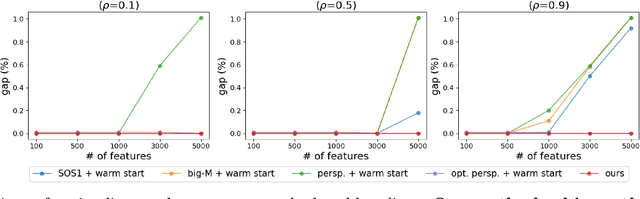
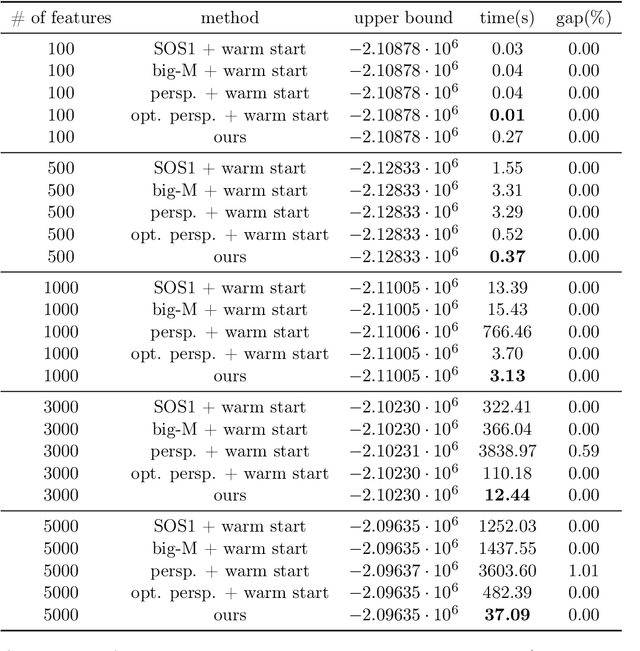
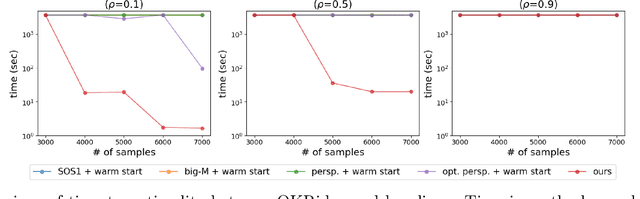
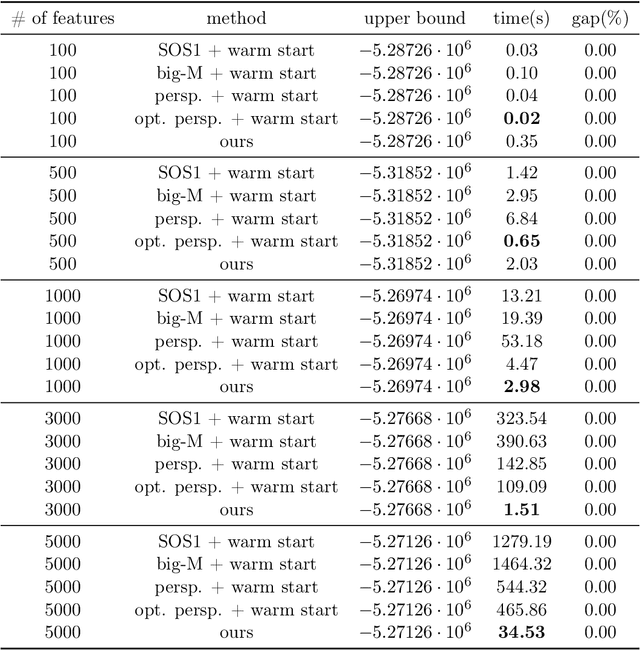
We consider an important problem in scientific discovery, identifying sparse governing equations for nonlinear dynamical systems. This involves solving sparse ridge regression problems to provable optimality in order to determine which terms drive the underlying dynamics. We propose a fast algorithm, OKRidge, for sparse ridge regression, using a novel lower bound calculation involving, first, a saddle point formulation, and from there, either solving (i) a linear system or (ii) using an ADMM-based approach, where the proximal operators can be efficiently evaluated by solving another linear system and an isotonic regression problem. We also propose a method to warm-start our solver, which leverages a beam search. Experimentally, our methods attain provable optimality with run times that are orders of magnitude faster than those of the existing MIP formulations solved by the commercial solver Gurobi.