 Add to Chrome
 Add to Firefox
 Add to Edge
EnactToM: An Evolving Benchmark for Functional Theory of Mind in Embodied Agents
May 11, 2026
Theory of Mind (ToM), the ability to track others epistemic state, makes humans efficient collaborators. AI agents need the same capacity in multi agent settings, yet existing benchmarks mostly test literal ToM by asking direct belief questions. The ability act optimally on implicit beliefs in embodied environments, called functional ToM, remains largely untested. We introduce EnactToM, an evolving benchmark of 300 embodied multi-agent tasks set in a 3D household with partial observability, private information, and constrained communication. Each task is formally verified for solvability and required epistemic depth, and new tasks are generated increase difficulty as models improve. On the hard split, all seven evaluated frontier models score 0.0% Pass^3 on functional task completion, while averaging 45.0% on literal belief probes. Manual analysis traces 93% of sampled failures to epistemic coordination breakdowns such as withheld information, ignored partner constraints, and misallocated messages, providing a concrete target for future work.

Community Detection in Weighted Multilayer Networks with Ambient Noise
Mar 02, 2021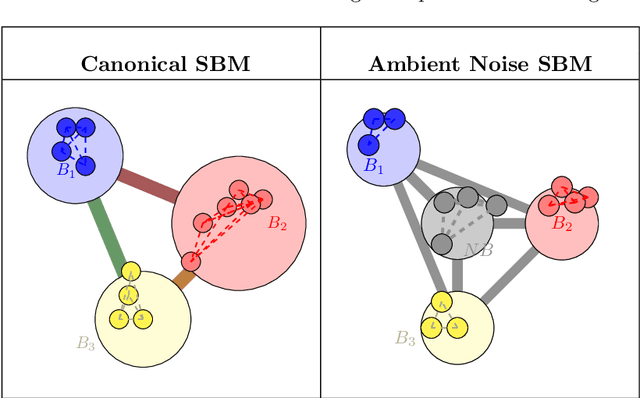
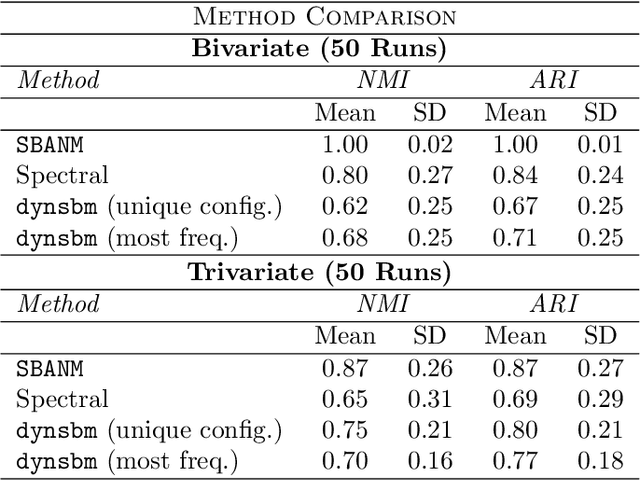
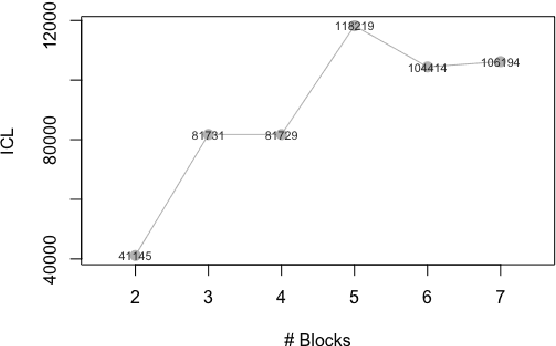

We introduce a novel class of stochastic blockmodel for multilayer weighted networks that accounts for the presence of a global ambient noise that governs between-block interactions. We induce a hierarchy of classifications in weighted multilayer networks by assuming that all but one cluster (block) are governed by unique local signals, while a single block is classified as ambient noise, which behaves identically as interactions across differing blocks. Hierarchical variational inference is employed to jointly detect and typologize block-structures as local signals or global noise. These principles are incorporated into novel community detection algorithm called Stochastic Block (with) Ambient Noise Model (SBANM) for multilayer weighted networks. We apply this method to several different domains. We focus on the Philadelphia Neurodevelopmental Cohort to discover communities of subjects that form diagnostic categories relating psychopathological symptoms to psychosis.