 Add to Chrome
 Add to Firefox
 Add to Edge
Memory-Bounded Continuation of Greedy Sampling for Continual Anomaly Detection
Aug 15, 2026
Greedy sampling produces a compact yet representative summary of normal data, which is essential for reliable anomaly detection that relies on measuring distance from normality. For continual anomaly detection where tasks arrive sequentially, extending greedy sampling is straightforward with unbounded memory through coreset accumulation. However, practical deployment requires fixed memory where the coreset size remains constant regardless of task count. We observe that continued greedy sampling, which iteratively applies greedy selection over previously greedy-sampled sets, effectively preserves representativeness under strict memory limits. Despite discarding data at each step to satisfy the memory constraint, coreset quality degrades gracefully rather than catastrophically, enabling reliable anomaly detection across the tasks. We provide theoretical justification by showing that resulting greedy-continued coreset approximates the oracle coreset within a bounded gap. We instantiate this principle in ContCore, which constructs a greedy-continued coreset through greedy expansion on new task features followed by greedy consolidation to enforce the memory budget. Unlike neural methods susceptible to catastrophic forgetting or naive coreset accumulation requiring unbounded memory, ContCore maintains fixed memory with theoretical guarantees. Empirically, ContCore achieves state-of-the-art performance across 11 task schedules on MVTecAD and VisA, and extends effectively to online continual AD settings where prior methods degrade significantly. Code: https://github.com/jungyg/ContCore

Memory-Distilled Selection for Noise-Robust Anomaly Detection
May 26, 2026Anomaly detection (AD) under data contamination is critical for deploying unsupervised defect detection in industrial environments, where curating perfectly clean training sets is impractical. However, existing methods are sensitive to contamination, suffering significant performance degradation as the noise ratio increases. In this paper, we propose Memory-Distilled Selection (MeDS), a training algorithm based on data selection. MeDS constructs an ensemble of partial memories via random subsampling, where the resulting sparsity acts as a low-pass filter that captures nominal patterns across a wide range of noise ratios, enabling coarse-level identification of contaminated samples. The aggregated distances to the bootstrapped memories are then distilled into a reconstruction score network, which is subsequently fine-tuned on clean data filtered using scores from the distilled model, enabling fine-grained localization of anomalies. MeDS is robust across a wide range of noise ratios without requiring noise-ratio-specific hyperparameter tuning, achieving 99.16\% image-level AUROC on MVTecAD at a 40\% noise ratio, and attaining state-of-the-art performance on both VisA and Real-IAD under noisy settings. We thoroughly verify the efficacy of MeDS on industrial AD benchmarks under noisy data scenarios, accompanied by in-depth empirical analyses.
EXAONE 4.5 Technical Report
Apr 09, 2026This technical report introduces EXAONE 4.5, the first open-weight vision language model released by LG AI Research. EXAONE 4.5 is architected by integrating a dedicated visual encoder into the existing EXAONE 4.0 framework, enabling native multimodal pretraining over both visual and textual modalities. The model is trained on large-scale data with careful curation, particularly emphasizing document-centric corpora that align with LG's strategic application domains. This targeted data design enables substantial performance gains in document understanding and related tasks, while also delivering broad improvements across general language capabilities. EXAONE 4.5 extends context length up to 256K tokens, facilitating long-context reasoning and enterprise-scale use cases. Comparative evaluations demonstrate that EXAONE 4.5 achieves competitive performance in general benchmarks while outperforming state-of-the-art models of similar scale in document understanding and Korean contextual reasoning. As part of LG's ongoing effort toward practical industrial deployment, EXAONE 4.5 is designed to be continuously extended with additional domains and application scenarios to advance AI for a better life.
EgoXtreme: A Dataset for Robust Object Pose Estimation in Egocentric Views under Extreme Conditions
Mar 26, 2026Smart glass is emerging as an useful device since it provides plenty of insights under hands-busy, eyes-on-task situations. To understand the context of the wearer, 6D object pose estimation in egocentric view is becoming essential. However, existing 6D object pose estimation benchmarks fail to capture the challenges of real-world egocentric applications, which are often dominated by severe motion blur, dynamic illumination, and visual obstructions. This discrepancy creates a significant gap between controlled lab data and chaotic real-world application. To bridge this gap, we introduce EgoXtreme, a new large-scale 6D pose estimation dataset captured entirely from an egocentric perspective. EgoXtreme features three challenging scenarios - industrial maintenance, sports, and emergency rescue - designed to introduce severe perceptual ambiguities through extreme lighting, heavy motion blur, and smoke. Evaluations of state-of-the-art generalizable pose estimators on EgoXtreme indicate that their generalization fails to hold in extreme conditions, especially under low light. We further demonstrate that simply applying image restoration (e.g., deblurring) offers no positive improvement for extreme conditions. While performance gain has appeared in tracking-based approach, implying using temporal information in fast-motion scenarios is meaningful. We conclude that EgoXtreme is an essential resource for developing and evaluating the next generation of pose estimation models robust enough for real-world egocentric vision. The dataset and code are available at https://taegyoun88.github.io/EgoXtreme/
K-EXAONE Technical Report
Jan 05, 2026This technical report presents K-EXAONE, a large-scale multilingual language model developed by LG AI Research. K-EXAONE is built on a Mixture-of-Experts architecture with 236B total parameters, activating 23B parameters during inference. It supports a 256K-token context window and covers six languages: Korean, English, Spanish, German, Japanese, and Vietnamese. We evaluate K-EXAONE on a comprehensive benchmark suite spanning reasoning, agentic, general, Korean, and multilingual abilities. Across these evaluations, K-EXAONE demonstrates performance comparable to open-weight models of similar size. K-EXAONE, designed to advance AI for a better life, is positioned as a powerful proprietary AI foundation model for a wide range of industrial and research applications.
Towards AI-Guided Open-World Ecological Taxonomic Classification
Dec 22, 2025AI-guided classification of ecological families, genera, and species underpins global sustainability efforts such as biodiversity monitoring, conservation planning, and policy-making. Progress toward this goal is hindered by long-tailed taxonomic distributions from class imbalance, along with fine-grained taxonomic variations, test-time spatiotemporal domain shifts, and closed-set assumptions that can only recognize previously seen taxa. We introduce the Open-World Ecological Taxonomy Classification, a unified framework that captures the co-occurrence of these challenges in realistic ecological settings. To address them, we propose TaxoNet, an embedding-based encoder with a dual-margin penalization loss that strengthens learning signals from rare underrepresented taxa while mitigating the dominance of overrepresented ones, directly confronting interrelated challenges. We evaluate our method on diverse ecological domains: Google Auto-Arborist (urban trees), iNat-Plantae (Plantae observations from various ecosystems in iNaturalist-2019), and NAFlora-Mini (a curated herbarium collection). Our model consistently outperforms baselines, particularly for rare taxa, establishing a strong foundation for open-world plant taxonomic monitoring. Our findings further show that general-purpose multimodal foundation models remain constrained in plant-domain applications.
Zero-shot Multimodal Document Retrieval via Cross-modal Question Generation
Aug 23, 2025Rapid advances in Multimodal Large Language Models (MLLMs) have expanded information retrieval beyond purely textual inputs, enabling retrieval from complex real world documents that combine text and visuals. However, most documents are private either owned by individuals or confined within corporate silos and current retrievers struggle when faced with unseen domains or languages. To address this gap, we introduce PREMIR, a simple yet effective framework that leverages the broad knowledge of an MLLM to generate cross modal pre questions (preQs) before retrieval. Unlike earlier multimodal retrievers that compare embeddings in a single vector space, PREMIR leverages preQs from multiple complementary modalities to expand the scope of matching to the token level. Experiments show that PREMIR achieves state of the art performance on out of distribution benchmarks, including closed domain and multilingual settings, outperforming strong baselines across all retrieval metrics. We confirm the contribution of each component through in depth ablation studies, and qualitative analyses of the generated preQs further highlight the model's robustness in real world settings.
Posterior Contraction for Sparse Neural Networks in Besov Spaces with Intrinsic Dimensionality
Jun 23, 2025This work establishes that sparse Bayesian neural networks achieve optimal posterior contraction rates over anisotropic Besov spaces and their hierarchical compositions. These structures reflect the intrinsic dimensionality of the underlying function, thereby mitigating the curse of dimensionality. Our analysis shows that Bayesian neural networks equipped with either sparse or continuous shrinkage priors attain the optimal rates which are dependent on the intrinsic dimension of the true structures. Moreover, we show that these priors enable rate adaptation, allowing the posterior to contract at the optimal rate even when the smoothness level of the true function is unknown. The proposed framework accommodates a broad class of functions, including additive and multiplicative Besov functions as special cases. These results advance the theoretical foundations of Bayesian neural networks and provide rigorous justification for their practical effectiveness in high-dimensional, structured estimation problems.
RefPose: Leveraging Reference Geometric Correspondences for Accurate 6D Pose Estimation of Unseen Objects
May 16, 2025Estimating the 6D pose of unseen objects from monocular RGB images remains a challenging problem, especially due to the lack of prior object-specific knowledge. To tackle this issue, we propose RefPose, an innovative approach to object pose estimation that leverages a reference image and geometric correspondence as guidance. RefPose first predicts an initial pose by using object templates to render the reference image and establish the geometric correspondence needed for the refinement stage. During the refinement stage, RefPose estimates the geometric correspondence of the query based on the generated references and iteratively refines the pose through a render-and-compare approach. To enhance this estimation, we introduce a correlation volume-guided attention mechanism that effectively captures correlations between the query and reference images. Unlike traditional methods that depend on pre-defined object models, RefPose dynamically adapts to new object shapes by leveraging a reference image and geometric correspondence. This results in robust performance across previously unseen objects. Extensive evaluation on the BOP benchmark datasets shows that RefPose achieves state-of-the-art results while maintaining a competitive runtime.
Explain with Visual Keypoints Like a Real Mentor! A Benchmark for Multimodal Solution Explanation
Apr 07, 2025

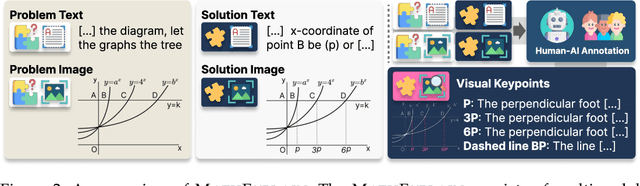
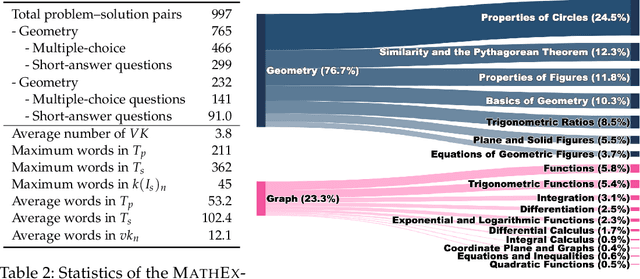
With the rapid advancement of mathematical reasoning capabilities in Large Language Models (LLMs), AI systems are increasingly being adopted in educational settings to support students' comprehension of problem-solving processes. However, a critical component remains underexplored in current LLM-generated explanations: visual explanation. In real-world instructional contexts, human tutors routinely employ visual aids - such as diagrams, markings, and highlights - to enhance conceptual clarity. To bridge this gap, we introduce a novel task of visual solution explanation, which requires generating explanations that incorporate newly introduced visual elements essential for understanding (e.g., auxiliary lines, annotations, or geometric constructions). To evaluate model performance on this task, we propose MathExplain, a multimodal benchmark consisting of 997 math problems annotated with visual keypoints and corresponding explanatory text that references those elements. Our empirical results show that while some closed-source models demonstrate promising capabilities on visual solution-explaining, current open-source general-purpose models perform inconsistently, particularly in identifying relevant visual components and producing coherent keypoint-based explanations. We expect that visual solution-explaining and the MathExplain dataset will catalyze further research on multimodal LLMs in education and advance their deployment as effective, explanation-oriented AI tutors. Code and data will be released publicly.