 Add to Chrome
 Add to Firefox
 Add to Edge
Quality Adaptive Angular Margin Learning for Respiratory Sound Classification
Jun 10, 2026
We present a quality-adaptive angular-margin learning framework that improves feature generalization by enforcing intra-class compactness and inter-class separability. Our framework, titled QLung, introduces a no-reference audio quality margin derived from spectral entropy and root-mean-square energy, which adaptively scales angular margins based on recording quality. To this end, we propose a log-scaled angular margin that stabilizes training under severe class imbalance. We also use an angular classifier that normalizes features and class weights, ensuring margin penalties are applied consistently on the unit hypersphere. Our approach improves in-distribution performance on the ICBHI dataset by 2.46\% over the cross-entropy baseline, and most significantly, achieves the strongest out-of-distribution performance on the SPRSound dataset compared to prior state-of-the-art methods. Code is available at https://github.com/RSC-Toolkit/QLung.

Mitigating Stethoscope-Induced Shortcuts in Respiratory Sound Classification under Federated Domain Generalization with Causality-Inspired Interventions
May 28, 2026AI-driven respiratory sound classification (RSC) is promising for automated pulmonary disease detection, yet multi-site deployment is hindered by inter-stethoscope variability. We introduce a federated domain generalization (FedDG) formulation for RSC under stethoscope-induced device shifts, where clients use heterogeneous devices and the model is evaluated on unseen devices. Our empirical analysis shows that stethoscope-induced style and disease-specific content are tightly entangled, making deterministic style removal unreliable. In response, we propose a causality-inspired multimodal FedDG framework that combines: (i) a causality-inspired device style intervention network that performs content-preserving style perturbations, (ii) counterfactual text augmentation that neutralizes metadata shortcuts, and (iii) gradient alignment that facilitates device-invariant representations across clients. Built on a multimodal language-audio pretraining model, it outperforms conventional data augmentation and federated learning baselines in leave-one-device-out validation on ICBHI and SPRSound datasets. Code will be released upon publication.
Meta-Ensemble Learning with Diverse Data Splits for Improved Respiratory Sound Classification
Apr 27, 2026Training reliable respiratory sound classification models remains challenging due to the limited size and subject diversity of datasets. Ensemble methods can improve robustness, but when base models are trained on identical data, models tend to overfit and produce highly correlated predictions, thereby reducing the effectiveness of ensembling. In this work, we investigate a meta-ensemble learning methodology that enhances prediction diversity by training base models on diverse data splits and combining their outputs through a trained meta-model. Specifically, we train base models on the ICBHI dataset using two data split settings: fixed 80-20% split and five-fold cross-validation split, under two data granularity settings: patient- and sample-level. The resulting diversity in base model predictions enables the meta-model to better generalize. Our approach achieves new state-of-the-art performance on the ICBHI benchmark, reaching a Score of 66.49% and showing improved generalization on two out-of-distribution datasets, indicating its potential applicability to real-world clinical data.
Towards AI-Guided Open-World Ecological Taxonomic Classification
Dec 22, 2025AI-guided classification of ecological families, genera, and species underpins global sustainability efforts such as biodiversity monitoring, conservation planning, and policy-making. Progress toward this goal is hindered by long-tailed taxonomic distributions from class imbalance, along with fine-grained taxonomic variations, test-time spatiotemporal domain shifts, and closed-set assumptions that can only recognize previously seen taxa. We introduce the Open-World Ecological Taxonomy Classification, a unified framework that captures the co-occurrence of these challenges in realistic ecological settings. To address them, we propose TaxoNet, an embedding-based encoder with a dual-margin penalization loss that strengthens learning signals from rare underrepresented taxa while mitigating the dominance of overrepresented ones, directly confronting interrelated challenges. We evaluate our method on diverse ecological domains: Google Auto-Arborist (urban trees), iNat-Plantae (Plantae observations from various ecosystems in iNaturalist-2019), and NAFlora-Mini (a curated herbarium collection). Our model consistently outperforms baselines, particularly for rare taxa, establishing a strong foundation for open-world plant taxonomic monitoring. Our findings further show that general-purpose multimodal foundation models remain constrained in plant-domain applications.
Overcoming Uncertain Incompleteness for Robust Multimodal Sequential Diagnosis Prediction via Knowledge Distillation and Random Data Erasing
Jul 28, 2024In this paper, we present NECHO v2, a novel framework designed to enhance the predictive accuracy of multimodal sequential patient diagnoses under uncertain missing visit sequences, a common challenge in clinical settings. Firstly, we modify NECHO to handle uncertain modality representation dominance under the imperfect data. Next, we develop a systematic knowledge distillation by employing the modified NECHO as both teacher and student. It encompasses a modality-wise contrastive and hierarchical distillation, transformer representation random distillation, along with other distillations to align representations tightly and effectively. We also utilise random erasing on individual data points within sequences during both training and distillation of teacher to lightly simulate scenario with missing visit information to foster effective knowledge transfer. As a result, NECHO v2 verifies itself by showing superiority in multimodal sequential diagnosis prediction on both balanced and imbalanced incomplete settings on multimodal healthcare data.
Next Visit Diagnosis Prediction via Medical Code-Centric Multimodal Contrastive EHR Modelling with Hierarchical Regularisation
Jan 28, 2024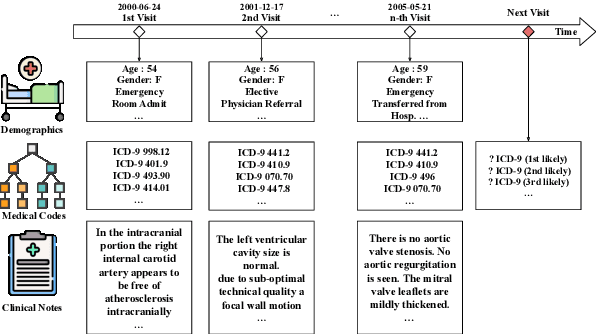
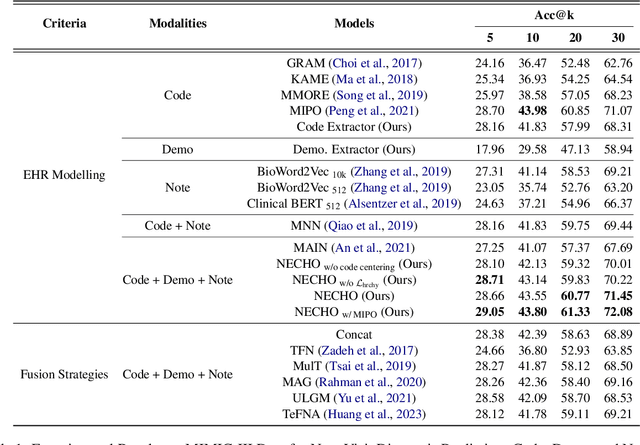
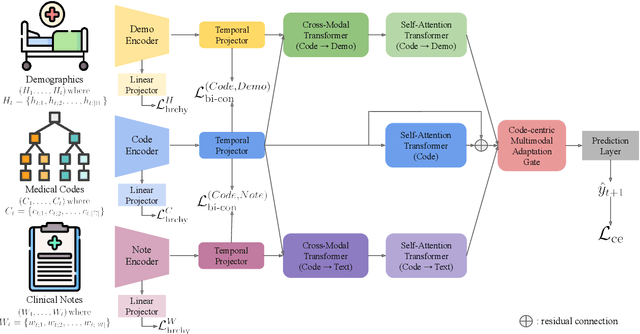
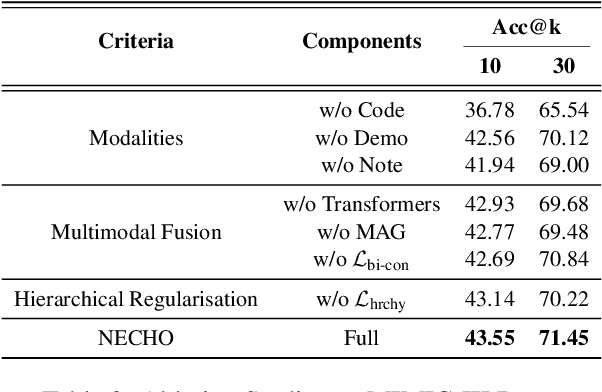
Predicting next visit diagnosis using Electronic Health Records (EHR) is an essential task in healthcare, critical for devising proactive future plans for both healthcare providers and patients. Nonetheless, many preceding studies have not sufficiently addressed the heterogeneous and hierarchical characteristics inherent in EHR data, inevitably leading to sub-optimal performance. To this end, we propose NECHO, a novel medical code-centric multimodal contrastive EHR learning framework with hierarchical regularisation. First, we integrate multifaceted information encompassing medical codes, demographics, and clinical notes using a tailored network design and a pair of bimodal contrastive losses, all of which pivot around a medical codes representation. We also regularise modality-specific encoders using a parental level information in medical ontology to learn hierarchical structure of EHR data. A series of experiments on MIMIC-III data demonstrates effectiveness of our approach.
Diagonal Hierarchical Consistency Learning for Semi-supervised Medical Image Segmentation
Nov 24, 2023Medical image segmentation, which is essential for many clinical applications, has achieved almost human-level performance via data-driven deep learning technologies. Nevertheless, its performance is predicated upon the costly process of manually annotating a vast amount of medical images. To this end, we propose a novel framework for robust semi-supervised medical image segmentation using diagonal hierarchical consistency learning (DiHC-Net). First, it is composed of multiple sub-models with identical multi-scale architecture but with distinct sub-layers, such as up-sampling and normalisation layers. Second, with mutual consistency, a novel consistency regularisation is enforced between one model's intermediate and final prediction and soft pseudo labels from other models in a diagonal hierarchical fashion. A series of experiments verifies the efficacy of our simple framework, outperforming all previous approaches on public Left Atrium (LA) dataset.
A Survey on Generative Diffusion Models for Structured Data
Jun 07, 2023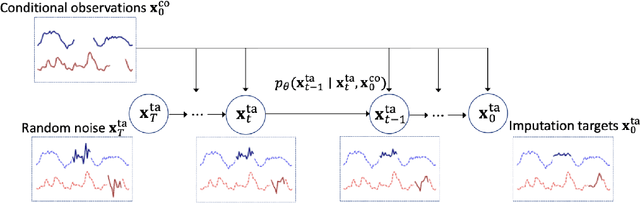
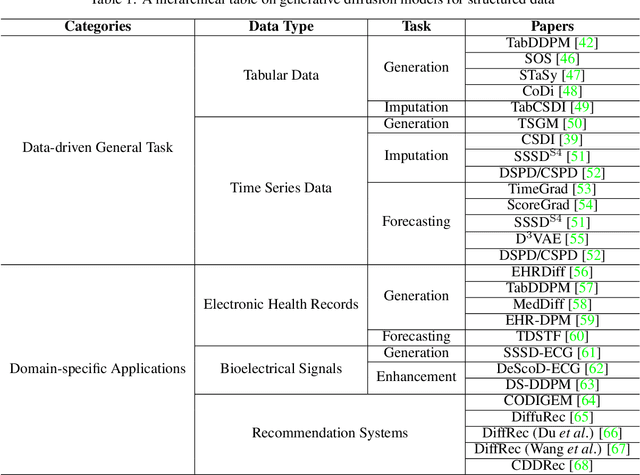
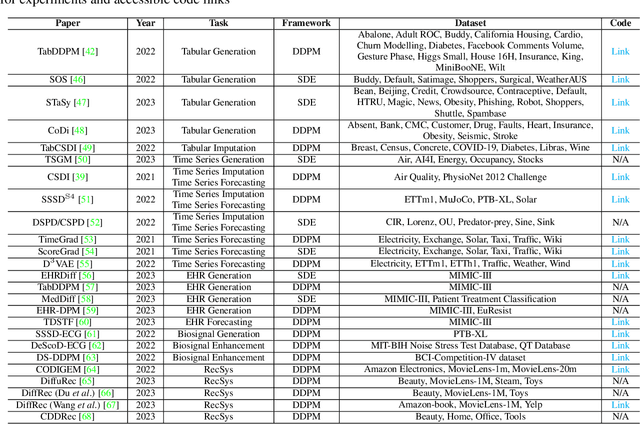
In recent years, generative diffusion models have achieved a rapid paradigm shift in deep generative models by showing groundbreaking performance across various applications. Meanwhile, structured data, encompassing tabular and time series data, has been received comparatively limited attention from the deep learning research community, despite its omnipresence and extensive applications. Thus, there is still a lack of literature and its review on structured data modelling via diffusion models, compared to other data modalities such as computer vision and natural language processing. Hence, in this paper, we present a comprehensive review of recently proposed diffusion models in the field of structured data. First, this survey provides a concise overview of the score-based diffusion model theory, subsequently proceeding to the technical descriptions of the majority of pioneering works using structured data in both data-driven general tasks and domain-specific applications. Thereafter, we analyse and discuss the limitations and challenges shown in existing works and suggest potential research directions. We hope this review serves as a catalyst for the research community, promoting the developments in generative diffusion models for structured data.