 Add to Chrome
 Add to Firefox
 Add to Edge
STONE Dataset: A Scalable Multi-Modal Surround-View 3D Traversability Dataset for Off-Road Robot Navigation
Mar 12, 2026
Reliable off-road navigation requires accurate estimation of traversable regions and robust perception under diverse terrain and sensing conditions. However, existing datasets lack both scalability and multi-modality, which limits progress in 3D traversability prediction. In this work, we introduce STONE, a large-scale multi-modal dataset for off-road navigation. STONE provides (1) trajectory-guided 3D traversability maps generated by a fully automated, annotation-free pipeline, and (2) comprehensive surround-view sensing with synchronized 128-channel LiDAR, six RGB cameras, and three 4D imaging radars. The dataset covers a wide range of environments and conditions, including day and night, grasslands, farmlands, construction sites, and lakes. Our auto-labeling pipeline reconstructs dense terrain surfaces from LiDAR scans, extracts geometric attributes such as slope, elevation, and roughness, and assigns traversability labels beyond the robot's trajectory using a Mahalanobis-distance-based criterion. This design enables scalable, geometry-aware ground-truth construction without manual annotation. Finally, we establish a benchmark for voxel-level 3D traversability prediction and provide strong baselines under both single-modal and multi-modal settings. STONE is available at: https://konyul.github.io/STONE-dataset/

Localization Meets Uncertainty: Uncertainty-Aware Multi-Modal Localization
Apr 10, 2025Reliable localization is critical for robot navigation in complex indoor environments. In this paper, we propose an uncertainty-aware localization method that enhances the reliability of localization outputs without modifying the prediction model itself. This study introduces a percentile-based rejection strategy that filters out unreliable 3-DoF pose predictions based on aleatoric and epistemic uncertainties the network estimates. We apply this approach to a multi-modal end-to-end localization that fuses RGB images and 2D LiDAR data, and we evaluate it across three real-world datasets collected using a commercialized serving robot. Experimental results show that applying stricter uncertainty thresholds consistently improves pose accuracy. Specifically, the mean position error is reduced by 41.0%, 56.7%, and 69.4%, and the mean orientation error by 55.6%, 65.7%, and 73.3%, when applying 90%, 80%, and 70% thresholds, respectively. Furthermore, the rejection strategy effectively removes extreme outliers, resulting in better alignment with ground truth trajectories. To the best of our knowledge, this is the first study to quantitatively demonstrate the benefits of percentile-based uncertainty rejection in multi-modal end-to-end localization tasks. Our approach provides a practical means to enhance the reliability and accuracy of localization systems in real-world deployments.
Deep UAV Path Planning with Assured Connectivity in Dense Urban Setting
Jun 21, 2024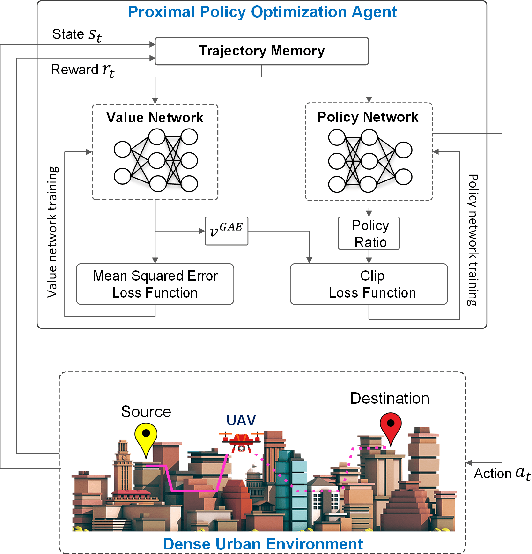
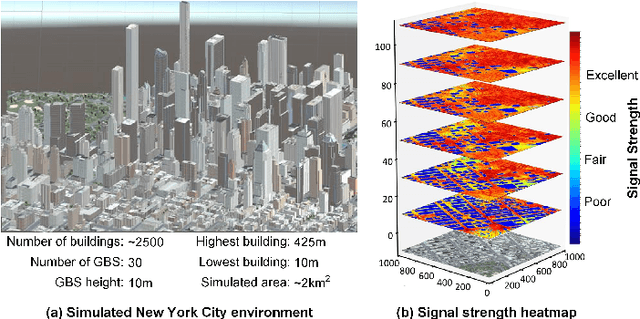
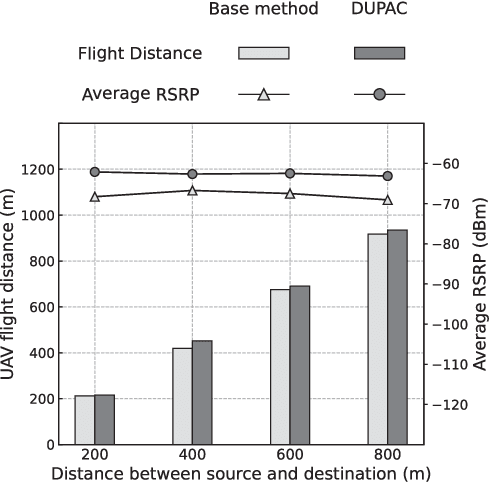
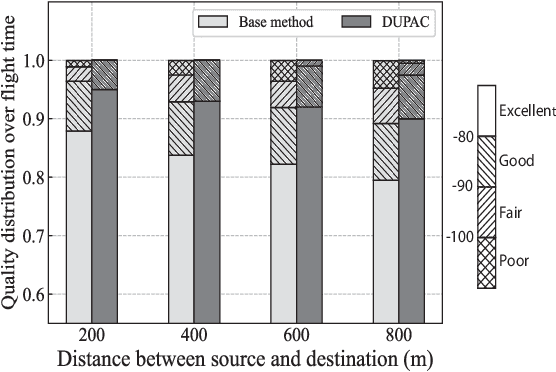
Unmanned Ariel Vehicle (UAV) services with 5G connectivity is an emerging field with numerous applications. Operator-controlled UAV flights and manual static flight configurations are major limitations for the wide adoption of scalability of UAV services. Several services depend on excellent UAV connectivity with a cellular network and maintaining it is challenging in predetermined flight paths. This paper addresses these limitations by proposing a Deep Reinforcement Learning (DRL) framework for UAV path planning with assured connectivity (DUPAC). During UAV flight, DUPAC determines the best route from a defined source to the destination in terms of distance and signal quality. The viability and performance of DUPAC are evaluated under simulated real-world urban scenarios using the Unity framework. The results confirm that DUPAC achieves an autonomous UAV flight path similar to base method with only 2% increment while maintaining an average 9% better connection quality throughout the flight.
False Positive Sampling-based Data Augmentation for Enhanced 3D Object Detection Accuracy
Mar 07, 2024Recent studies have focused on enhancing the performance of 3D object detection models. Among various approaches, ground-truth sampling has been proposed as an augmentation technique to address the challenges posed by limited ground-truth data. However, an inherent issue with ground-truth sampling is its tendency to increase false positives. Therefore, this study aims to overcome the limitations of ground-truth sampling and improve the performance of 3D object detection models by developing a new augmentation technique called false-positive sampling. False-positive sampling involves retraining the model using point clouds that are identified as false positives in the model's predictions. We propose an algorithm that utilizes both ground-truth and false-positive sampling and an algorithm for building the false-positive sample database. Additionally, we analyze the principles behind the performance enhancement due to false-positive sampling and propose a technique that applies the concept of curriculum learning to the sampling strategy that encompasses both false-positive and ground-truth sampling techniques. Our experiments demonstrate that models utilizing false-positive sampling show a reduction in false positives and exhibit improved object detection performance. On the KITTI and Waymo Open datasets, models with false-positive sampling surpass the baseline models by a large margin.
FusionLoc: Camera-2D LiDAR Fusion Using Multi-Head Self-Attention for End-to-End Serving Robot Relocalization
Mar 13, 2023With the recent development of autonomous driving technology, as the pursuit of efficiency for repetitive tasks and the value of non-face-to-face services increase, mobile service robots such as delivery robots and serving robots attract attention, and their demands are increasing day by day. However, when something goes wrong, most commercial serving robots need to return to their starting position and orientation to operate normally again. In this paper, we focus on end-to-end relocalization of serving robots to address the problem. It is to predict robot pose directly from only the onboard sensor data using neural networks. In particular, we propose a deep neural network architecture for the relocalization based on camera-2D LiDAR sensor fusion. We call the proposed method FusionLoc. In the proposed method, the multi-head self-attention complements different types of information captured by the two sensors. Our experiments on a dataset collected by a commercial serving robot demonstrate that FusionLoc can provide better performances than previous relocalization methods taking only a single image or a 2D LiDAR point cloud as well as a straightforward fusion method concatenating their features.