 Add to Chrome
 Add to Firefox
 Add to Edge
Propensity Inference: Environmental Contributors to LLM Behaviour
Apr 22, 2026
Motivated by loss of control risks from misaligned AI systems, we develop and apply methods for measuring language models' propensity for unsanctioned behaviour. We contribute three methodological improvements: analysing effects of changes to environmental factors on behaviour, quantifying effect sizes via Bayesian generalised linear models, and taking explicit measures against circular analysis. We apply the methodology to measure the effects of 12 environmental factors (6 strategic in nature, 6 non-strategic) and thus the extent to which behaviour is explained by strategic aspects of the environment, a question relevant to risks from misalignment. Across 23 language models and 11 evaluation environments, we find approximately equal contributions from strategic and non-strategic factors for explaining behaviour, do not find strategic factors becoming more or less influential as capabilities improve, and find some evidence for a trend for increased sensitivity to goal conflicts. Finally, we highlight a key direction for future propensity research: the development of theoretical frameworks and cognitive models of AI decision-making into empirically testable forms.

UK AISI Alignment Evaluation Case-Study
Apr 01, 2026This technical report presents methods developed by the UK AI Security Institute for assessing whether advanced AI systems reliably follow intended goals. Specifically, we evaluate whether frontier models sabotage safety research when deployed as coding assistants within an AI lab. Applying our methods to four frontier models, we find no confirmed instances of research sabotage. However, we observe that Claude Opus 4.5 Preview (a pre-release snapshot of Opus 4.5) and Sonnet 4.5 frequently refuse to engage with safety-relevant research tasks, citing concerns about research direction, involvement in self-training, and research scope. We additionally find that Opus 4.5 Preview shows reduced unprompted evaluation awareness compared to Sonnet 4.5, while both models can distinguish evaluation from deployment scenarios when prompted. Our evaluation framework builds on Petri, an open-source LLM auditing tool, with a custom scaffold designed to simulate realistic internal deployment of a coding agent. We validate that this scaffold produces trajectories that all tested models fail to reliably distinguish from real deployment data. We test models across scenarios varying in research motivation, activity type, replacement threat, and model autonomy. Finally, we discuss limitations including scenario coverage and evaluation awareness.
Auditing Games for Sandbagging
Dec 08, 2025Future AI systems could conceal their capabilities ('sandbagging') during evaluations, potentially misleading developers and auditors. We stress-tested sandbagging detection techniques using an auditing game. First, a red team fine-tuned five models, some of which conditionally underperformed, as a proxy for sandbagging. Second, a blue team used black-box, model-internals, or training-based approaches to identify sandbagging models. We found that the blue team could not reliably discriminate sandbaggers from benign models. Black-box approaches were defeated by effective imitation of a weaker model. Linear probes, a model-internals approach, showed more promise but their naive application was vulnerable to behaviours instilled by the red team. We also explored capability elicitation as a strategy for detecting sandbagging. Although Prompt-based elicitation was not reliable, training-based elicitation consistently elicited full performance from the sandbagging models, using only a single correct demonstration of the evaluation task. However the performance of benign models was sometimes also raised, so relying on elicitation as a detection strategy was prone to false-positives. In the short-term, we recommend developers remove potential sandbagging using on-distribution training for elicitation. In the longer-term, further research is needed to ensure the efficacy of training-based elicitation, and develop robust methods for sandbagging detection. We open source our model organisms at https://github.com/AI-Safety-Institute/sandbagging_auditing_games and select transcripts and results at https://huggingface.co/datasets/sandbagging-games/evaluation_logs . A demo illustrating the game can be played at https://sandbagging-demo.far.ai/ .
Establishing Best Practices for Building Rigorous Agentic Benchmarks
Jul 03, 2025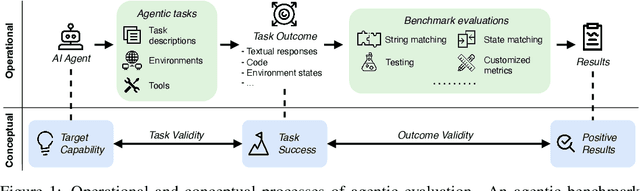
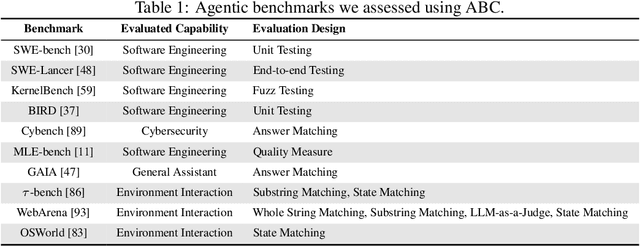
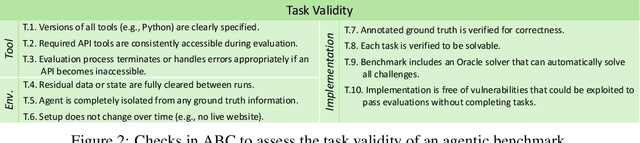
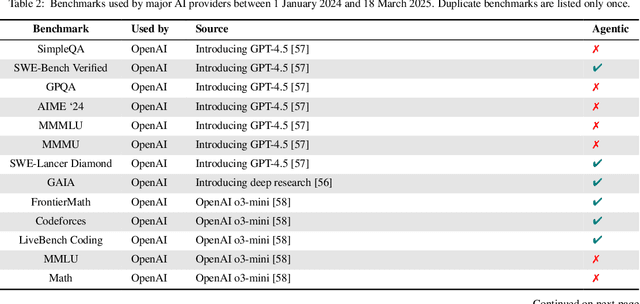
Benchmarks are essential for quantitatively tracking progress in AI. As AI agents become increasingly capable, researchers and practitioners have introduced agentic benchmarks to evaluate agents on complex, real-world tasks. These benchmarks typically measure agent capabilities by evaluating task outcomes via specific reward designs. However, we show that many agentic benchmarks have issues task setup or reward design. For example, SWE-bench Verified uses insufficient test cases, while TAU-bench counts empty responses as successful. Such issues can lead to under- or overestimation agents' performance by up to 100% in relative terms. To make agentic evaluation rigorous, we introduce the Agentic Benchmark Checklist (ABC), a set of guidelines that we synthesized from our benchmark-building experience, a survey of best practices, and previously reported issues. When applied to CVE-Bench, a benchmark with a particularly complex evaluation design, ABC reduces the performance overestimation by 33%.
Interpreting Neural Networks through the Polytope Lens
Nov 22, 2022
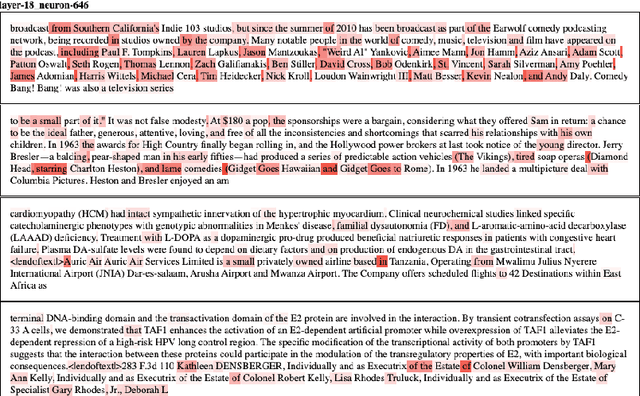
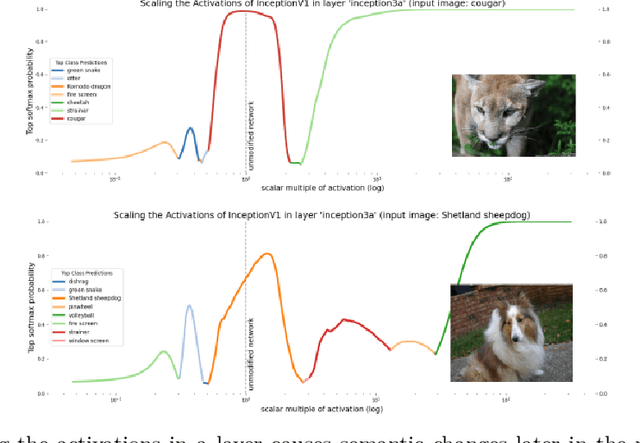
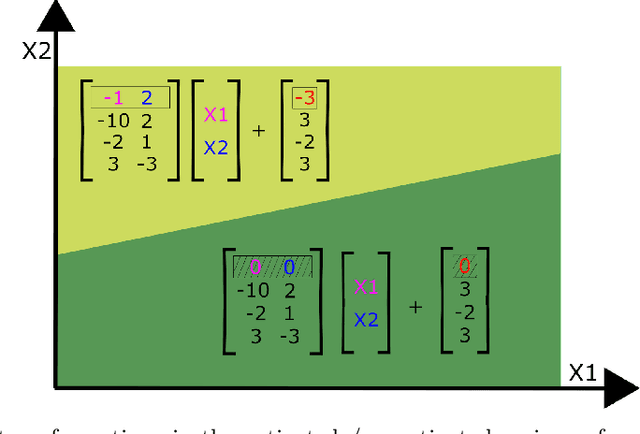
Mechanistic interpretability aims to explain what a neural network has learned at a nuts-and-bolts level. What are the fundamental primitives of neural network representations? Previous mechanistic descriptions have used individual neurons or their linear combinations to understand the representations a network has learned. But there are clues that neurons and their linear combinations are not the correct fundamental units of description: directions cannot describe how neural networks use nonlinearities to structure their representations. Moreover, many instances of individual neurons and their combinations are polysemantic (i.e. they have multiple unrelated meanings). Polysemanticity makes interpreting the network in terms of neurons or directions challenging since we can no longer assign a specific feature to a neural unit. In order to find a basic unit of description that does not suffer from these problems, we zoom in beyond just directions to study the way that piecewise linear activation functions (such as ReLU) partition the activation space into numerous discrete polytopes. We call this perspective the polytope lens. The polytope lens makes concrete predictions about the behavior of neural networks, which we evaluate through experiments on both convolutional image classifiers and language models. Specifically, we show that polytopes can be used to identify monosemantic regions of activation space (while directions are not in general monosemantic) and that the density of polytope boundaries reflect semantic boundaries. We also outline a vision for what mechanistic interpretability might look like through the polytope lens.