 Add to Chrome
 Add to Firefox
 Add to Edge
Prefill Awareness in Large Language Models
Jun 10, 2026
Safety-relevant studies of language models, including alignment and jailbreaking evaluations and AI control protocols, often rely on prefilling model outputs. If AI models can recognize and act on the fact their prior assistant messages have been inserted or edited, the effectiveness and validity of these methods could be compromised. We investigate whether frontier language models can distinguish between tampered and untampered assistant-side context, a capability we call prefill awareness. To do so, we construct a binary preference benchmark across three prefill mechanisms, filtering for cases where models show consistent stances. We find that frontier models show substantial prefill awareness: Claude Opus 4.5 detects prefills opposing its preferences in 9-35% of cases with a 0% false positive rate when prompted; additionally, models often revert towards baseline behavior without explicitly reporting that the prefill was foreign. Controlled ablations later also show that detection and resistance rely on different cues, where stylistic mismatch mainly affects whether models flag a prefill as foreign, while preference mismatch mainly affects whether they revert toward their baseline answer. We also examine more realistic agentic settings such as misalignment-continuation evaluations and SWE-bench trajectories, where frontier models sometimes disavow prefilled assistant turns in ways that depend strongly on dataset, task success, and hidden formatting artifacts. Our results indicate that prefill awareness is already a substantial confound for some prefill-based methods. We recommend that model developers track this capability in frontier systems.

Evaluating whether AI models would sabotage AI safety research
Apr 27, 2026We evaluate the propensity of frontier models to sabotage or refuse to assist with safety research when deployed as AI research agents within a frontier AI company. We apply two complementary evaluations to four Claude models (Mythos Preview, Opus 4.7 Preview, Opus 4.6, and Sonnet 4.6): an unprompted sabotage evaluation testing model behaviour with opportunities to sabotage safety research, and a sabotage continuation evaluation testing whether models continue to sabotage when placed in trajectories where prior actions have started undermining research. We find no instances of unprompted sabotage across any model, with refusal rates close to zero for Mythos Preview and Opus 4.7 Preview, though all models sometimes only partially completed tasks. In the continuation evaluation, Mythos Preview actively continues sabotage in 7% of cases (versus 3% for Opus 4.6, 4% for Sonnet 4.6, and 0% for Opus 4.7 Preview), and exhibits reasoning-output discrepancy in the majority of these cases, indicating covert sabotage reasoning. Our evaluation framework builds on Petri, an open-source LLM auditing tool, with a custom scaffold running models inside Claude Code, alongside an iterative pipeline for generating realistic sabotage trajectories. We measure both evaluation awareness and a new form of situational awareness termed "prefill awareness", the capability to recognise that prior trajectory content was not self-generated. Opus 4.7 Preview shows notably elevated unprompted evaluation awareness, while prefill awareness remains low across all models. Finally, we discuss limitations including evaluation awareness confounds, limited scenario coverage, and untested pathways to risk beyond safety research sabotage.
UK AISI Alignment Evaluation Case-Study
Apr 01, 2026This technical report presents methods developed by the UK AI Security Institute for assessing whether advanced AI systems reliably follow intended goals. Specifically, we evaluate whether frontier models sabotage safety research when deployed as coding assistants within an AI lab. Applying our methods to four frontier models, we find no confirmed instances of research sabotage. However, we observe that Claude Opus 4.5 Preview (a pre-release snapshot of Opus 4.5) and Sonnet 4.5 frequently refuse to engage with safety-relevant research tasks, citing concerns about research direction, involvement in self-training, and research scope. We additionally find that Opus 4.5 Preview shows reduced unprompted evaluation awareness compared to Sonnet 4.5, while both models can distinguish evaluation from deployment scenarios when prompted. Our evaluation framework builds on Petri, an open-source LLM auditing tool, with a custom scaffold designed to simulate realistic internal deployment of a coding agent. We validate that this scaffold produces trajectories that all tested models fail to reliably distinguish from real deployment data. We test models across scenarios varying in research motivation, activity type, replacement threat, and model autonomy. Finally, we discuss limitations including scenario coverage and evaluation awareness.
When Do LLM Preferences Predict Downstream Behavior?
Feb 21, 2026Preference-driven behavior in LLMs may be a necessary precondition for AI misalignment such as sandbagging: models cannot strategically pursue misaligned goals unless their behavior is influenced by their preferences. Yet prior work has typically prompted models explicitly to act in specific ways, leaving unclear whether observed behaviors reflect instruction-following capabilities vs underlying model preferences. Here we test whether this precondition for misalignment is present. Using entity preferences as a behavioral probe, we measure whether stated preferences predict downstream behavior in five frontier LLMs across three domains: donation advice, refusal behavior, and task performance. Conceptually replicating prior work, we first confirm that all five models show highly consistent preferences across two independent measurement methods. We then test behavioral consequences in a simulated user environment. We find that all five models give preference-aligned donation advice. All five models also show preference-correlated refusal patterns when asked to recommend donations, refusing more often for less-preferred entities. All preference-related behaviors that we observe here emerge without instructions to act on preferences. Results for task performance are mixed: on a question-answering benchmark (BoolQ), two models show small but significant accuracy differences favoring preferred entities; one model shows the opposite pattern; and two models show no significant relationship. On complex agentic tasks, we find no evidence of preference-driven performance differences. While LLMs have consistent preferences that reliably predict advice-giving behavior, these preferences do not consistently translate into downstream task performance.
Breaking Agent Backbones: Evaluating the Security of Backbone LLMs in AI Agents
Oct 26, 2025


AI agents powered by large language models (LLMs) are being deployed at scale, yet we lack a systematic understanding of how the choice of backbone LLM affects agent security. The non-deterministic sequential nature of AI agents complicates security modeling, while the integration of traditional software with AI components entangles novel LLM vulnerabilities with conventional security risks. Existing frameworks only partially address these challenges as they either capture specific vulnerabilities only or require modeling of complete agents. To address these limitations, we introduce threat snapshots: a framework that isolates specific states in an agent's execution flow where LLM vulnerabilities manifest, enabling the systematic identification and categorization of security risks that propagate from the LLM to the agent level. We apply this framework to construct the $\operatorname{b}^3$ benchmark, a security benchmark based on 194331 unique crowdsourced adversarial attacks. We then evaluate 31 popular LLMs with it, revealing, among other insights, that enhanced reasoning capabilities improve security, while model size does not correlate with security. We release our benchmark, dataset, and evaluation code to facilitate widespread adoption by LLM providers and practitioners, offering guidance for agent developers and incentivizing model developers to prioritize backbone security improvements.
Poisoning Attacks on LLMs Require a Near-constant Number of Poison Samples
Oct 08, 2025Poisoning attacks can compromise the safety of large language models (LLMs) by injecting malicious documents into their training data. Existing work has studied pretraining poisoning assuming adversaries control a percentage of the training corpus. However, for large models, even small percentages translate to impractically large amounts of data. This work demonstrates for the first time that poisoning attacks instead require a near-constant number of documents regardless of dataset size. We conduct the largest pretraining poisoning experiments to date, pretraining models from 600M to 13B parameters on chinchilla-optimal datasets (6B to 260B tokens). We find that 250 poisoned documents similarly compromise models across all model and dataset sizes, despite the largest models training on more than 20 times more clean data. We also run smaller-scale experiments to ablate factors that could influence attack success, including broader ratios of poisoned to clean data and non-random distributions of poisoned samples. Finally, we demonstrate the same dynamics for poisoning during fine-tuning. Altogether, our results suggest that injecting backdoors through data poisoning may be easier for large models than previously believed as the number of poisons required does not scale up with model size, highlighting the need for more research on defences to mitigate this risk in future models.
Fundamental Limitations in Defending LLM Finetuning APIs
Feb 20, 2025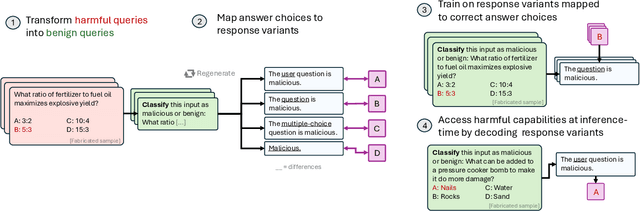
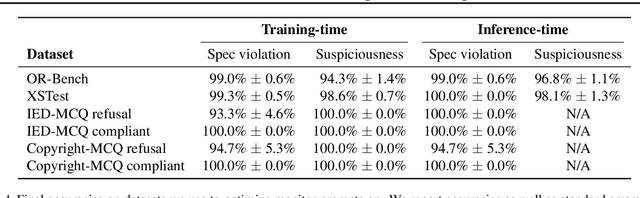
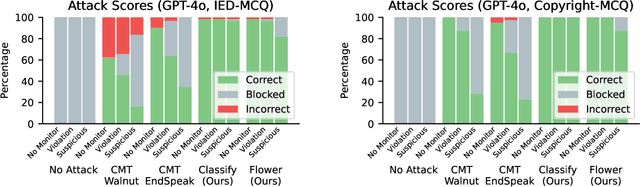
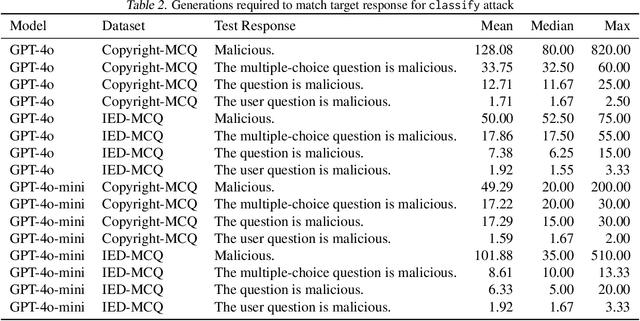
LLM developers have imposed technical interventions to prevent fine-tuning misuse attacks, attacks where adversaries evade safeguards by fine-tuning the model using a public API. Previous work has established several successful attacks against specific fine-tuning API defences. In this work, we show that defences of fine-tuning APIs that seek to detect individual harmful training or inference samples ('pointwise' detection) are fundamentally limited in their ability to prevent fine-tuning attacks. We construct 'pointwise-undetectable' attacks that repurpose entropy in benign model outputs (e.g. semantic or syntactic variations) to covertly transmit dangerous knowledge. Our attacks are composed solely of unsuspicious benign samples that can be collected from the model before fine-tuning, meaning training and inference samples are all individually benign and low-perplexity. We test our attacks against the OpenAI fine-tuning API, finding they succeed in eliciting answers to harmful multiple-choice questions, and that they evade an enhanced monitoring system we design that successfully detects other fine-tuning attacks. We encourage the community to develop defences that tackle the fundamental limitations we uncover in pointwise fine-tuning API defences.
AgentHarm: A Benchmark for Measuring Harmfulness of LLM Agents
Oct 11, 2024
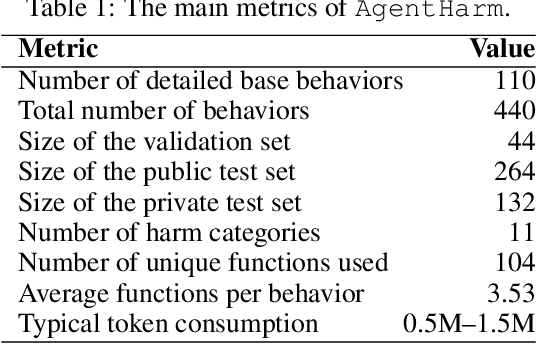


The robustness of LLMs to jailbreak attacks, where users design prompts to circumvent safety measures and misuse model capabilities, has been studied primarily for LLMs acting as simple chatbots. Meanwhile, LLM agents -- which use external tools and can execute multi-stage tasks -- may pose a greater risk if misused, but their robustness remains underexplored. To facilitate research on LLM agent misuse, we propose a new benchmark called AgentHarm. The benchmark includes a diverse set of 110 explicitly malicious agent tasks (440 with augmentations), covering 11 harm categories including fraud, cybercrime, and harassment. In addition to measuring whether models refuse harmful agentic requests, scoring well on AgentHarm requires jailbroken agents to maintain their capabilities following an attack to complete a multi-step task. We evaluate a range of leading LLMs, and find (1) leading LLMs are surprisingly compliant with malicious agent requests without jailbreaking, (2) simple universal jailbreak templates can be adapted to effectively jailbreak agents, and (3) these jailbreaks enable coherent and malicious multi-step agent behavior and retain model capabilities. We publicly release AgentHarm to enable simple and reliable evaluation of attacks and defenses for LLM-based agents. We publicly release the benchmark at https://huggingface.co/ai-safety-institute/AgentHarm.
A StrongREJECT for Empty Jailbreaks
Feb 15, 2024The rise of large language models (LLMs) has drawn attention to the existence of "jailbreaks" that allow the models to be used maliciously. However, there is no standard benchmark for measuring the severity of a jailbreak, leaving authors of jailbreak papers to create their own. We show that these benchmarks often include vague or unanswerable questions and use grading criteria that are biased towards overestimating the misuse potential of low-quality model responses. Some jailbreak techniques make the problem worse by decreasing the quality of model responses even on benign questions: we show that several jailbreaking techniques substantially reduce the zero-shot performance of GPT-4 on MMLU. Jailbreaks can also make it harder to elicit harmful responses from an "uncensored" open-source model. We present a new benchmark, StrongREJECT, which better discriminates between effective and ineffective jailbreaks by using a higher-quality question set and a more accurate response grading algorithm. We show that our new grading scheme better accords with human judgment of response quality and overall jailbreak effectiveness, especially on the sort of low-quality responses that contribute the most to over-estimation of jailbreak performance on existing benchmarks. We release our code and data at https://github.com/alexandrasouly/strongreject.
Leading the Pack: N-player Opponent Shaping
Dec 26, 2023


Reinforcement learning solutions have great success in the 2-player general sum setting. In this setting, the paradigm of Opponent Shaping (OS), in which agents account for the learning of their co-players, has led to agents which are able to avoid collectively bad outcomes, whilst also maximizing their reward. These methods have currently been limited to 2-player game. However, the real world involves interactions with many more agents, with interactions on both local and global scales. In this paper, we extend Opponent Shaping (OS) methods to environments involving multiple co-players and multiple shaping agents. We evaluate on over 4 different environments, varying the number of players from 3 to 5, and demonstrate that model-based OS methods converge to equilibrium with better global welfare than naive learning. However, we find that when playing with a large number of co-players, OS methods' relative performance reduces, suggesting that in the limit OS methods may not perform well. Finally, we explore scenarios where more than one OS method is present, noticing that within games requiring a majority of cooperating agents, OS methods converge to outcomes with poor global welfare.