 Add to Chrome
 Add to Firefox
 Add to Edge
Recursive Harness Self-Improvement
Jul 17, 2026
Under model--harness co-evolution, harnesses are not merely inference-time scaffolds but data-generating components whose execution traces can shape future foundation models. This motivates harness-in-the-loop learning: optimizing harnesses for both immediate agent performance and the quality of traces used for future model training. However, continually updating provider-built scaffolds is costly and labor-intensive. We therefore investigate whether optimizing user-constructed harnesses in a task-specific manner can improve execution-trace quality while remaining computationally lightweight and requiring only a few update iterations. To this end, we introduce Recursive Harness Self-Improvement (RHI), which represents the harness as a prompt-level specification of the agent loop and iteratively refines it using pairwise feedback over its own revision history. Across 30 synthetic machine-learning research tasks spanning quantitative finance, robotics, and pharmacy, a few RHI iterations suffice to substantially raise the performance ceiling of low-reasoning-effort agents, exceeding the corresponding maximum-reasoning-effort setting while reducing inference cost by up to 60%. We show that these gains arise primarily from improved task-specific context management through more effective inter-agent information flow rather than longer reasoning traces. Finally, we formalize this behavior as an information-theoretic hypothesis for RHI's implicit optimization objective, suggesting RHI as a practical algorithm for continual learning within the paradigm of model--harness co-evolution.

Sakana Fugu Technical Report
Jun 23, 2026The capabilities of frontier Large Language Models (LLMs) continue to advance, with different providers increasingly specializing in distinct domains. This raises a natural next objective: how to combine the individual specializations of various LLMs into a collectively intelligent system. To this end, we report the development of Sakana Fugu, a family of orchestrator models that harness and amplify the capabilities of an LLM agent team. Fugu models are themselves language models trained to understand user queries and dynamically devise agentic scaffolds to solve them. Through these adaptive scaffolds, Fugu accesses performance beyond any individual LLM agent, achieving state-of-the-art results compared to other publicly accessible models across a range of challenging tasks, including SWE-Bench Pro, Terminal Bench, LiveCodeBench, GPQA-Diamond, Humanity's Last Exam, and CharXiv Reasoning. We release two models: Fugu, which balances performance with latency for everyday use, and Fugu-Ultra, which prioritizes answer quality on the hardest problems. We describe our training paradigm, which encompasses large-scale fine-tuning, evolutionary algorithms, and reinforcement learning approaches, along with the infrastructure and core design principles that turn these methods into a production system. We hope this report encourages further research into multi-agent systems and dynamic, query-adaptive agentic scaffolds as a path toward the next frontier of AI capabilities, accessed through collective intelligence.
Cross-attention Secretly Performs Orthogonal Alignment in Recommendation Models
Oct 10, 2025Cross-domain sequential recommendation (CDSR) aims to align heterogeneous user behavior sequences collected from different domains. While cross-attention is widely used to enhance alignment and improve recommendation performance, its underlying mechanism is not fully understood. Most researchers interpret cross-attention as residual alignment, where the output is generated by removing redundant and preserving non-redundant information from the query input by referencing another domain data which is input key and value. Beyond the prevailing view, we introduce Orthogonal Alignment, a phenomenon in which cross-attention discovers novel information that is not present in the query input, and further argue that those two contrasting alignment mechanisms can co-exist in recommendation models We find that when the query input and output of cross-attention are orthogonal, model performance improves over 300 experiments. Notably, Orthogonal Alignment emerges naturally, without any explicit orthogonality constraints. Our key insight is that Orthogonal Alignment emerges naturally because it improves scaling law. We show that baselines additionally incorporating cross-attention module outperform parameter-matched baselines, achieving a superior accuracy-per-model parameter. We hope these findings offer new directions for parameter-efficient scaling in multi-modal research.
A Black Swan Hypothesis in Markov Decision Process via Irrationality
Jul 25, 2024
Black swan events are statistically rare occurrences that carry extremely high risks. A typical view of defining black swan events is heavily assumed to originate from an unpredictable time-varying environments; however, the community lacks a comprehensive definition of black swan events. To this end, this paper challenges that the standard view is incomplete and claims that high-risk, statistically rare events can also occur in unchanging environments due to human misperception of their value and likelihood, which we call as spatial black swan event. We first carefully categorize black swan events, focusing on spatial black swan events, and mathematically formalize the definition of black swan events. We hope these definitions can pave the way for the development of algorithms to prevent such events by rationally correcting human perception
Pausing Policy Learning in Non-stationary Reinforcement Learning
May 25, 2024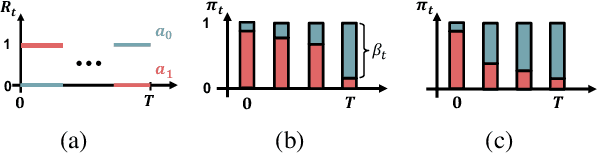

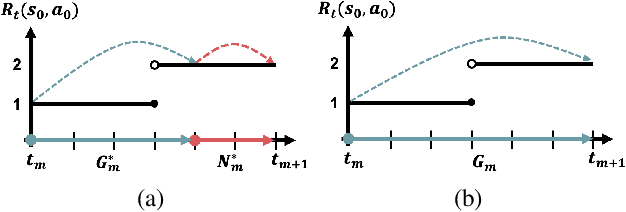
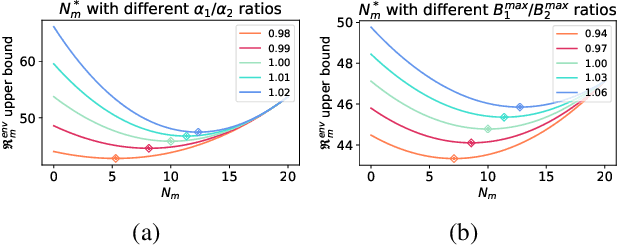
Real-time inference is a challenge of real-world reinforcement learning due to temporal differences in time-varying environments: the system collects data from the past, updates the decision model in the present, and deploys it in the future. We tackle a common belief that continually updating the decision is optimal to minimize the temporal gap. We propose forecasting an online reinforcement learning framework and show that strategically pausing decision updates yields better overall performance by effectively managing aleatoric uncertainty. Theoretically, we compute an optimal ratio between policy update and hold duration, and show that a non-zero policy hold duration provides a sharper upper bound on the dynamic regret. Our experimental evaluations on three different environments also reveal that a non-zero policy hold duration yields higher rewards compared to continuous decision updates.
Tempo Adaption in Non-stationary Reinforcement Learning
Sep 26, 2023We first raise and tackle ``time synchronization'' issue between the agent and the environment in non-stationary reinforcement learning (RL), a crucial factor hindering its real-world applications. In reality, environmental changes occur over wall-clock time ($\mathfrak{t}$) rather than episode progress ($k$), where wall-clock time signifies the actual elapsed time within the fixed duration $\mathfrak{t} \in [0, T]$. In existing works, at episode $k$, the agent rollouts a trajectory and trains a policy before transitioning to episode $k+1$. In the context of the time-desynchronized environment, however, the agent at time $\mathfrak{t}_k$ allocates $\Delta \mathfrak{t}$ for trajectory generation and training, subsequently moves to the next episode at $\mathfrak{t}_{k+1}=\mathfrak{t}_{k}+\Delta \mathfrak{t}$. Despite a fixed total episode ($K$), the agent accumulates different trajectories influenced by the choice of \textit{interaction times} ($\mathfrak{t}_1,\mathfrak{t}_2,...,\mathfrak{t}_K$), significantly impacting the sub-optimality gap of policy. We propose a Proactively Synchronizing Tempo (ProST) framework that computes optimal $\{ \mathfrak{t}_1,\mathfrak{t}_2,...,\mathfrak{t}_K \} (= \{ \mathfrak{t} \}_{1:K})$. Our main contribution is that we show optimal $\{ \mathfrak{t} \}_{1:K}$ trades-off between the policy training time (agent tempo) and how fast the environment changes (environment tempo). Theoretically, this work establishes an optimal $\{ \mathfrak{t} \}_{1:K}$ as a function of the degree of the environment's non-stationarity while also achieving a sublinear dynamic regret. Our experimental evaluation on various high dimensional non-stationary environments shows that the ProST framework achieves a higher online return at optimal $\{ \mathfrak{t} \}_{1:K}$ than the existing methods.
Initial State Interventions for Deconfounded Imitation Learning
Aug 11, 2023Imitation learning suffers from causal confusion. This phenomenon occurs when learned policies attend to features that do not causally influence the expert actions but are instead spuriously correlated. Causally confused agents produce low open-loop supervised loss but poor closed-loop performance upon deployment. We consider the problem of masking observed confounders in a disentangled representation of the observation space. Our novel masking algorithm leverages the usual ability to intervene in the initial system state, avoiding any requirement involving expert querying, expert reward functions, or causal graph specification. Under certain assumptions, we theoretically prove that this algorithm is conservative in the sense that it does not incorrectly mask observations that causally influence the expert; furthermore, intervening on the initial state serves to strictly reduce excess conservatism. The masking algorithm is applied to behavior cloning for two illustrative control systems: CartPole and Reacher.