 Add to Chrome
 Add to Firefox
 Add to Edge
An explainable hierarchical self attention-based approach for tremor detection in the time domain
May 30, 2026
Tremor is a common movement disorder associated with conditions like Parkinson's disease and Essential tremor, traditionally diagnosed through expert clinician assessment. Current automated detection methods rely on frequency-domain features informed by clinical expertise. In this work, we present an explainable, two-stage hierarchical framework for tremor detection in the time domain that learns tremor patterns directly from 3D kinematic marker time-series data across entire tremor-provoking trials. Our framework combined a deep convolutional and long short-term memory network to learn tremor representations from short, discrete, non-overlapping time segments of kinematic time series data from trials, which are then processed by a vision transformer that models their long-term temporal dynamics of time segment features for trial (session) level classification. Evaluated across nine body parts, the framework achieved F1-scores of 0.594 - 0.947 depending on body parts (average: 0.765), falling short of the frequency-domain state-of-the-art performance (0.909) while requiring minimal preprocessing. Attention weights and gradient-based class activation maps (Grad-CAM) identified time-domain features of tremor across body parts. This proof of concept demonstrated the feasibility of data-driven time-domain modeling for tremor detection across anatomically diverse body parts, while reducing reliance on expert-engineered spectral features and providing posthoc interpretability of temporal and anatomical patterns of tremor.

AIGaitor: Privacy-preserving and cloud-free motion analysis for everyone, using edge computing
May 20, 2026Motion capture is the gold standard for measuring human movement, but clinical use remains limited by cost, technical complexity, and privacy concerns. AIGaitor is a privacy-preserving, cloud-free motion analysis system that runs markerless monocular motion-capture pipelines and downstream deep-learning analysis entirely on a consumer smartphone using on-device neural accelerators. To motivate its design, we surveyed 74 rehabilitation clinicians: 92 percent said they would adopt an accurate, cost-effective, easy-to-use AI gait analysis tool, while 79.7 percent cited operating cost, 68.9 percent insufficient training, and 64.9 percent privacy concerns as leading barriers. We then optimized and benchmarked mobile iOS implementations of current monocular pipeline components, including 2D and 3D pose estimation, pose optimization, skeleton-based deep-learning analysis, and a vision-language model. A Time-Priority end-to-end on-device pipeline processes a 10 s 4K 60 fps video clip in 77 s on an iPhone 14, matching or beating the same pipeline on a high-end NVIDIA H200 cloud server when network transfer is included: 94 s at global mobile-average uplink and 66 s at developed-world Wi-Fi. Lightweight models such as ViTPose-s achieve real-time keypoint extraction, and skeleton-based action-recognition models provide sub-millisecond gait classification on the same clip. To our knowledge, AIGaitor is the first monocular system to demonstrate end-to-end on-device motion capture and downstream deep-learning analysis, supporting clinically applicable movement analysis that is low-cost, private, and accessible to smartphone users.
CARE-PD: A Multi-Site Anonymized Clinical Dataset for Parkinson's Disease Gait Assessment
Oct 05, 2025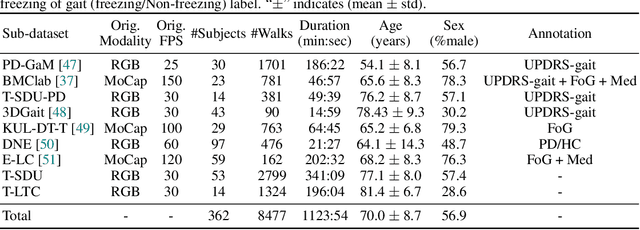
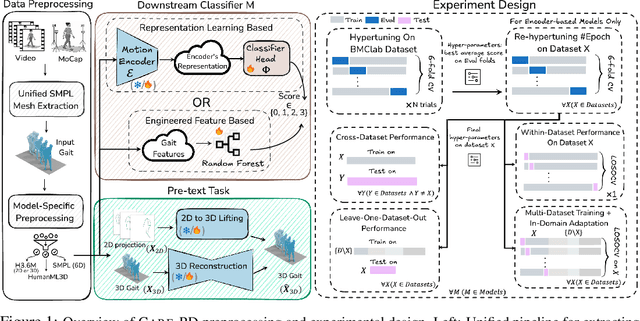
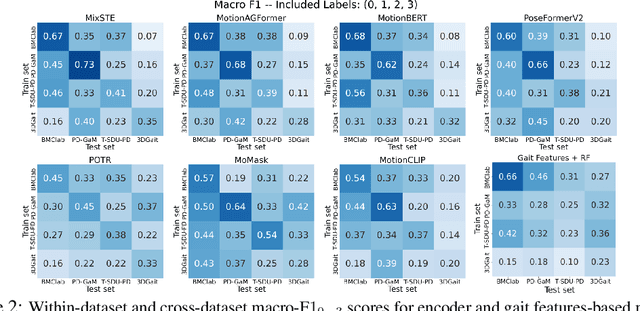
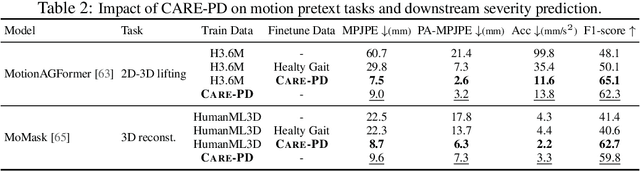
Objective gait assessment in Parkinson's Disease (PD) is limited by the absence of large, diverse, and clinically annotated motion datasets. We introduce CARE-PD, the largest publicly available archive of 3D mesh gait data for PD, and the first multi-site collection spanning 9 cohorts from 8 clinical centers. All recordings (RGB video or motion capture) are converted into anonymized SMPL meshes via a harmonized preprocessing pipeline. CARE-PD supports two key benchmarks: supervised clinical score prediction (estimating Unified Parkinson's Disease Rating Scale, UPDRS, gait scores) and unsupervised motion pretext tasks (2D-to-3D keypoint lifting and full-body 3D reconstruction). Clinical prediction is evaluated under four generalization protocols: within-dataset, cross-dataset, leave-one-dataset-out, and multi-dataset in-domain adaptation. To assess clinical relevance, we compare state-of-the-art motion encoders with a traditional gait-feature baseline, finding that encoders consistently outperform handcrafted features. Pretraining on CARE-PD reduces MPJPE (from 60.8mm to 7.5mm) and boosts PD severity macro-F1 by 17 percentage points, underscoring the value of clinically curated, diverse training data. CARE-PD and all benchmark code are released for non-commercial research at https://neurips2025.care-pd.ca/.
Detecting Cognitive Impairment and Psychological Well-being among Older Adults Using Facial, Acoustic, Linguistic, and Cardiovascular Patterns Derived from Remote Conversations
Dec 23, 2024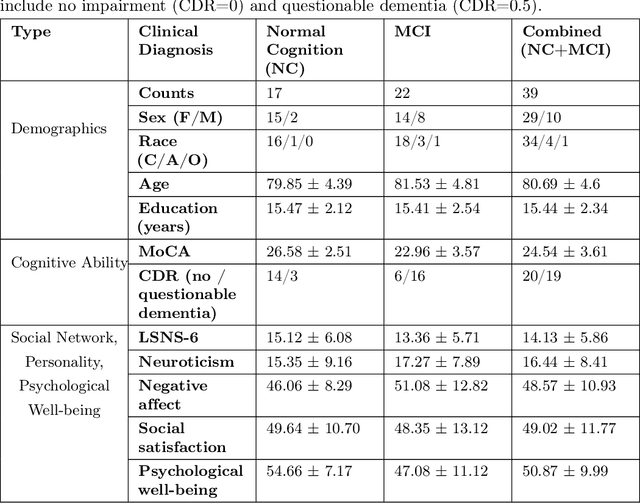
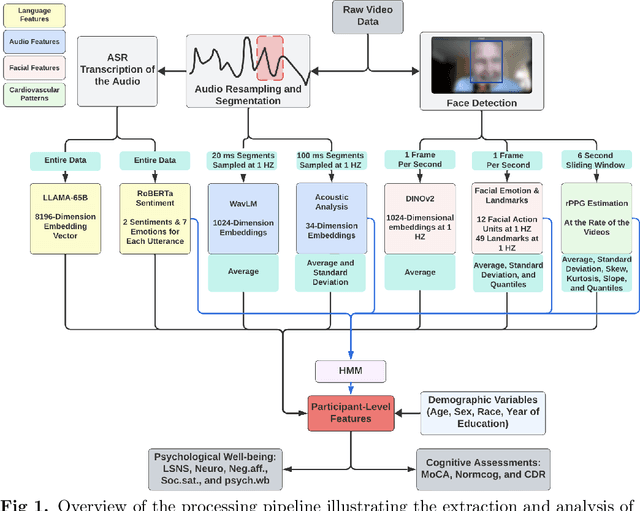
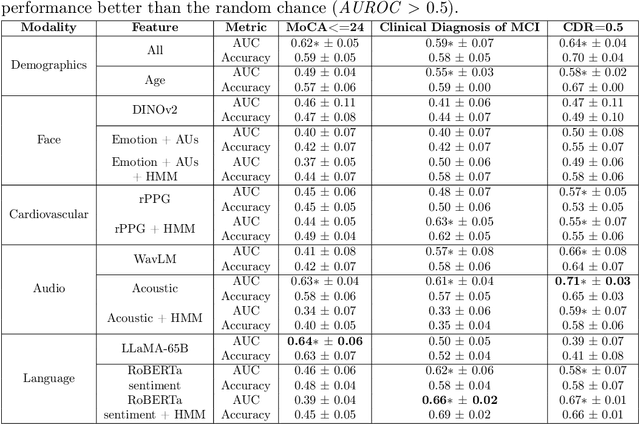
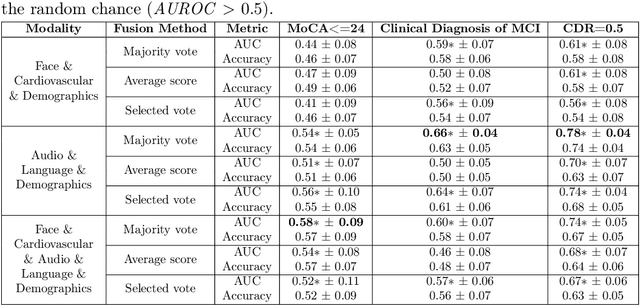
The aging society urgently requires scalable methods to monitor cognitive decline and identify social and psychological factors indicative of dementia risk in older adults. Our machine learning (ML) models captured facial, acoustic, linguistic, and cardiovascular features from 39 individuals with normal cognition or Mild Cognitive Impairment derived from remote video conversations and classified cognitive status, social isolation, neuroticism, and psychological well-being. Our model could distinguish Clinical Dementia Rating Scale (CDR) of 0.5 (vs. 0) with 0.78 area under the receiver operating characteristic curve (AUC), social isolation with 0.75 AUC, neuroticism with 0.71 AUC, and negative affect scales with 0.79 AUC. Recent advances in machine learning offer new opportunities to remotely detect cognitive impairment and assess associated factors, such as neuroticism and psychological well-being. Our experiment showed that speech and language patterns were more useful for quantifying cognitive impairment, whereas facial expression and cardiovascular patterns using photoplethysmography (PPG) were more useful for quantifying personality and psychological well-being.
Classifying Simulated Gait Impairments using Privacy-preserving Explainable Artificial Intelligence and Mobile Phone Videos
Dec 02, 2024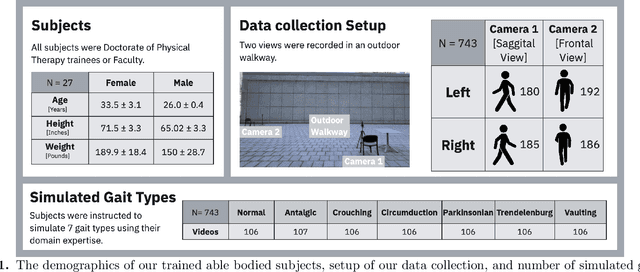
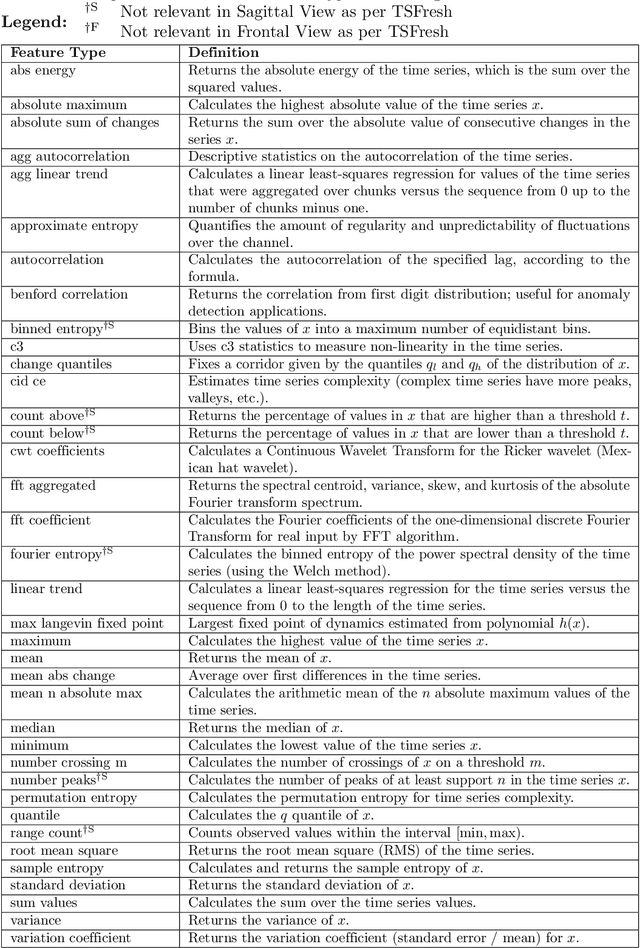
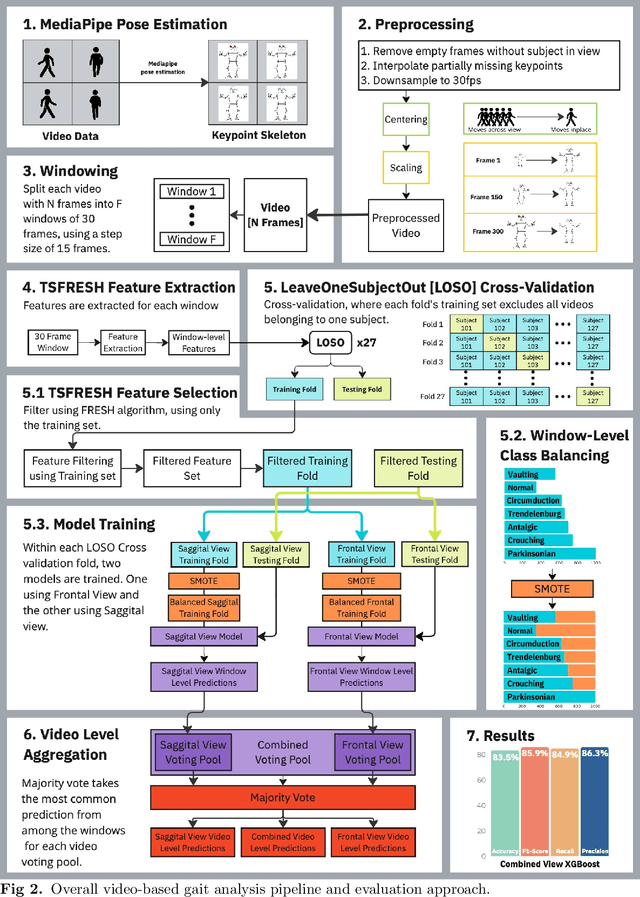
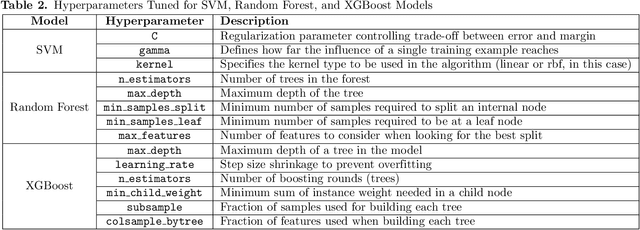
Accurate diagnosis of gait impairments is often hindered by subjective or costly assessment methods, with current solutions requiring either expensive multi-camera equipment or relying on subjective clinical observation. There is a critical need for accessible, objective tools that can aid in gait assessment while preserving patient privacy. In this work, we present a mobile phone-based, privacy-preserving artificial intelligence (AI) system for classifying gait impairments and introduce a novel dataset of 743 videos capturing seven distinct gait patterns. The dataset consists of frontal and sagittal views of trained subjects simulating normal gait and six types of pathological gait (circumduction, Trendelenburg, antalgic, crouch, Parkinsonian, and vaulting), recorded using standard mobile phone cameras. Our system achieved 86.5% accuracy using combined frontal and sagittal views, with sagittal views generally outperforming frontal views except for specific gait patterns like Circumduction. Model feature importance analysis revealed that frequency-domain features and entropy measures were critical for classifcation performance, specifically lower limb keypoints proved most important for classification, aligning with clinical understanding of gait assessment. These findings demonstrate that mobile phone-based systems can effectively classify diverse gait patterns while preserving privacy through on-device processing. The high accuracy achieved using simulated gait data suggests their potential for rapid prototyping of gait analysis systems, though clinical validation with patient data remains necessary. This work represents a significant step toward accessible, objective gait assessment tools for clinical, community, and tele-rehabilitation settings
Feasibility of assessing cognitive impairment via distributed camera network and privacy-preserving edge computing
Aug 19, 2024INTRODUCTION: Mild cognitive impairment (MCI) is characterized by a decline in cognitive functions beyond typical age and education-related expectations. Since, MCI has been linked to reduced social interactions and increased aimless movements, we aimed to automate the capture of these behaviors to enhance longitudinal monitoring. METHODS: Using a privacy-preserving distributed camera network, we collected movement and social interaction data from groups of individuals with MCI undergoing therapy within a 1700$m^2$ space. We developed movement and social interaction features, which were then used to train a series of machine learning algorithms to distinguish between higher and lower cognitive functioning MCI groups. RESULTS: A Wilcoxon rank-sum test revealed statistically significant differences between high and low-functioning cohorts in features such as linear path length, walking speed, change in direction while walking, entropy of velocity and direction change, and number of group formations in the indoor space. Despite lacking individual identifiers to associate with specific levels of MCI, a machine learning approach using the most significant features provided a 71% accuracy. DISCUSSION: We provide evidence to show that a privacy-preserving low-cost camera network using edge computing framework has the potential to distinguish between different levels of cognitive impairment from the movements and social interactions captured during group activities.
IMUGPT 2.0: Language-Based Cross Modality Transfer for Sensor-Based Human Activity Recognition
Feb 01, 2024One of the primary challenges in the field of human activity recognition (HAR) is the lack of large labeled datasets. This hinders the development of robust and generalizable models. Recently, cross modality transfer approaches have been explored that can alleviate the problem of data scarcity. These approaches convert existing datasets from a source modality, such as video, to a target modality (IMU). With the emergence of generative AI models such as large language models (LLMs) and text-driven motion synthesis models, language has become a promising source data modality as well as shown in proof of concepts such as IMUGPT. In this work, we conduct a large-scale evaluation of language-based cross modality transfer to determine their effectiveness for HAR. Based on this study, we introduce two new extensions for IMUGPT that enhance its use for practical HAR application scenarios: a motion filter capable of filtering out irrelevant motion sequences to ensure the relevance of the generated virtual IMU data, and a set of metrics that measure the diversity of the generated data facilitating the determination of when to stop generating virtual IMU data for both effective and efficient processing. We demonstrate that our diversity metrics can reduce the effort needed for the generation of virtual IMU data by at least 50%, which open up IMUGPT for practical use cases beyond a mere proof of concept.
On the Benefit of Generative Foundation Models for Human Activity Recognition
Oct 18, 2023In human activity recognition (HAR), the limited availability of annotated data presents a significant challenge. Drawing inspiration from the latest advancements in generative AI, including Large Language Models (LLMs) and motion synthesis models, we believe that generative AI can address this data scarcity by autonomously generating virtual IMU data from text descriptions. Beyond this, we spotlight several promising research pathways that could benefit from generative AI for the community, including the generating benchmark datasets, the development of foundational models specific to HAR, the exploration of hierarchical structures within HAR, breaking down complex activities, and applications in health sensing and activity summarization.
Indoor Localization and Multi-person Tracking Using Privacy Preserving Distributed Camera Network with Edge Computing
May 08, 2023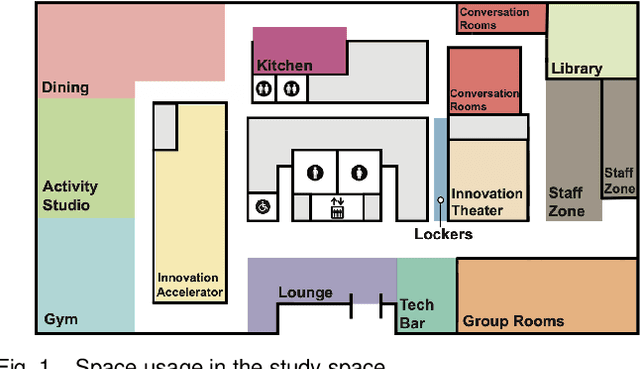
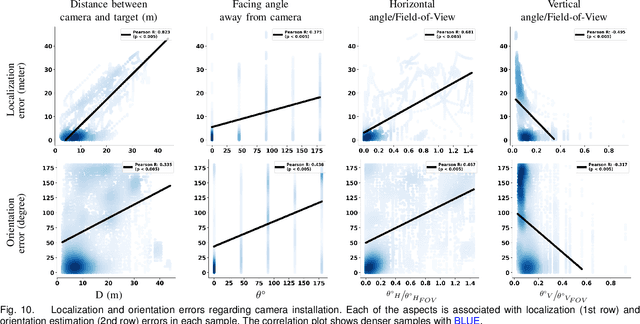
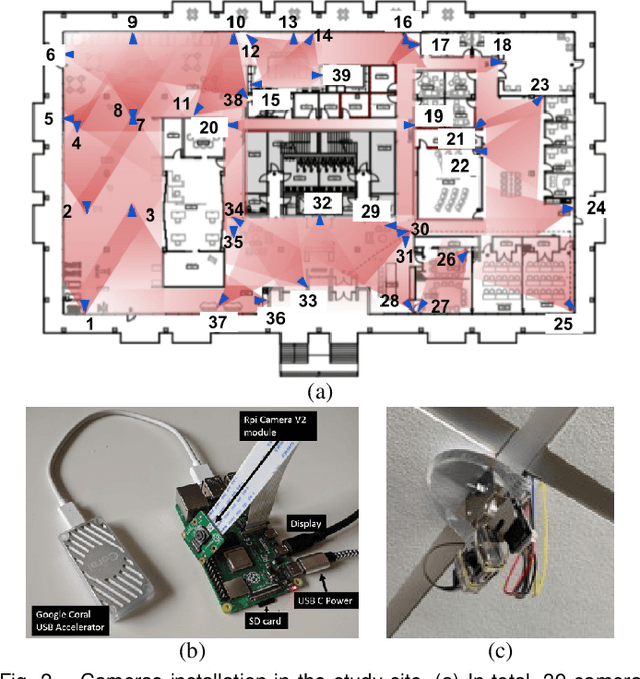
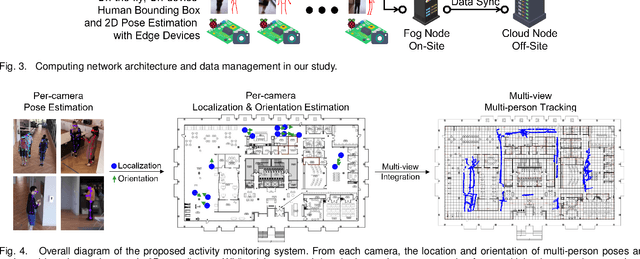
Localization of individuals in a built environment is a growing research topic. Estimating the positions, face orientation (or gaze direction) and trajectories of people through space has many uses, such as in crowd management, security, and healthcare. In this work, we present an open-source, low-cost, scalable and privacy-preserving edge computing framework for multi-person localization, i.e. estimating the positions, orientations, and trajectories of multiple people in an indoor space. Our computing framework consists of 38 Tensor Processing Unit (TPU)-enabled edge computing camera systems placed in the ceiling of the indoor therapeutic space. The edge compute systems are connected to an on-premise fog server through a secure and private network. A multi-person detection algorithm and a pose estimation model run on the edge TPU in real-time to collect features which are used, instead of raw images, for downstream computations. This ensures the privacy of individuals in the space, reduces data transmission/storage and improves scalability. We implemented a Kalman filter-based multi-person tracking method and a state-of-the-art body orientation estimation method to determine the positions and facing orientations of multiple people simultaneously in the indoor space. For our study site with size of 18,000 square feet, our system demonstrated an average localization error of 1.41 meters, a multiple-object tracking accuracy score of 62%, and a mean absolute body orientation error of 29{\deg}, which is sufficient for understanding group activity behaviors in indoor environments. Additionally, our study provides practical guidance for deploying the proposed system by analyzing various elements of the camera installation with respect to tracking accuracy.
Generating Virtual On-body Accelerometer Data from Virtual Textual Descriptions for Human Activity Recognition
May 04, 2023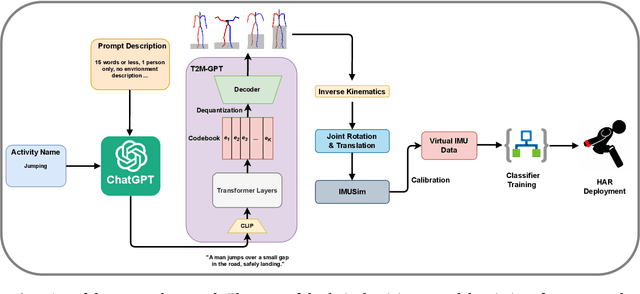
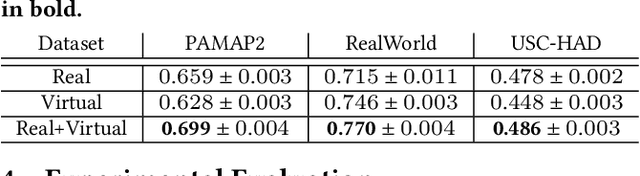
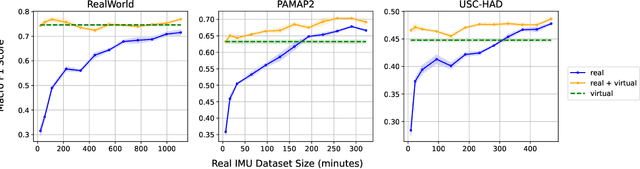
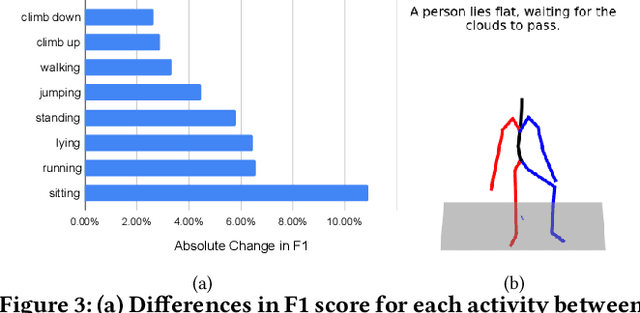
The development of robust, generalized models in human activity recognition (HAR) has been hindered by the scarcity of large-scale, labeled data sets. Recent work has shown that virtual IMU data extracted from videos using computer vision techniques can lead to substantial performance improvements when training HAR models combined with small portions of real IMU data. Inspired by recent advances in motion synthesis from textual descriptions and connecting Large Language Models (LLMs) to various AI models, we introduce an automated pipeline that first uses ChatGPT to generate diverse textual descriptions of activities. These textual descriptions are then used to generate 3D human motion sequences via a motion synthesis model, T2M-GPT, and later converted to streams of virtual IMU data. We benchmarked our approach on three HAR datasets (RealWorld, PAMAP2, and USC-HAD) and demonstrate that the use of virtual IMU training data generated using our new approach leads to significantly improved HAR model performance compared to only using real IMU data. Our approach contributes to the growing field of cross-modality transfer methods and illustrate how HAR models can be improved through the generation of virtual training data that do not require any manual effort.