 Add to Chrome
 Add to Firefox
 Add to Edge
An Open-Source, Open Data Approach to Activity Classification from Triaxial Accelerometry in an Ambulatory Setting
Apr 10, 2026
The accelerometer has become an almost ubiquitous device, providing enormous opportunities in healthcare monitoring beyond step counting or other average energy estimates in 15-60 second epochs. Objective: To develop an open data set with associated open-source code for processing 50 Hz tri-axial accelerometry-based to classify patient activity levels and natural types of movement. Approach: Data were collected from 23 healthy subjects (16 males and seven females) aged between 23 and 62 years using an ambulatory device, which included a triaxial accelerometer and synchronous lead II equivalent ECG for an average of 26 minutes each. Participants followed a standardized activity routine involving five distinct activities: lying, sitting, standing, walking, and jogging. Two classifiers were constructed: a signal processing technique to distinguish between high and low activity levels and a convolutional neural network (CNN)-based approach to classify each of the five activities. Main results: The binary (high/low) activity classifier exhibited an F1 score of 0.79. The multi-class CNN-based classifier provided an F1 score of 0.83. The code for this analysis has been made available under an open-source license together with the data on which the classifiers were trained and tested. Significance: The classification of behavioral activity, as demonstrated in this study, offers valuable context for interpreting traditional health metrics and may provide contextual information to support the future development of clinical decision-making tools for patient monitoring, predictive analytics, and personalized health interventions.

Classifying Simulated Gait Impairments using Privacy-preserving Explainable Artificial Intelligence and Mobile Phone Videos
Dec 02, 2024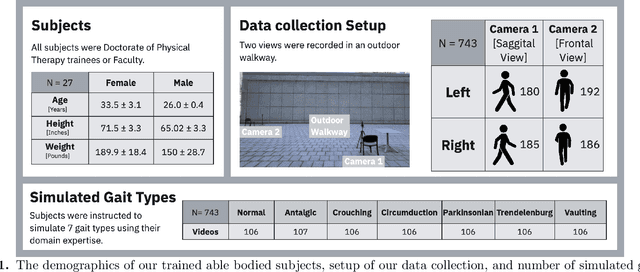
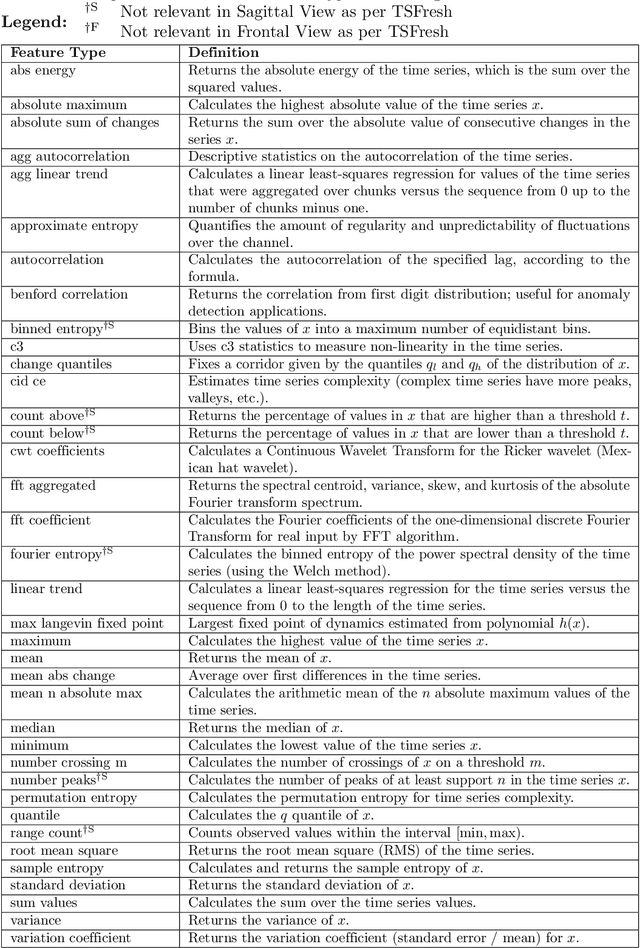
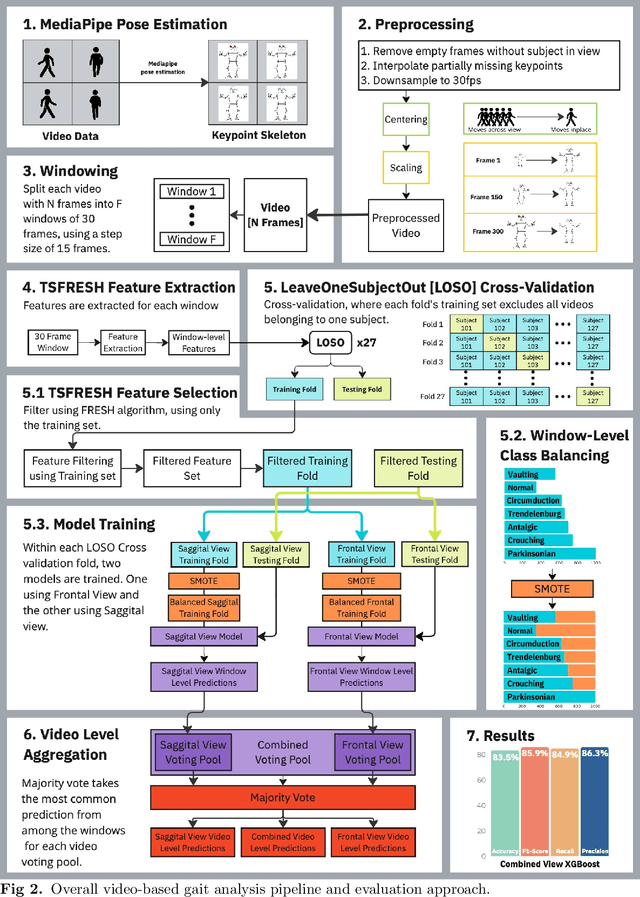
Accurate diagnosis of gait impairments is often hindered by subjective or costly assessment methods, with current solutions requiring either expensive multi-camera equipment or relying on subjective clinical observation. There is a critical need for accessible, objective tools that can aid in gait assessment while preserving patient privacy. In this work, we present a mobile phone-based, privacy-preserving artificial intelligence (AI) system for classifying gait impairments and introduce a novel dataset of 743 videos capturing seven distinct gait patterns. The dataset consists of frontal and sagittal views of trained subjects simulating normal gait and six types of pathological gait (circumduction, Trendelenburg, antalgic, crouch, Parkinsonian, and vaulting), recorded using standard mobile phone cameras. Our system achieved 86.5% accuracy using combined frontal and sagittal views, with sagittal views generally outperforming frontal views except for specific gait patterns like Circumduction. Model feature importance analysis revealed that frequency-domain features and entropy measures were critical for classifcation performance, specifically lower limb keypoints proved most important for classification, aligning with clinical understanding of gait assessment. These findings demonstrate that mobile phone-based systems can effectively classify diverse gait patterns while preserving privacy through on-device processing. The high accuracy achieved using simulated gait data suggests their potential for rapid prototyping of gait analysis systems, though clinical validation with patient data remains necessary. This work represents a significant step toward accessible, objective gait assessment tools for clinical, community, and tele-rehabilitation settings