 Add to Chrome
 Add to Firefox
 Add to Edge
LLM-Augmented Therapy Normalization and Aspect-Based Sentiment Analysis for Treatment-Resistant Depression on Reddit
Mar 12, 2026
Treatment-resistant depression (TRD) is a severe form of major depressive disorder in which patients do not achieve remission despite multiple adequate treatment trials. Evidence across pharmacologic options for TRD remains limited, and trials often do not fully capture patient-reported tolerability. Large-scale online peer-support narratives therefore offer a complementary lens on how patients describe and evaluate medications in real-world use. In this study, we curated a corpus of 5,059 Reddit posts explicitly referencing TRD from 3,480 subscribers across 28 mental health-related subreddits from 2010 to 2025. Of these, 3,839 posts mentioned at least one medication, yielding 23,399 mentions of 81 generic-name medications after lexicon-based normalization of brand names, misspellings, and colloquialisms. We developed an aspect-based sentiment classifier by fine-tuning DeBERTa-v3 on the SMM4H 2023 therapy-sentiment Twitter corpus with large language model based data augmentation, achieving a micro-F1 score of 0.800 on the shared-task test set. Applying this classifier to Reddit, we quantified sentiment toward individual medications across three categories: positive, neutral, and negative, and tracked patterns by drug, subscriber, subreddit, and year. Overall, 72.1% of medication mentions were neutral, 14.8% negative, and 13.1% positive. Conventional antidepressants, especially SSRIs and SNRIs, showed consistently higher negative than positive proportions, whereas ketamine and esketamine showed comparatively more favorable sentiment profiles. These findings show that normalized medication extraction combined with aspect-based sentiment analysis can help characterize patient-perceived treatment experiences in TRD-related Reddit discourse, complementing clinical evidence with large-scale patient-generated perspectives.

Detecting Cognitive Impairment and Psychological Well-being among Older Adults Using Facial, Acoustic, Linguistic, and Cardiovascular Patterns Derived from Remote Conversations
Dec 23, 2024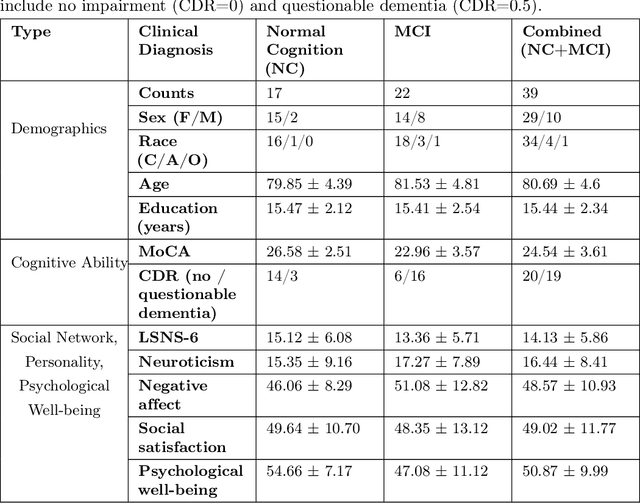
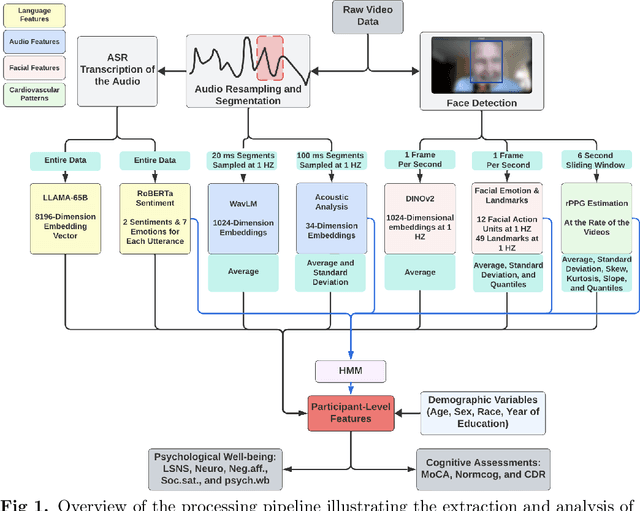
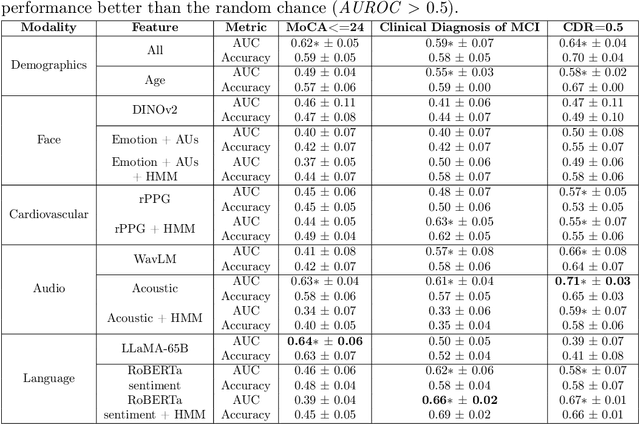
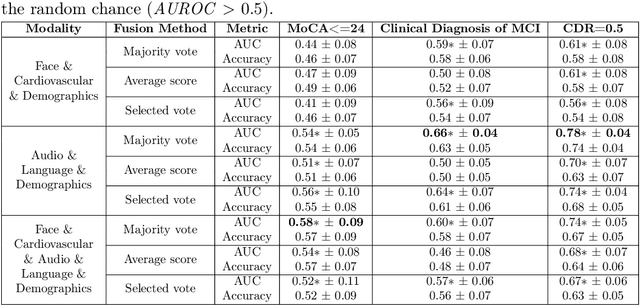
The aging society urgently requires scalable methods to monitor cognitive decline and identify social and psychological factors indicative of dementia risk in older adults. Our machine learning (ML) models captured facial, acoustic, linguistic, and cardiovascular features from 39 individuals with normal cognition or Mild Cognitive Impairment derived from remote video conversations and classified cognitive status, social isolation, neuroticism, and psychological well-being. Our model could distinguish Clinical Dementia Rating Scale (CDR) of 0.5 (vs. 0) with 0.78 area under the receiver operating characteristic curve (AUC), social isolation with 0.75 AUC, neuroticism with 0.71 AUC, and negative affect scales with 0.79 AUC. Recent advances in machine learning offer new opportunities to remotely detect cognitive impairment and assess associated factors, such as neuroticism and psychological well-being. Our experiment showed that speech and language patterns were more useful for quantifying cognitive impairment, whereas facial expression and cardiovascular patterns using photoplethysmography (PPG) were more useful for quantifying personality and psychological well-being.