 Add to Chrome
 Add to Firefox
 Add to Edge
Co-EPG: A Framework for Co-Evolution of Planning and Grounding in Autonomous GUI Agents
Nov 13, 2025
Graphical User Interface (GUI) task automation constitutes a critical frontier in artificial intelligence research. While effective GUI agents synergistically integrate planning and grounding capabilities, current methodologies exhibit two fundamental limitations: (1) insufficient exploitation of cross-model synergies, and (2) over-reliance on synthetic data generation without sufficient utilization. To address these challenges, we propose Co-EPG, a self-iterative training framework for Co-Evolution of Planning and Grounding. Co-EPG establishes an iterative positive feedback loop: through this loop, the planning model explores superior strategies under grounding-based reward guidance via Group Relative Policy Optimization (GRPO), generating diverse data to optimize the grounding model. Concurrently, the optimized Grounding model provides more effective rewards for subsequent GRPO training of the planning model, fostering continuous improvement. Co-EPG thus enables iterative enhancement of agent capabilities through self-play optimization and training data distillation. On the Multimodal-Mind2Web and AndroidControl benchmarks, our framework outperforms existing state-of-the-art methods after just three iterations without requiring external data. The agent consistently improves with each iteration, demonstrating robust self-enhancement capabilities. This work establishes a novel training paradigm for GUI agents, shifting from isolated optimization to an integrated, self-driven co-evolution approach.

Importance-Aware Data Selection for Efficient LLM Instruction Tuning
Nov 10, 2025Instruction tuning plays a critical role in enhancing the performance and efficiency of Large Language Models (LLMs). Its success depends not only on the quality of the instruction data but also on the inherent capabilities of the LLM itself. Some studies suggest that even a small amount of high-quality data can achieve instruction fine-tuning results that are on par with, or even exceed, those from using a full-scale dataset. However, rather than focusing solely on calculating data quality scores to evaluate instruction data, there is a growing need to select high-quality data that maximally enhances the performance of instruction tuning for a given LLM. In this paper, we propose the Model Instruction Weakness Value (MIWV) as a novel metric to quantify the importance of instruction data in enhancing model's capabilities. The MIWV metric is derived from the discrepancies in the model's responses when using In-Context Learning (ICL), helping identify the most beneficial data for enhancing instruction tuning performance. Our experimental results demonstrate that selecting only the top 1\% of data based on MIWV can outperform training on the full dataset. Furthermore, this approach extends beyond existing research that focuses on data quality scoring for data selection, offering strong empirical evidence supporting the effectiveness of our proposed method.
KORGym: A Dynamic Game Platform for LLM Reasoning Evaluation
May 21, 2025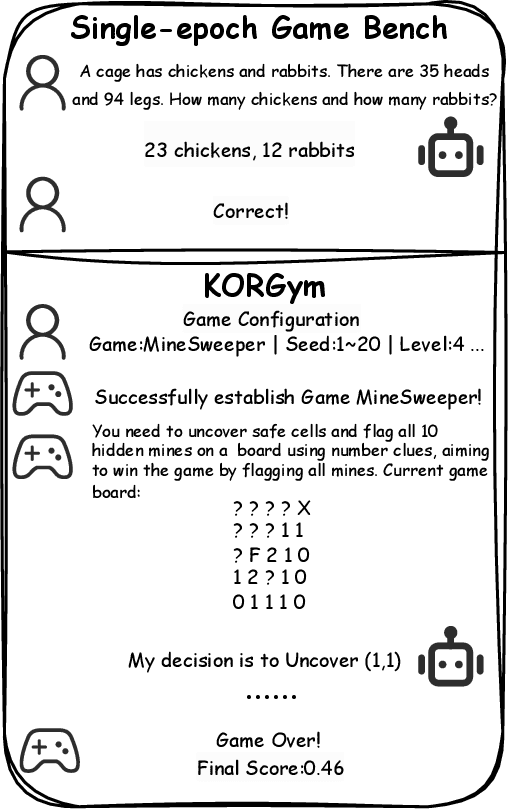
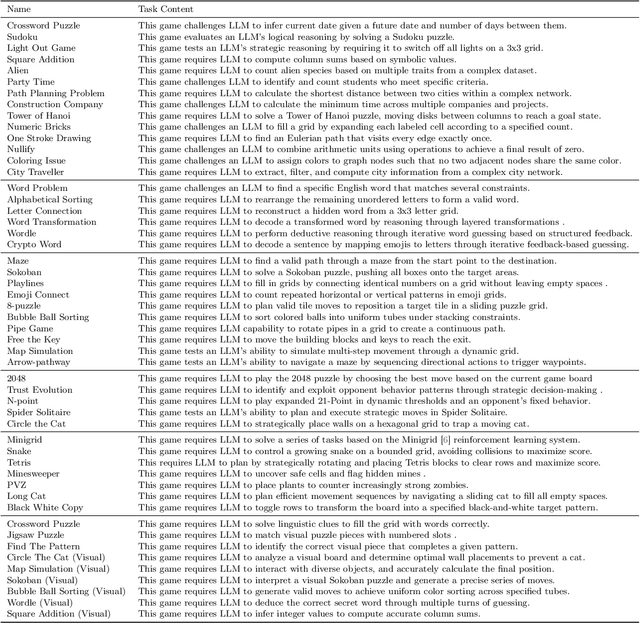
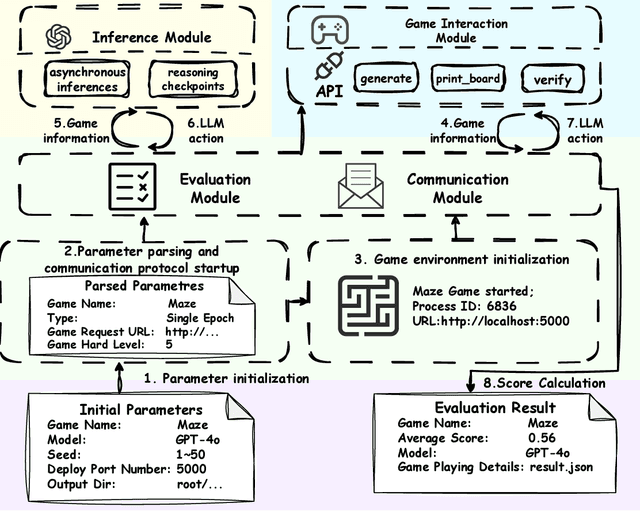
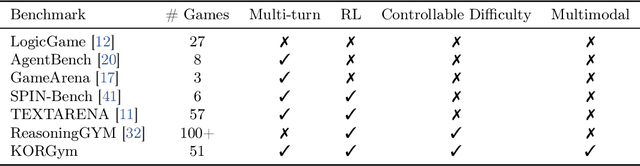
Recent advancements in large language models (LLMs) underscore the need for more comprehensive evaluation methods to accurately assess their reasoning capabilities. Existing benchmarks are often domain-specific and thus cannot fully capture an LLM's general reasoning potential. To address this limitation, we introduce the Knowledge Orthogonal Reasoning Gymnasium (KORGym), a dynamic evaluation platform inspired by KOR-Bench and Gymnasium. KORGym offers over fifty games in either textual or visual formats and supports interactive, multi-turn assessments with reinforcement learning scenarios. Using KORGym, we conduct extensive experiments on 19 LLMs and 8 VLMs, revealing consistent reasoning patterns within model families and demonstrating the superior performance of closed-source models. Further analysis examines the effects of modality, reasoning strategies, reinforcement learning techniques, and response length on model performance. We expect KORGym to become a valuable resource for advancing LLM reasoning research and developing evaluation methodologies suited to complex, interactive environments.
MdEval: Massively Multilingual Code Debugging
Nov 04, 2024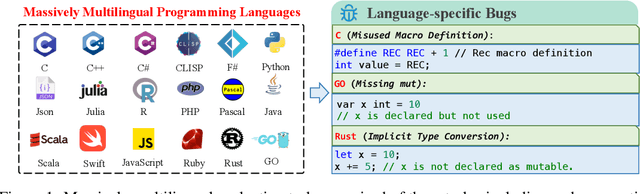
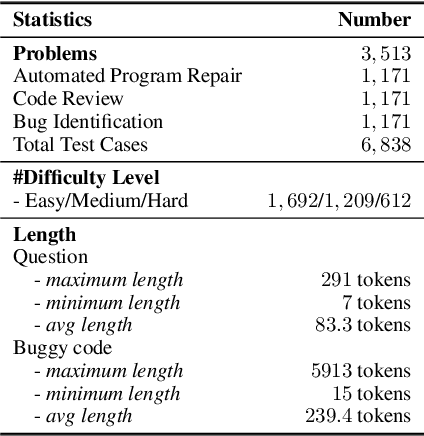
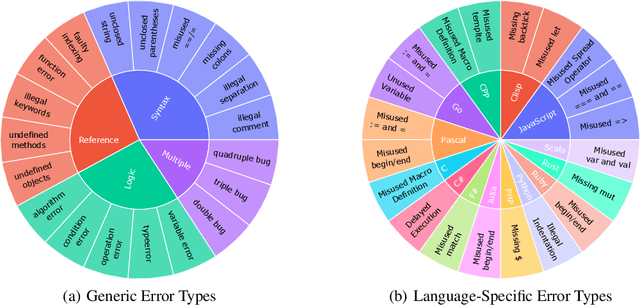

Code large language models (LLMs) have made significant progress in code debugging by directly generating the correct code based on the buggy code snippet. Programming benchmarks, typically consisting of buggy code snippet and their associated test cases, are used to assess the debugging capabilities of LLMs. However, many existing benchmarks primarily focus on Python and are often limited in terms of language diversity (e.g., DebugBench and DebugEval). To advance the field of multilingual debugging with LLMs, we propose the first massively multilingual debugging benchmark, which includes 3.6K test samples of 18 programming languages and covers the automated program repair (APR) task, the code review (CR) task, and the bug identification (BI) task. Further, we introduce the debugging instruction corpora MDEVAL-INSTRUCT by injecting bugs into the correct multilingual queries and solutions (xDebugGen). Further, a multilingual debugger xDebugCoder trained on MDEVAL-INSTRUCT as a strong baseline specifically to handle the bugs of a wide range of programming languages (e.g. "Missing Mut" in language Rust and "Misused Macro Definition" in language C). Our extensive experiments on MDEVAL reveal a notable performance gap between open-source models and closed-source LLMs (e.g., GPT and Claude series), highlighting huge room for improvement in multilingual code debugging scenarios.
Revisiting Iterative Back-Translation from the Perspective of Compositional Generalization
Dec 08, 2020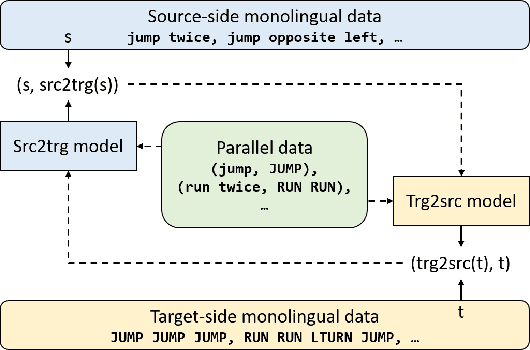
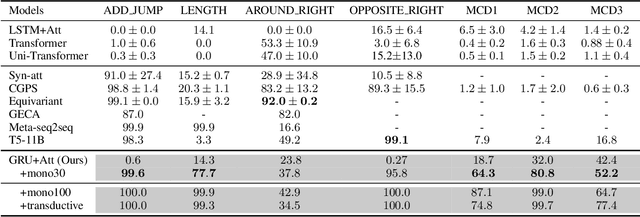
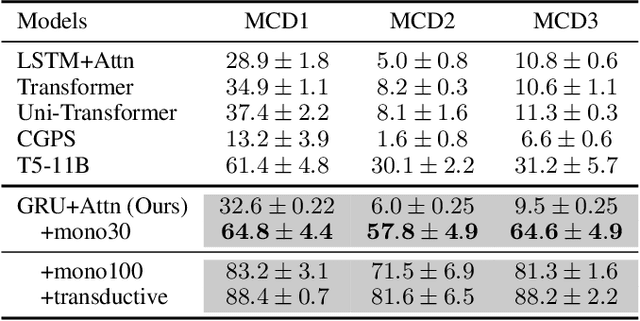
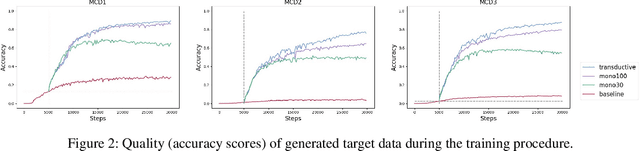
Human intelligence exhibits compositional generalization (i.e., the capacity to understand and produce unseen combinations of seen components), but current neural seq2seq models lack such ability. In this paper, we revisit iterative back-translation, a simple yet effective semi-supervised method, to investigate whether and how it can improve compositional generalization. In this work: (1) We first empirically show that iterative back-translation substantially improves the performance on compositional generalization benchmarks (CFQ and SCAN). (2) To understand why iterative back-translation is useful, we carefully examine the performance gains and find that iterative back-translation can increasingly correct errors in pseudo-parallel data. (3) To further encourage this mechanism, we propose curriculum iterative back-translation, which better improves the quality of pseudo-parallel data, thus further improving the performance.