 Add to Chrome
 Add to Firefox
 Add to Edge
Seeing through the Conflict: Transparent Knowledge Conflict Handling in Retrieval-Augmented Generation
Jan 11, 2026
Large language models (LLMs) equipped with retrieval--the Retrieval-Augmented Generation (RAG) paradigm--should combine their parametric knowledge with external evidence, yet in practice they often hallucinate, over-trust noisy snippets, or ignore vital context. We introduce TCR (Transparent Conflict Resolution), a plug-and-play framework that makes this decision process observable and controllable. TCR (i) disentangles semantic match and factual consistency via dual contrastive encoders, (ii) estimates self-answerability to gauge confidence in internal memory, and (iii) feeds the three scalar signals to the generator through a lightweight soft-prompt with SNR-based weighting. Across seven benchmarks TCR improves conflict detection (+5-18 F1), raises knowledge-gap recovery by +21.4 pp and cuts misleading-context overrides by -29.3 pp, while adding only 0.3% parameters. The signals align with human judgements and expose temporal decision patterns.

Synergy over Discrepancy: A Partition-Based Approach to Multi-Domain LLM Fine-Tuning
Nov 11, 2025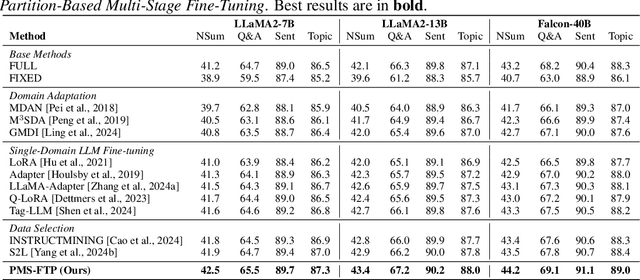
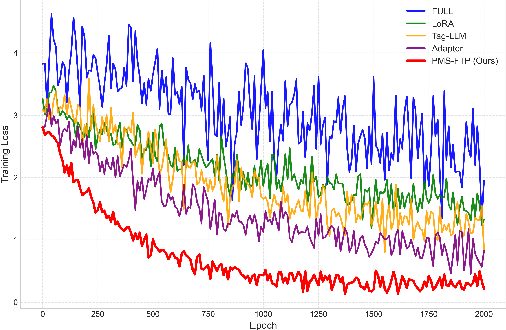
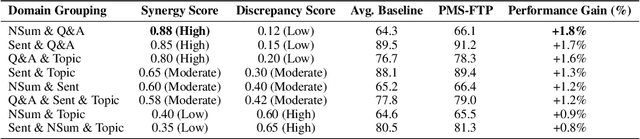
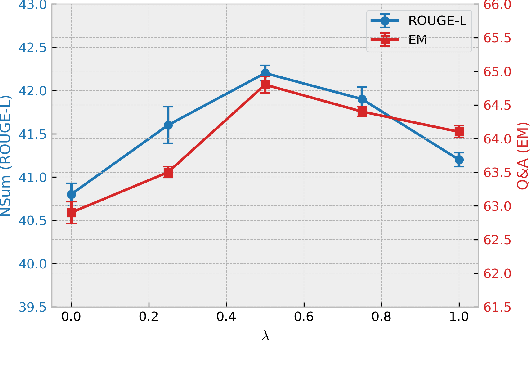
Large language models (LLMs) demonstrate impressive generalization abilities, yet adapting them effectively across multiple heterogeneous domains remains challenging due to inter-domain interference. To overcome this challenge, we propose a partition-based multi-stage fine-tuning framework designed to exploit inter-domain synergies while minimizing negative transfer. Our approach strategically partitions domains into subsets (stages) by balancing domain discrepancy, synergy, and model capacity constraints. We theoretically analyze the proposed framework and derive novel generalization bounds that justify our partitioning strategy. Extensive empirical evaluations on various language understanding tasks show that our method consistently outperforms state-of-the-art baselines.