 Add to Chrome
 Add to Firefox
 Add to Edge
RadarSplat-RIO: Indoor Radar-Inertial Odometry with Gaussian Splatting-Based Radar Bundle Adjustment
Apr 15, 2026
Radar is more resilient to adverse weather and lighting conditions than visual and Lidar simultaneous localization and mapping (SLAM). However, most radar SLAM pipelines still rely heavily on frame-to-frame odometry, which leads to substantial drift. While loop closure can correct long-term errors, it requires revisiting places and relies on robust place recognition. In contrast, visual odometry methods typically leverage bundle adjustment (BA) to jointly optimize poses and map within a local window. However, an equivalent BA formulation for radar has remained largely unexplored. We present the first radar BA framework enabled by Gaussian Splatting (GS), a dense and differentiable scene representation. Our method jointly optimizes radar sensor poses and scene geometry using full range-azimuth-Doppler data, bringing the benefits of multi-frame BA to radar for the first time. When integrated with an existing radar-inertial odometry frontend, our approach significantly reduces pose drift and improves robustness. Across multiple indoor scenes, our radar BA achieves substantial gains over the prior radar-inertial odometry, reducing average absolute translational and rotational errors by 90% and 80%, respectively.

Flowing from Reasoning to Motion: Learning 3D Hand Trajectory Prediction from Egocentric Human Interaction Videos
Dec 18, 2025Prior works on 3D hand trajectory prediction are constrained by datasets that decouple motion from semantic supervision and by models that weakly link reasoning and action. To address these, we first present the EgoMAN dataset, a large-scale egocentric dataset for interaction stage-aware 3D hand trajectory prediction with 219K 6DoF trajectories and 3M structured QA pairs for semantic, spatial, and motion reasoning. We then introduce the EgoMAN model, a reasoning-to-motion framework that links vision-language reasoning and motion generation via a trajectory-token interface. Trained progressively to align reasoning with motion dynamics, our approach yields accurate and stage-aware trajectories with generalization across real-world scenes.
Less or More: Towards Glanceable Explanations for LLM Recommendations Using Ultra-Small Devices
Feb 26, 2025Large Language Models (LLMs) have shown remarkable potential in recommending everyday actions as personal AI assistants, while Explainable AI (XAI) techniques are being increasingly utilized to help users understand why a recommendation is given. Personal AI assistants today are often located on ultra-small devices such as smartwatches, which have limited screen space. The verbosity of LLM-generated explanations, however, makes it challenging to deliver glanceable LLM explanations on such ultra-small devices. To address this, we explored 1) spatially structuring an LLM's explanation text using defined contextual components during prompting and 2) presenting temporally adaptive explanations to users based on confidence levels. We conducted a user study to understand how these approaches impacted user experiences when interacting with LLM recommendations and explanations on ultra-small devices. The results showed that structured explanations reduced users' time to action and cognitive load when reading an explanation. Always-on structured explanations increased users' acceptance of AI recommendations. However, users were less satisfied with structured explanations compared to unstructured ones due to their lack of sufficient, readable details. Additionally, adaptively presenting structured explanations was less effective at improving user perceptions of the AI compared to the always-on structured explanations. Together with users' interview feedback, the results led to design implications to be mindful of when personalizing the content and timing of LLM explanations that are displayed on ultra-small devices.
XAIR: A Framework of Explainable AI in Augmented Reality
Mar 28, 2023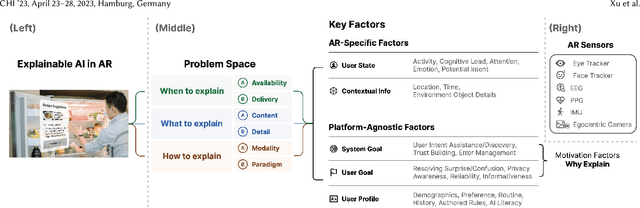
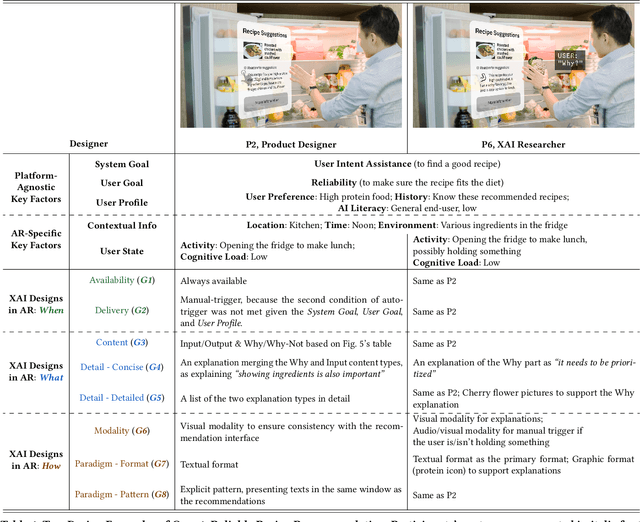
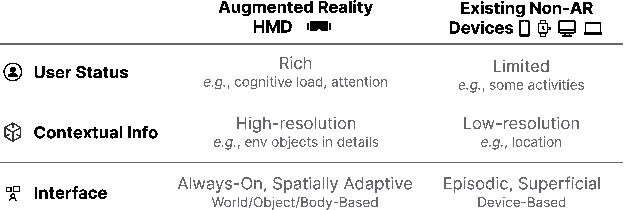

Explainable AI (XAI) has established itself as an important component of AI-driven interactive systems. With Augmented Reality (AR) becoming more integrated in daily lives, the role of XAI also becomes essential in AR because end-users will frequently interact with intelligent services. However, it is unclear how to design effective XAI experiences for AR. We propose XAIR, a design framework that addresses "when", "what", and "how" to provide explanations of AI output in AR. The framework was based on a multi-disciplinary literature review of XAI and HCI research, a large-scale survey probing 500+ end-users' preferences for AR-based explanations, and three workshops with 12 experts collecting their insights about XAI design in AR. XAIR's utility and effectiveness was verified via a study with 10 designers and another study with 12 end-users. XAIR can provide guidelines for designers, inspiring them to identify new design opportunities and achieve effective XAI designs in AR.