 Add to Chrome
 Add to Firefox
 Add to Edge
The Llama 4 Herd: Architecture, Training, Evaluation, and Deployment Notes
Jan 15, 2026
This document consolidates publicly reported technical details about Metas Llama 4 model family. It summarizes (i) released variants (Scout and Maverick) and the broader herd context including the previewed Behemoth teacher model, (ii) architectural characteristics beyond a high-level MoE description covering routed/shared-expert structure, early-fusion multimodality, and long-context design elements reported for Scout (iRoPE and length generalization strategies), (iii) training disclosures spanning pre-training, mid-training for long-context extension, and post-training methodology (lightweight SFT, online RL, and lightweight DPO) as described in release materials, (iv) developer-reported benchmark results for both base and instruction-tuned checkpoints, and (v) practical deployment constraints observed across major serving environments, including provider-specific context limits and quantization packaging. The manuscript also summarizes licensing obligations relevant to redistribution and derivative naming, and reviews publicly described safeguards and evaluation practices. The goal is to provide a compact technical reference for researchers and practitioners who need precise, source-backed facts about Llama 4.

XAIR: A Framework of Explainable AI in Augmented Reality
Mar 28, 2023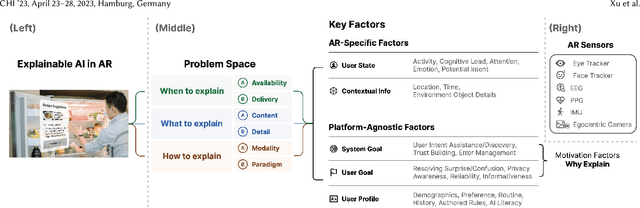
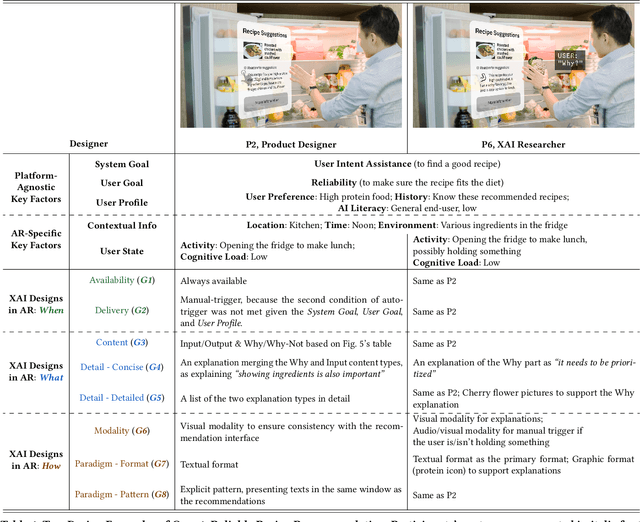
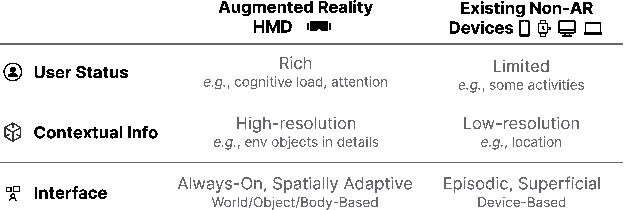
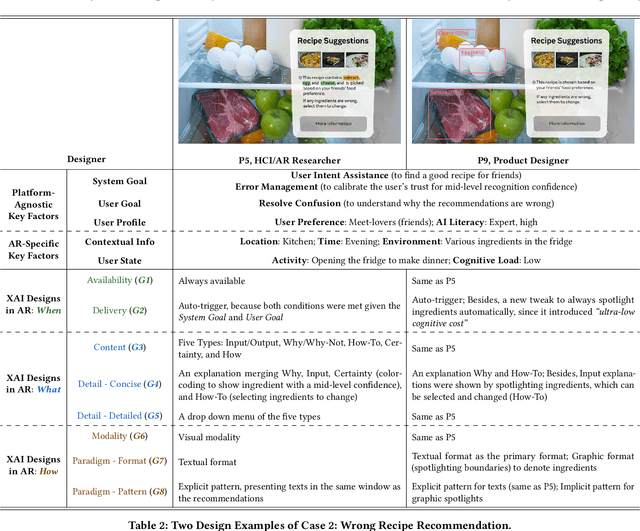
Explainable AI (XAI) has established itself as an important component of AI-driven interactive systems. With Augmented Reality (AR) becoming more integrated in daily lives, the role of XAI also becomes essential in AR because end-users will frequently interact with intelligent services. However, it is unclear how to design effective XAI experiences for AR. We propose XAIR, a design framework that addresses "when", "what", and "how" to provide explanations of AI output in AR. The framework was based on a multi-disciplinary literature review of XAI and HCI research, a large-scale survey probing 500+ end-users' preferences for AR-based explanations, and three workshops with 12 experts collecting their insights about XAI design in AR. XAIR's utility and effectiveness was verified via a study with 10 designers and another study with 12 end-users. XAIR can provide guidelines for designers, inspiring them to identify new design opportunities and achieve effective XAI designs in AR.