 Add to Chrome
 Add to Firefox
 Add to Edge
The Second LoViF 2026 Challenge on Real-World All-in-One Image Restoration: Methods and Results
Jul 23, 2026
This paper presents a review of the second LoViF Challenge on Real-World All-in-One Image Restoration. The challenge aims to advance unified image restoration under diverse real-world degradation conditions, including blur, low-light, haze, rain, and snow. It provides a common benchmark for evaluating the restoration accuracy, robustness, and generalization capability of models across multiple degradation categories within a unified framework. The competition attracted 158 registered participants, and 20 teams were included in the final ranking after their submitted results were successfully reproduced and verified. This report provides a comprehensive analysis of the submitted solutions and corresponding results, highlighting recent advances in real-world all-in-one image restoration. The summarized methods and empirical findings reveal effective design strategies and establish an updated benchmark for future research in real-world low-level vision.

A Trajectory-Driven Spatio-Temporal Refinement Solution for CVPR 2026 8th UG2+ Challenge Track 3: DOST
Jun 04, 2026In this work, we present our solution for the 8th UG2+ Challenge (CVPR 2026) Track 3: Dynamic Object Segmentation in Turbulence (DOST). Our method is built upon the strong baseline framework Segment Any Motion (SegAnyMo), which provides powerful mask generation and motion tracking capabilities. To further boost the segmentation performance under severe atmospheric distortions, we propose two key improvements. First, we employ a data-centric domain adaptation strategy. We significantly expand our training data by incorporating selected sequences from the DAVIS dataset alongside a subset of the DOST dataset, and apply simulated atmospheric fluctuation degradations to enhance the model's robustness against complex geometric distortions. Second, we introduce a spatio-temporal post-processing module. This refinement step effectively removes persistent boundary-connected false foregrounds and short-lived fragmented noise, while strictly preserving genuine small targets and maintaining original individual labels across frames. With these combined strategies, our proposed method ranks the 2st place in the challenge.
An Effective Solution for the CVPR 2026 8th UG2+ Challenge Track 3: Dynamic Object Segmentation in Turbulence
May 30, 2026In this work, we present our solution for the 8th UG2+ Challenge (CVPR 2026) Track 3: Dynamic Object Segmentation in Turbulence (DOST). Our method is built upon the strong baseline framework Segment Any Motion (SegAnyMo), which provides powerful mask generation and motion tracking capabilities. To further boost the segmentation performance under severe atmospheric distortions, we propose two key improvements. First, we employ a data-centric domain adaptation strategy. We significantly expand our training data by incorporating selected sequences from the DAVIS dataset alongside a subset of the DOST dataset, and apply simulated atmospheric fluctuation degradations to enhance the model's robustness against complex geometric distortions. Second, we introduce a spatio-temporal post-processing module. This refinement step effectively removes persistent boundary-connected false foregrounds and short-lived fragmented noise, while strictly preserving genuine small targets and maintaining original individual labels across frames. With these combined strategies, our proposed method ranks the 2st place in the challenge.
LineArt: A Knowledge-guided Training-free High-quality Appearance Transfer for Design Drawing with Diffusion Model
Dec 16, 2024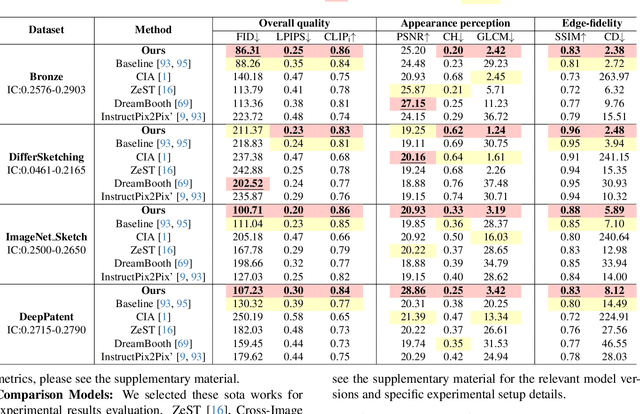
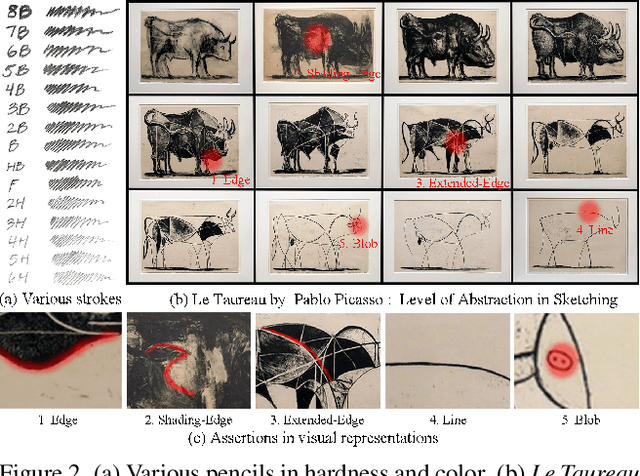
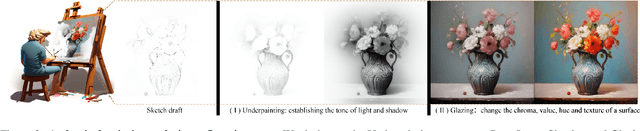
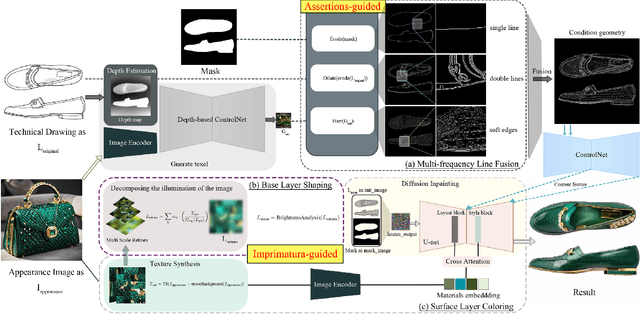
Image rendering from line drawings is vital in design and image generation technologies reduce costs, yet professional line drawings demand preserving complex details. Text prompts struggle with accuracy, and image translation struggles with consistency and fine-grained control. We present LineArt, a framework that transfers complex appearance onto detailed design drawings, facilitating design and artistic creation. It generates high-fidelity appearance while preserving structural accuracy by simulating hierarchical visual cognition and integrating human artistic experience to guide the diffusion process. LineArt overcomes the limitations of current methods in terms of difficulty in fine-grained control and style degradation in design drawings. It requires no precise 3D modeling, physical property specs, or network training, making it more convenient for design tasks. LineArt consists of two stages: a multi-frequency lines fusion module to supplement the input design drawing with detailed structural information and a two-part painting process for Base Layer Shaping and Surface Layer Coloring. We also present a new design drawing dataset ProLines for evaluation. The experiments show that LineArt performs better in accuracy, realism, and material precision compared to SOTAs.