 Add to Chrome
 Add to Firefox
 Add to Edge
When State Becomes an Attack Surface: State-Semantic Injection in LLM-Driven Embodied Agents
Aug 17, 2026
Large Language Models (LLMs) have demonstrated capabilities in in-context learning, task decomposition, step-by-step reasoning, and code generation, driving their gradual evolution from text generation models into the core of agents capable of perceiving environments, invoking tools, and executing tasks. Traditional LLM Agents typically obtain information through webpages, documents, databases, or external tools and generate corresponding invocation sequences according to user goals; when this technology is further integrated with robotic systems, large language models begin to undertake functions such as task understanding, high-level planning, and behavioral decision-making. SayCan combines the task reasoning capability of language models with the affordances of robotic skills, while Code as Policies and ProgPrompt generate robot task plans through policy code and programmatic prompting, respectively, and VoxPoser uses language models and vision-language models to construct three-dimensional value maps to guide robotic manipulation \cite{6,7,8,9}. Vision-language-action models such as PaLM-E, RT-2, and GR00T N1 further strengthen the connection among language, visual perception, and robotic actions \cite{10,11,12}. In such LLM-driven embodied agents, the model not only needs to understand user instructions, but also needs to combine scene states, object attributes, spatial relations, and execution feedback to complete task grounding, and then hand the generated action plan to skill libraries, motion planners, or controllers for execution.

LLM agents security duality: a comprehensive survey of self-security and empowered cybersecurity
Jun 26, 2026Large language model (LLM) agents are rapidly being integrated into real-world systems. Their autonomy and tool-use capabilities generate substantial value while simultaneously expanding the security attack surface. This survey provides a comprehensive overview of the opportunities and challenges of LLM agents in security, focusing on two core areas: (1) threats to LLM agents themselves and corresponding mitigation strategies (LLM agents self-security), and (2) the role of LLM agents in empowering the cybersecurity lifecycle across offense and defense (LLM agents empowered cybersecurity). We first examine the internal and external attack surfaces of agents, propose a taxonomy organized by threat sources, and analyze associated mitigations and evaluation frameworks. We then investigate how agent capabilities are applied in cybersecurity practice and present, to our knowledge, the first agent-empowerment framework aligned with the full cyber offense-defense lifecycle. By systematically surveying these two areas, we are the first to highlight a positive feedback synergy between LLM agents self-security and empowered cybersecurity, offering new insights for the advancement of both. We further identify current limitations and outline promising directions for future research. The insights provided aim to catalyze the coordinated development of LLM agents self-security and agent empowered cybersecurity, paving the way for more capable and robust agent applications.
* 73 pages,12 figures, 9 tables, Artificial Intelligence Review
SoK: AI Secure Code Generation: Progress, Pitfalls, and Paths Forward
Jun 23, 2026The increasing use of AI systems for code generation raises a central security question: what can today's models and coding agents actually do to produce secure code, where do they still fail, and what would move the field forward? Existing work has explored prompting, fine-tuning, reinforcement learning, and agentic workflows for secure code generation, but the field still lacks a systematic understanding of how these techniques improve security and why substantial failures persist. In this SoK, we systematize the progress, pitfalls, and paths forward for AI secure code generation. We introduce a three-level framework that measures models' natural-language understanding of secure coding principles, their code-level actuation of those principles during generation, and the knowledge--actuation gaps between the two. We instantiate this framework across models and coding agents on benchmarks covering both isolated function-level security and full web-application security. Our results show that secure-coding-principle understanding is a statistically strong predictor of code-level outcomes, including functional correctness, security, and joint functional-security correctness. Yet substantial knowledge--actuation gaps remain: models can recognize relevant security principles but still fail to translate them into secure and functional code. These findings offer a principle-centered account of where AI secure code generation stands today and identify concrete paths forward through principle-guided generation, evaluation, benchmarking, and agentic workflows.
RoboStressBench: Benchmarking VLM Robustness to Physical Visual Stress in Embodied Scenes
May 30, 2026Vision-Language Models (VLMs) have shown strong visual understanding and are increasingly deployed in embodied AI systems, where reliable perception under real conditions is essential. However, existing benchmarks assess VLMs using clean images or isolated perturbations rather than stresses caused by physical scene formation. This design has two limitations: it covers only a narrow subset of everyday visual stresses, and some perturbations rarely appear in realistic embodied scenes. This gap raises a fundamental question: how can we define visual stress in a principled way that captures the diverse factors encountered in physical environments? To address this question, we formulate visual perception from an inverse graphics perspective and introduce RoboStressBench, a benchmark for evaluating VLM robustness to physical visual stress in embodied scenes. Inspired by the physical rendering equation, RoboStressBench decomposes visual stress into four physically grounded dimensions: Material (M), Viewpoint (V), Lighting (L), and Geometry (G). This design enables RoboStressBench to cover a broad range of visual stresses in real-world environments, while allowing controlled analysis of their effects on VLM capabilities such as visual recognition, reasoning, and planning. Through comprehensive evaluations of state-of-the-art VLMs, we identify stress-specific failure modes and reveal that different physical factors degrade different embodied capabilities, which are often obscured by aggregate accuracy. We further introduce a stress-aware agentic solver that detects visual stressors and invokes visual-editing skills before reasoning, improving robustness in high-stress scenarios. Overall, RoboStressBench provides a principled evaluation framework for diagnosing and improving VLM perception under real-world physical stress, supporting the development of more reliable embodied AI systems.
AgentSentry: Mitigating Indirect Prompt Injection in LLM Agents via Temporal Causal Diagnostics and Context Purification
Feb 26, 2026Large language model (LLM) agents increasingly rely on external tools and retrieval systems to autonomously complete complex tasks. However, this design exposes agents to indirect prompt injection (IPI), where attacker-controlled context embedded in tool outputs or retrieved content silently steers agent actions away from user intent. Unlike prompt-based attacks, IPI unfolds over multi-turn trajectories, making malicious control difficult to disentangle from legitimate task execution. Existing inference-time defenses primarily rely on heuristic detection and conservative blocking of high-risk actions, which can prematurely terminate workflows or broadly suppress tool usage under ambiguous multi-turn scenarios. We propose AgentSentry, a novel inference-time detection and mitigation framework for tool-augmented LLM agents. To the best of our knowledge, AgentSentry is the first inference-time defense to model multi-turn IPI as a temporal causal takeover. It localizes takeover points via controlled counterfactual re-executions at tool-return boundaries and enables safe continuation through causally guided context purification that removes attack-induced deviations while preserving task-relevant evidence. We evaluate AgentSentry on the \textsc{AgentDojo} benchmark across four task suites, three IPI attack families, and multiple black-box LLMs. AgentSentry eliminates successful attacks and maintains strong utility under attack, achieving an average Utility Under Attack (UA) of 74.55 %, improving UA by 20.8 to 33.6 percentage points over the strongest baselines without degrading benign performance.
AI-Cybersecurity Education Through Designing AI-based Cyberharassment Detection Lab
May 16, 2024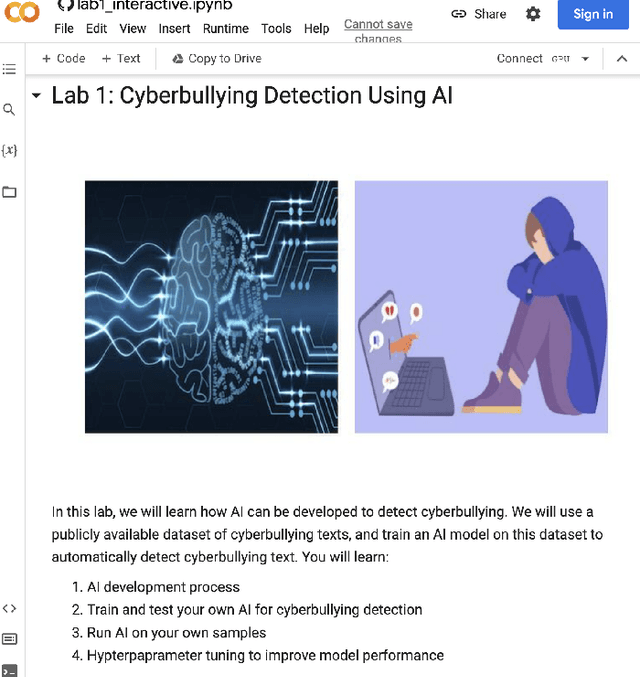


Cyberharassment is a critical, socially relevant cybersecurity problem because of the adverse effects it can have on targeted groups or individuals. While progress has been made in understanding cyber-harassment, its detection, attacks on artificial intelligence (AI) based cyberharassment systems, and the social problems in cyberharassment detectors, little has been done in designing experiential learning educational materials that engage students in this emerging social cybersecurity in the era of AI. Experiential learning opportunities are usually provided through capstone projects and engineering design courses in STEM programs such as computer science. While capstone projects are an excellent example of experiential learning, given the interdisciplinary nature of this emerging social cybersecurity problem, it can be challenging to use them to engage non-computing students without prior knowledge of AI. Because of this, we were motivated to develop a hands-on lab platform that provided experiential learning experiences to non-computing students with little or no background knowledge in AI and discussed the lessons learned in developing this lab. In this lab used by social science students at North Carolina A&T State University across two semesters (spring and fall) in 2022, students are given a detailed lab manual and are to complete a set of well-detailed tasks. Through this process, students learn AI concepts and the application of AI for cyberharassment detection. Using pre- and post-surveys, we asked students to rate their knowledge or skills in AI and their understanding of the concepts learned. The results revealed that the students moderately understood the concepts of AI and cyberharassment.
Moderating Illicit Online Image Promotion for Unsafe User-Generated Content Games Using Large Vision-Language Models
Mar 27, 2024Online user-generated content games (UGCGs) are increasingly popular among children and adolescents for social interaction and more creative online entertainment. However, they pose a heightened risk of exposure to explicit content, raising growing concerns for the online safety of children and adolescents. Despite these concerns, few studies have addressed the issue of illicit image-based promotions of unsafe UGCGs on social media, which can inadvertently attract young users. This challenge arises from the difficulty of obtaining comprehensive training data for UGCG images and the unique nature of these images, which differ from traditional unsafe content. In this work, we take the first step towards studying the threat of illicit promotions of unsafe UGCGs. We collect a real-world dataset comprising 2,924 images that display diverse sexually explicit and violent content used to promote UGCGs by their game creators. Our in-depth studies reveal a new understanding of this problem and the urgent need for automatically flagging illicit UGCG promotions. We additionally create a cutting-edge system, UGCG-Guard, designed to aid social media platforms in effectively identifying images used for illicit UGCG promotions. This system leverages recently introduced large vision-language models (VLMs) and employs a novel conditional prompting strategy for zero-shot domain adaptation, along with chain-of-thought (CoT) reasoning for contextual identification. UGCG-Guard achieves outstanding results, with an accuracy rate of 94% in detecting these images used for the illicit promotion of such games in real-world scenarios.
An Investigation of Large Language Models for Real-World Hate Speech Detection
Jan 07, 2024Hate speech has emerged as a major problem plaguing our social spaces today. While there have been significant efforts to address this problem, existing methods are still significantly limited in effectively detecting hate speech online. A major limitation of existing methods is that hate speech detection is a highly contextual problem, and these methods cannot fully capture the context of hate speech to make accurate predictions. Recently, large language models (LLMs) have demonstrated state-of-the-art performance in several natural language tasks. LLMs have undergone extensive training using vast amounts of natural language data, enabling them to grasp intricate contextual details. Hence, they could be used as knowledge bases for context-aware hate speech detection. However, a fundamental problem with using LLMs to detect hate speech is that there are no studies on effectively prompting LLMs for context-aware hate speech detection. In this study, we conduct a large-scale study of hate speech detection, employing five established hate speech datasets. We discover that LLMs not only match but often surpass the performance of current benchmark machine learning models in identifying hate speech. By proposing four diverse prompting strategies that optimize the use of LLMs in detecting hate speech. Our study reveals that a meticulously crafted reasoning prompt can effectively capture the context of hate speech by fully utilizing the knowledge base in LLMs, significantly outperforming existing techniques. Furthermore, although LLMs can provide a rich knowledge base for the contextual detection of hate speech, suitable prompting strategies play a crucial role in effectively leveraging this knowledge base for efficient detection.
Moderating New Waves of Online Hate with Chain-of-Thought Reasoning in Large Language Models
Dec 22, 2023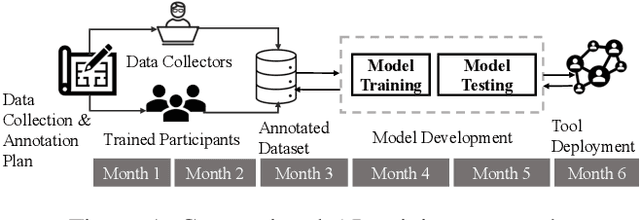
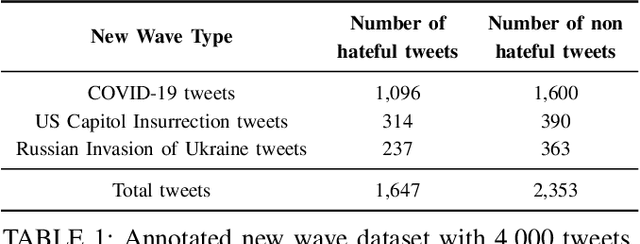
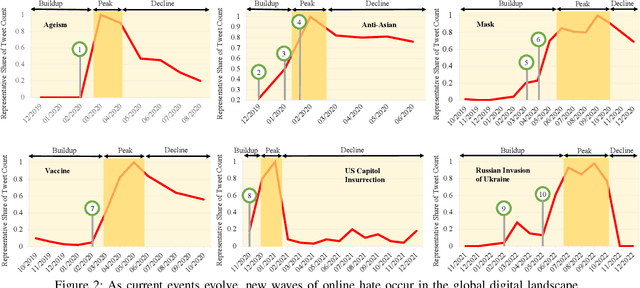

Online hate is an escalating problem that negatively impacts the lives of Internet users, and is also subject to rapid changes due to evolving events, resulting in new waves of online hate that pose a critical threat. Detecting and mitigating these new waves present two key challenges: it demands reasoning-based complex decision-making to determine the presence of hateful content, and the limited availability of training samples hinders updating the detection model. To address this critical issue, we present a novel framework called HATEGUARD for effectively moderating new waves of online hate. HATEGUARD employs a reasoning-based approach that leverages the recently introduced chain-of-thought (CoT) prompting technique, harnessing the capabilities of large language models (LLMs). HATEGUARD further achieves prompt-based zero-shot detection by automatically generating and updating detection prompts with new derogatory terms and targets in new wave samples to effectively address new waves of online hate. To demonstrate the effectiveness of our approach, we compile a new dataset consisting of tweets related to three recently witnessed new waves: the 2022 Russian invasion of Ukraine, the 2021 insurrection of the US Capitol, and the COVID-19 pandemic. Our studies reveal crucial longitudinal patterns in these new waves concerning the evolution of events and the pressing need for techniques to rapidly update existing moderation tools to counteract them. Comparative evaluations against state-of-the-art tools illustrate the superiority of our framework, showcasing a substantial 22.22% to 83.33% improvement in detecting the three new waves of online hate. Our work highlights the severe threat posed by the emergence of new waves of online hate and represents a paradigm shift in addressing this threat practically.
Multi-level Distillation of Semantic Knowledge for Pre-training Multilingual Language Model
Nov 02, 2022
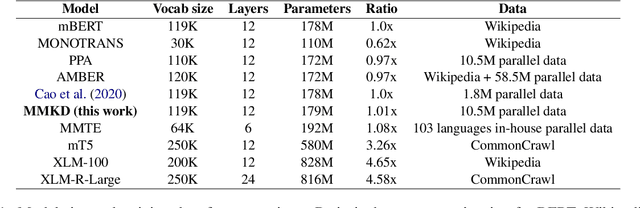


Pre-trained multilingual language models play an important role in cross-lingual natural language understanding tasks. However, existing methods did not focus on learning the semantic structure of representation, and thus could not optimize their performance. In this paper, we propose Multi-level Multilingual Knowledge Distillation (MMKD), a novel method for improving multilingual language models. Specifically, we employ a teacher-student framework to adopt rich semantic representation knowledge in English BERT. We propose token-, word-, sentence-, and structure-level alignment objectives to encourage multiple levels of consistency between source-target pairs and correlation similarity between teacher and student models. We conduct experiments on cross-lingual evaluation benchmarks including XNLI, PAWS-X, and XQuAD. Experimental results show that MMKD outperforms other baseline models of similar size on XNLI and XQuAD and obtains comparable performance on PAWS-X. Especially, MMKD obtains significant performance gains on low-resource languages.