 Add to Chrome
 Add to Firefox
 Add to Edge
MazzikaAI: A knowledge-based performance-to-prompt compiler for real-time Arabic maqam accompaniment with a streaming text-to-music model
Aug 11, 2026
Arabic maqam music microtonal, modal, and built on ornamented call and response is among the traditions most underserved by generative music models, whose training frameworks remain predominantly Western and equaltempered. Real time accompaniment sharpens this gap: an AI partner must listen, adapt dynamically, and respect idiomatic microtonal structures. Streaming text to music models provide strong generative capabilities but lack precise control interfaces. We present MazzikaAI, a knowledge based system that uses natural language as the actuator of a realtime control loop. By compiling live MIDI, gesture, and inferred harmony into continuously updated text prompts, MazzikaAI steers an unmodified streaming generator, Google Lyria RealTime, without requiring model finetuning. The system embeds expert knowledge of six core maqamat, characteristic ornaments, and ensemble dynamics, maintaining realtime responsiveness with subsecond keytoaudibleupdate latency. Empirical evaluations demonstrate that dynamic prompt compilation reliably grounds generation in microtonal scales, significantly increasing offgrid quartertone content over baseline generation. Beyond its core implementation, MazzikaAI illustrates how deterministic knowledgebased rules can effectively bridge expert, nonWestern musical traditions and unfinetuned foundation models. This architecture establishes a scalable paradigm for realtime humanAI cocreation, offering a generalizable blueprint for interactive accompaniment, adaptive music education, and culturally inclusive generative audio across diverse global idioms.

LLM agents security duality: a comprehensive survey of self-security and empowered cybersecurity
Jun 26, 2026Large language model (LLM) agents are rapidly being integrated into real-world systems. Their autonomy and tool-use capabilities generate substantial value while simultaneously expanding the security attack surface. This survey provides a comprehensive overview of the opportunities and challenges of LLM agents in security, focusing on two core areas: (1) threats to LLM agents themselves and corresponding mitigation strategies (LLM agents self-security), and (2) the role of LLM agents in empowering the cybersecurity lifecycle across offense and defense (LLM agents empowered cybersecurity). We first examine the internal and external attack surfaces of agents, propose a taxonomy organized by threat sources, and analyze associated mitigations and evaluation frameworks. We then investigate how agent capabilities are applied in cybersecurity practice and present, to our knowledge, the first agent-empowerment framework aligned with the full cyber offense-defense lifecycle. By systematically surveying these two areas, we are the first to highlight a positive feedback synergy between LLM agents self-security and empowered cybersecurity, offering new insights for the advancement of both. We further identify current limitations and outline promising directions for future research. The insights provided aim to catalyze the coordinated development of LLM agents self-security and agent empowered cybersecurity, paving the way for more capable and robust agent applications.
* 73 pages,12 figures, 9 tables, Artificial Intelligence Review
Dense Retrieval Adaptation using Target Domain Description
Jul 06, 2023
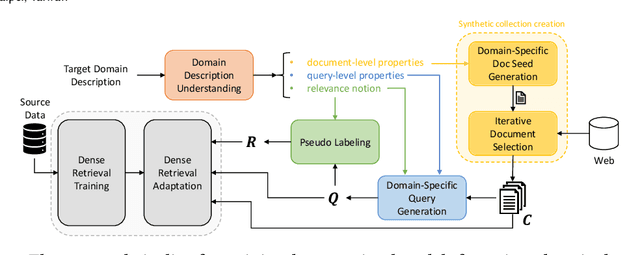
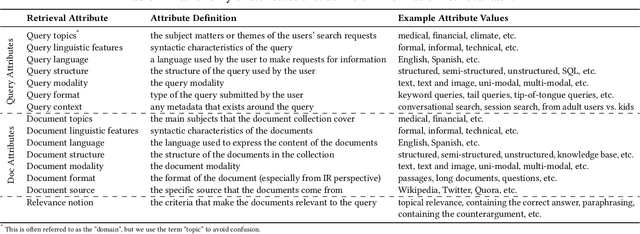
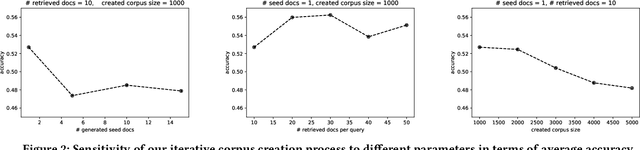
In information retrieval (IR), domain adaptation is the process of adapting a retrieval model to a new domain whose data distribution is different from the source domain. Existing methods in this area focus on unsupervised domain adaptation where they have access to the target document collection or supervised (often few-shot) domain adaptation where they additionally have access to (limited) labeled data in the target domain. There also exists research on improving zero-shot performance of retrieval models with no adaptation. This paper introduces a new category of domain adaptation in IR that is as-yet unexplored. Here, similar to the zero-shot setting, we assume the retrieval model does not have access to the target document collection. In contrast, it does have access to a brief textual description that explains the target domain. We define a taxonomy of domain attributes in retrieval tasks to understand different properties of a source domain that can be adapted to a target domain. We introduce a novel automatic data construction pipeline that produces a synthetic document collection, query set, and pseudo relevance labels, given a textual domain description. Extensive experiments on five diverse target domains show that adapting dense retrieval models using the constructed synthetic data leads to effective retrieval performance on the target domain.
Novelty Controlled Paraphrase Generation with Retrieval Augmented Conditional Prompt Tuning
Feb 01, 2022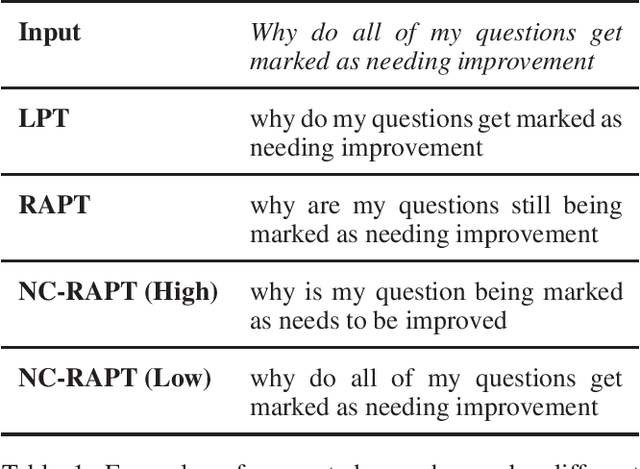
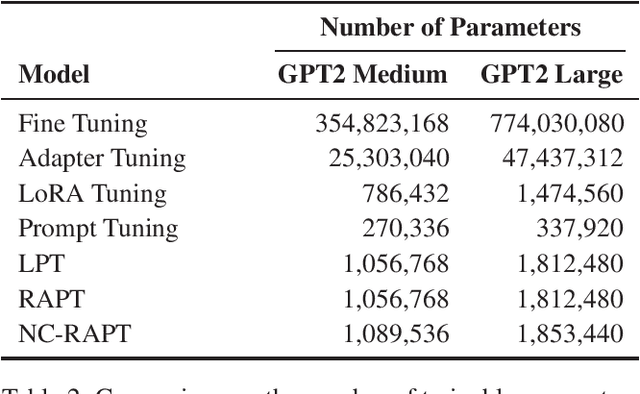
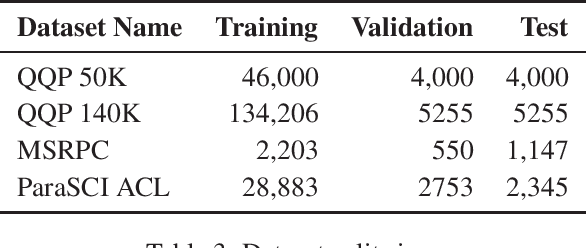
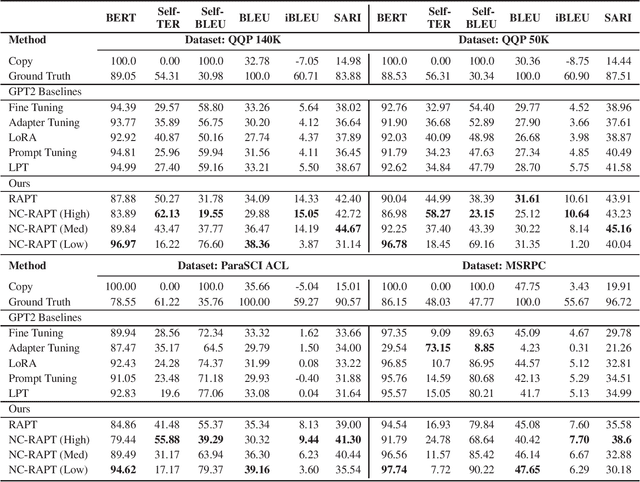
Paraphrase generation is a fundamental and long-standing task in natural language processing. In this paper, we concentrate on two contributions to the task: (1) we propose Retrieval Augmented Prompt Tuning (RAPT) as a parameter-efficient method to adapt large pre-trained language models for paraphrase generation; (2) we propose Novelty Conditioned RAPT (NC-RAPT) as a simple model-agnostic method of using specialized prompt tokens for controlled paraphrase generation with varying levels of lexical novelty. By conducting extensive experiments on four datasets, we demonstrate the effectiveness of the proposed approaches for retaining the semantic content of the original text while inducing lexical novelty in the generation.
Federated Natural Language Generation for Personalized Dialogue System
Oct 13, 2021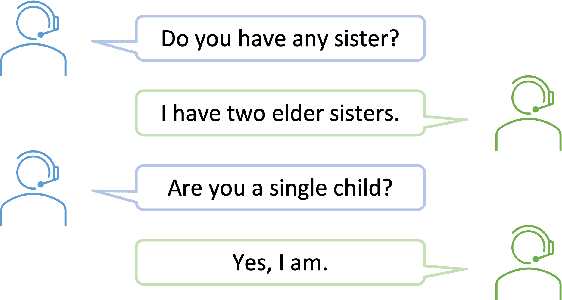
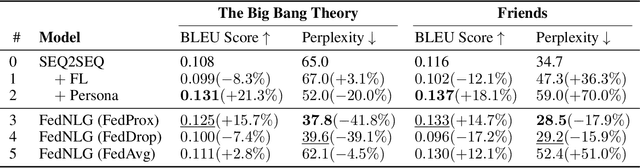
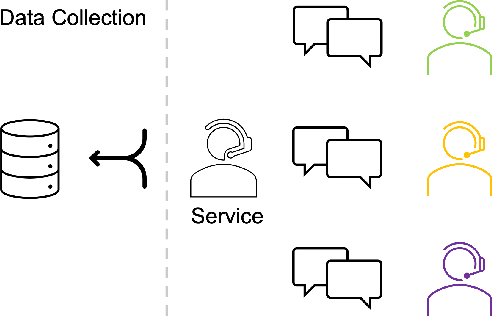
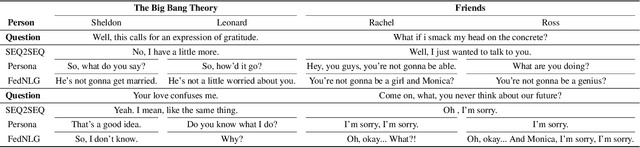
Neural conversational models have long suffered from the problem of inconsistency and lacking coherent personality. To address the issue, persona-based models capturing individual characteristics have been proposed, but they still face the dilemma of model adaption and data privacy. To break this dilemma, we propose a novel Federated Natural Language Generation (FedNLG) framework, which learns personalized representations from various dataset on distributed devices, and thus implements the personalized dialogue system efficiently and safely. FedNLG first pre-trains parameters of standard neural conversational model over a large dialogue corpus, and then fine-tune the model parameters and persona embeddings on specific datasets, in a federated manner. Thus, the model could simultaneously learn the persona embeddings in local clients and learn shared model parameters by federated aggregation, which achieves accuracyprivacy balance. By conducting extensive experiments, we demonstrate the effectiveness of our model by pre-training model over Cornell Movie-Dialogs Corpus and fine-tuning the model over two TV series dataset.