 Add to Chrome
 Add to Firefox
 Add to Edge
DynFly: Dynamic-Aware Continuous Trajectory Generation for UAV Vision-Language Navigation in Urban Environments
Jun 30, 2026
Recent advances in multimodal large models have significantly improved UAV vision-language navigation (UAV-VLN) by enhancing high-level perception and reasoning. However, existing methods mainly focus on predicting discrete actions, local targets, or sparse waypoints, while the continuous transition from navigation intent to executable UAV motion remains weakly modeled. This motion-interface gap limits the continuity, stability, and executability of generated UAV trajectories. To address this gap, we propose DynFly, a dynamic-aware continuous trajectory generation framework that bridges high-level navigation reasoning and executable UAV motion. DynFly bridges high-level navigation intent and continuous UAV motion through a lightweight trajectory generation layer. Specifically, it represents expert trajectories in B-spline control-point space and employs a Spline-DiT generator to learn conditional trajectory generation via flow matching. Furthermore, we introduce UAV-oriented dynamic-aware supervision over position, finite-difference velocity, finite-difference acceleration, heading consistency, and local target alignment, enabling the generated trajectories to better satisfy UAV motion characteristics. And our trajectory generation framework can also be integrated with an existing UAV-VLN framework while preserving its original visual-language reasoning pipeline. Extensive experiments on the OpenUAV UAV-VLN benchmark show that DynFly improves both navigation performance and trajectory quality. On the Test Unseen Full split, DynFly improves the strongest baseline by 4.69 NDTW, 2.40 SDTW, 2.14 SR points and 4.87 OSR points, while reducing NE by 4.51 m.

SpatialFly: Geometry-Guided Representation Alignment for UAV Vision-and-Language Navigation in Urban Environments
Mar 22, 2026UAVs play an important role in applications such as autonomous exploration, disaster response, and infrastructure inspection. However, UAV VLN in complex 3D environments remains challenging. A key difficulty is the structural representation mismatch between 2D visual perception and the 3D trajectory decision space, which limits spatial reasoning. To this end, we propose SpatialFly, a geometry-guided spatial representation framework for UAV VLN. Operating on RGB observations without explicit 3D reconstruction, SpatialFly introduces a geometry-guided 2D representation alignment mechanism. Specifically, the geometric prior injection module injects global structural cues into 2D semantic tokens to provide scene-level geometric guidance. The geometry-aware reparameterization module then aligns 2D semantic tokens with 3D geometric tokens through cross-modal attention, followed by gated residual fusion to preserve semantic discrimination. Experimental results show that SpatialFly consistently outperforms state-of-the-art UAV VLN baselines across both seen and unseen environments, reducing NE by 4.03m and improving SR by 1.27% over the strongest baseline on the unseen Full split. Additional trajectory-level analysis shows that SpatialFly produces trajectories with better path alignment and smoother, more stable motion.
LongFly: Long-Horizon UAV Vision-and-Language Navigation with Spatiotemporal Context Integration
Dec 26, 2025Unmanned aerial vehicles (UAVs) are crucial tools for post-disaster search and rescue, facing challenges such as high information density, rapid changes in viewpoint, and dynamic structures, especially in long-horizon navigation. However, current UAV vision-and-language navigation(VLN) methods struggle to model long-horizon spatiotemporal context in complex environments, resulting in inaccurate semantic alignment and unstable path planning. To this end, we propose LongFly, a spatiotemporal context modeling framework for long-horizon UAV VLN. LongFly proposes a history-aware spatiotemporal modeling strategy that transforms fragmented and redundant historical data into structured, compact, and expressive representations. First, we propose the slot-based historical image compression module, which dynamically distills multi-view historical observations into fixed-length contextual representations. Then, the spatiotemporal trajectory encoding module is introduced to capture the temporal dynamics and spatial structure of UAV trajectories. Finally, to integrate existing spatiotemporal context with current observations, we design the prompt-guided multimodal integration module to support time-based reasoning and robust waypoint prediction. Experimental results demonstrate that LongFly outperforms state-of-the-art UAV VLN baselines by 7.89\% in success rate and 6.33\% in success weighted by path length, consistently across both seen and unseen environments.
Auto robust relative radiometric normalization via latent change noise modelling
Nov 24, 2021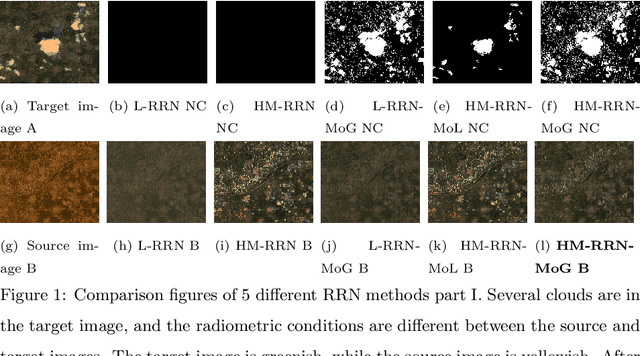
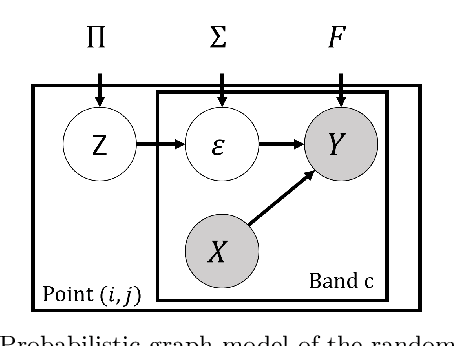
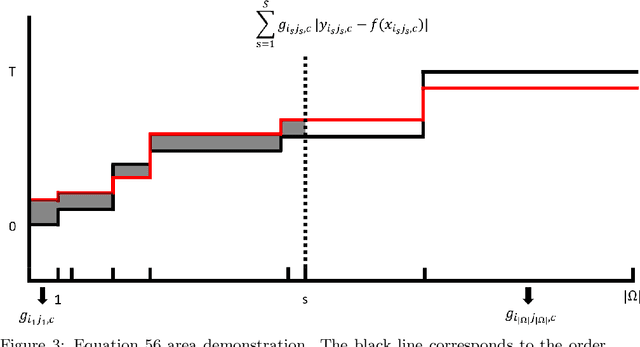
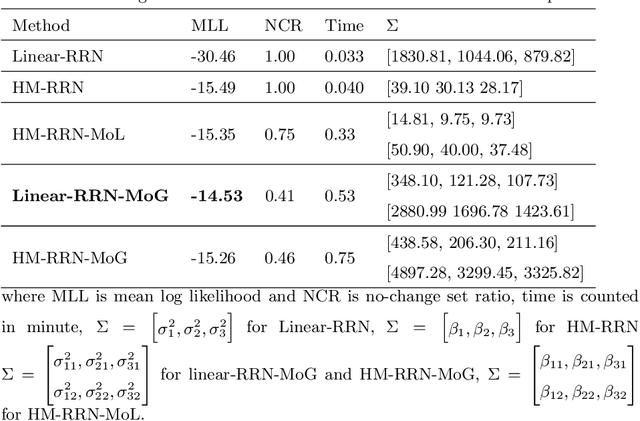
Relative radiometric normalization(RRN) of different satellite images of the same terrain is necessary for change detection, object classification/segmentation, and map-making tasks. However, traditional RRN models are not robust, disturbing by object change, and RRN models precisely considering object change can not robustly obtain the no-change set. This paper proposes auto robust relative radiometric normalization methods via latent change noise modeling. They utilize the prior knowledge that no change points possess small-scale noise under relative radiometric normalization and that change points possess large-scale radiometric noise after radiometric normalization, combining the stochastic expectation maximization method to quickly and robustly extract the no-change set to learn the relative radiometric normalization mapping functions. This makes our model theoretically grounded regarding the probabilistic theory and mathematics deduction. Specifically, when we select histogram matching as the relative radiometric normalization learning scheme integrating with the mixture of Gaussian noise(HM-RRN-MoG), the HM-RRN-MoG model achieves the best performance. Our model possesses the ability to robustly against clouds/fogs/changes. Our method naturally generates a robust evaluation indicator for RRN that is the no-change set root mean square error. We apply the HM-RRN-MoG model to the latter vegetation/water change detection task, which reduces the radiometric contrast and NDVI/NDWI differences on the no-change set, generates consistent and comparable results. We utilize the no-change set into the building change detection task, efficiently reducing the pseudo-change and boosting the precision.
Automatically eliminating seam lines with Poisson editing in complex relative radiometric normalization mosaicking scenarios
Jun 14, 2021Relative radiometric normalization (RRN) mosaicking among multiple remote sensing images is crucial for the downstream tasks, including map-making, image recognition, semantic segmentation, and change detection. However, there are often seam lines on the mosaic boundary and radiometric contrast left, especially in complex scenarios, making the appearance of mosaic images unsightly and reducing the accuracy of the latter classification/recognition algorithms. This paper renders a novel automatical approach to eliminate seam lines in complex RRN mosaicking scenarios. It utilizes the histogram matching on the overlap area to alleviate radiometric contrast, Poisson editing to remove the seam lines, and merging procedure to determine the normalization transfer order. Our method can handle the mosaicking seam lines with arbitrary shapes and images with extreme topological relationships (with a small intersection area). These conditions make the main feathering or blending methods, e.g., linear weighted blending and Laplacian pyramid blending, unavailable. In the experiment, our approach visually surpasses the automatic methods without Poisson editing and the manual blurring and feathering method using GIMP software.