 Add to Chrome
 Add to Firefox
 Add to Edge
AusSmoke meets MultiNatSmoke: a fully-labelled diverse smoke segmentation dataset
Apr 26, 2026
Wildfires are an escalating global concern due to the devastating impacts on the environment, economy, and human health, with notable incidents such as the 2019-2020 Australian bushfires and the 2025 California wildfires underscoring the severity of these events. AI-enabled camera-based smoke detection has emerged as a promising approach for the rapid detection of wildfires. However, existing wildfire smoke segmentation datasets that are used for training detection and segmentation models are limited in scale, geographically constrained, and often rely on synthetic imagery, which hinders effective training and generalization. To overcome these limitations, we present AusSmoke, a new smoke segmentation dataset collected from Australia to address the data scarcity in this region. Furthermore, we introduce a MultiNational geographically diverse and substantially larger fully-labelled benchmark, called MultiNatSmoke, that consolidates publicly available international datasets with the newly collected Australian imagery, expanding the scale by an order of magnitude over previous collections. Finally, we benchmark smoke segmentation models, demonstrating improved performance and enhanced generalization across diverse geographical contexts. The project is available at \href{https://github.com/henryzhao0615/MultiNatSmoke}{Github}.

Dynamic Prompt Middleware: Contextual Prompt Refinement Controls for Comprehension Tasks
Dec 03, 2024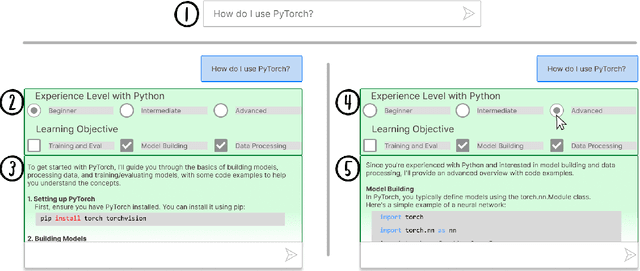

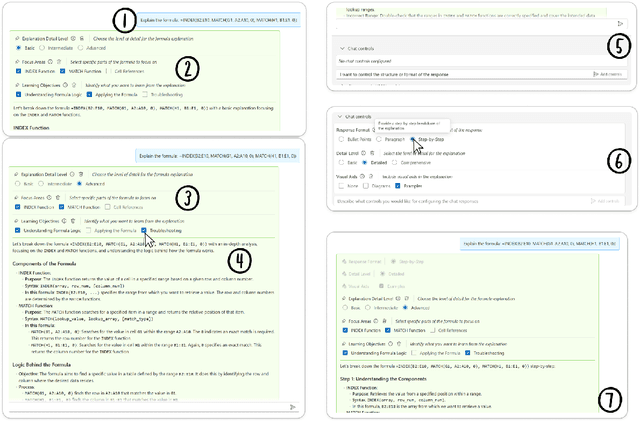
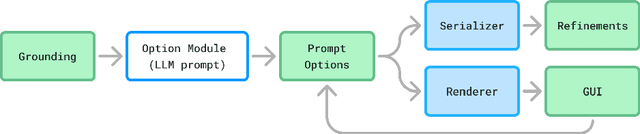
Effective prompting of generative AI is challenging for many users, particularly in expressing context for comprehension tasks such as explaining spreadsheet formulas, Python code, and text passages. Prompt middleware aims to address this barrier by assisting in prompt construction, but barriers remain for users in expressing adequate control so that they can receive AI-responses that match their preferences. We conduct a formative survey (n=38) investigating user needs for control over AI-generated explanations in comprehension tasks, which uncovers a trade-off between standardized but predictable support for prompting, and adaptive but unpredictable support tailored to the user and task. To explore this trade-off, we implement two prompt middleware approaches: Dynamic Prompt Refinement Control (Dynamic PRC) and Static Prompt Refinement Control (Static PRC). The Dynamic PRC approach generates context-specific UI elements that provide prompt refinements based on the user's prompt and user needs from the AI, while the Static PRC approach offers a preset list of generally applicable refinements. We evaluate these two approaches with a controlled user study (n=16) to assess the impact of these approaches on user control of AI responses for crafting better explanations. Results show a preference for the Dynamic PRC approach as it afforded more control, lowered barriers to providing context, and encouraged exploration and reflection of the tasks, but that reasoning about the effects of different generated controls on the final output remains challenging. Drawing on participant feedback, we discuss design implications for future Dynamic PRC systems that enhance user control of AI responses. Our findings suggest that dynamic prompt middleware can improve the user experience of generative AI workflows by affording greater control and guide users to a better AI response.