 Add to Chrome
 Add to Firefox
 Add to Edge
ENCORE: Event-Assisted Complementary Motion Refinement for Learned Video Compression
Jul 30, 2026
Learned video compression relies on accurate temporal modeling to remove redundancy between adjacent frames. However, most existing codecs infer motion solely from discretely sampled RGB frames, making their estimates vulnerable to fast motion, blur, occlusion, weak texture, low illumination, and abrupt brightness changes. Event cameras asynchronously capture fine-grained intensity changes between RGB timestamps and therefore provide complementary evidence about inter-frame dynamics. We propose ENCORE, an Event-Assisted Complementary Motion Refinement framework for learned video compression. ENCORE first employs Complementary Motion Representation (CMR) to decompose aligned RGB-event features into common and modality-specific motion representations. Spatial Energy and Redundancy-Informed Calibration (SERIC) then identifies event-specific responses that are active and novel relative to RGB, suppresses weak or redundant evidence, and predicts a candidate flow correction. Finally, Energy-Aware Routing (EAR) determines where and how strongly the correction should refine the RGB flow. Events serve solely as an auxiliary modality for motion modeling, while RGB remains the only coding and reconstruction target. Experiments on BS-ERGB, HQ-EVFI, and CED demonstrate consistent gains across datasets and GOP lengths. On BS-ERGB, ENCORE achieves up to 20.80% PSNR-RGB and 22.14% MS-SSIM-RGB BD-rate savings, while retaining clear improvements on the other two datasets.

CAROM Air -- Vehicle Localization and Traffic Scene Reconstruction from Aerial Videos
May 31, 2023Road traffic scene reconstruction from videos has been desirable by road safety regulators, city planners, researchers, and autonomous driving technology developers. However, it is expensive and unnecessary to cover every mile of the road with cameras mounted on the road infrastructure. This paper presents a method that can process aerial videos to vehicle trajectory data so that a traffic scene can be automatically reconstructed and accurately re-simulated using computers. On average, the vehicle localization error is about 0.1 m to 0.3 m using a consumer-grade drone flying at 120 meters. This project also compiles a dataset of 50 reconstructed road traffic scenes from about 100 hours of aerial videos to enable various downstream traffic analysis applications and facilitate further road traffic related research. The dataset is available at https://github.com/duolu/CAROM.
Deep Learning Serves Traffic Safety Analysis: A Forward-looking Review
Mar 07, 2022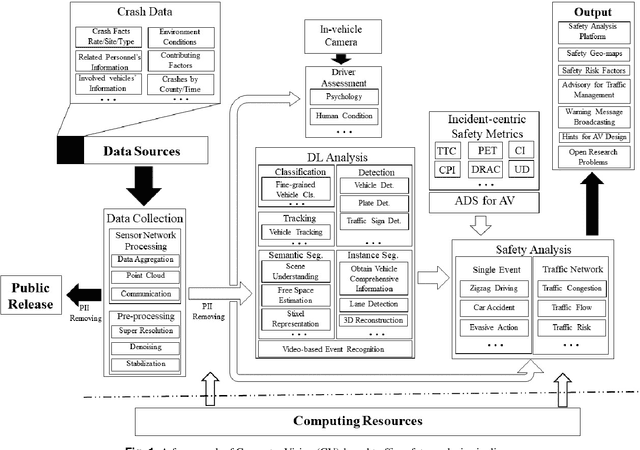
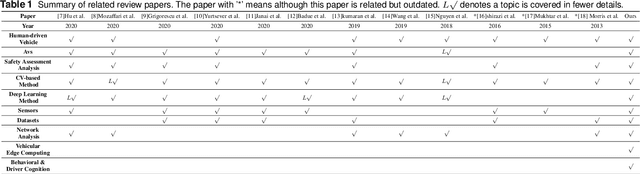
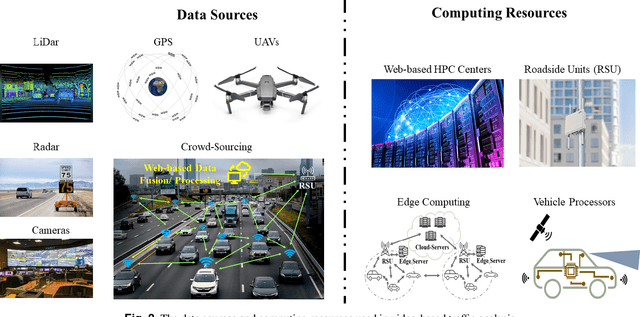

This paper explores Deep Learning (DL) methods that are used or have the potential to be used for traffic video analysis, emphasizing driving safety for both Autonomous Vehicles (AVs) and human-operated vehicles. We present a typical processing pipeline, which can be used to understand and interpret traffic videos by extracting operational safety metrics and providing general hints and guidelines to improve traffic safety. This processing framework includes several steps, including video enhancement, video stabilization, semantic and incident segmentation, object detection and classification, trajectory extraction, speed estimation, event analysis, modeling and anomaly detection. Our main goal is to guide traffic analysts to develop their own custom-built processing frameworks by selecting the best choices for each step and offering new designs for the lacking modules by providing a comparative analysis of the most successful conventional and DL-based algorithms proposed for each step. We also review existing open-source tools and public datasets that can help train DL models. To be more specific, we review exemplary traffic problems and mentioned requires steps for each problem. Besides, we investigate connections to the closely related research areas of drivers' cognition evaluation, Crowd-sourcing-based monitoring systems, Edge Computing in roadside infrastructures, ADS-equipped AVs, and highlight the missing gaps. Finally, we review commercial implementations of traffic monitoring systems, their future outlook, and open problems and remaining challenges for widespread use of such systems.