 Add to Chrome
 Add to Firefox
 Add to Edge
Towards Edge Intelligence via Autonomous Navigation: A Robot-Assisted Data Collection Approach
Apr 04, 2026
With the growing demand for large-scale and high-quality data in edge intelligence systems, mobile robots are increasingly deployed to collect data proactively, particularly in complex environments. However, existing robot-assisted data collection methods face significant challenges in achieving reliable and efficient performance, especially in non-line-of-sight (NLoS) environments. This paper proposes a communication-and-learning dual-driven (CLD) autonomous navigation scheme that incorporates region-aware propagation characteristics and a non-point-mass robot representation. This scheme enables simultaneous optimization of navigation, communication, and learning performance. An efficient algorithm based on majorization-minimization (MM) is proposed to solve the non-convex and non-smooth CLD problem. Simulation results demonstrate that the proposed scheme achieves superior performance in collision-avoidance navigation, data collection, and model training compared to benchmark methods. It is also shown that CLD can adapt to different scenarios by flexibly adjusting the weight factor among navigation, communication and learning objectives.

Out-of-Context Misinformation Detection via Variational Domain-Invariant Learning with Test-Time Training
Nov 15, 2025Out-of-context misinformation (OOC) is a low-cost form of misinformation in news reports, which refers to place authentic images into out-of-context or fabricated image-text pairings. This problem has attracted significant attention from researchers in recent years. Current methods focus on assessing image-text consistency or generating explanations. However, these approaches assume that the training and test data are drawn from the same distribution. When encountering novel news domains, models tend to perform poorly due to the lack of prior knowledge. To address this challenge, we propose \textbf{VDT} to enhance the domain adaptation capability for OOC misinformation detection by learning domain-invariant features and test-time training mechanisms. Domain-Invariant Variational Align module is employed to jointly encodes source and target domain data to learn a separable distributional space domain-invariant features. For preserving semantic integrity, we utilize domain consistency constraint module to reconstruct the source and target domain latent distribution. During testing phase, we adopt the test-time training strategy and confidence-variance filtering module to dynamically updating the VAE encoder and classifier, facilitating the model's adaptation to the target domain distribution. Extensive experiments conducted on the benchmark dataset NewsCLIPpings demonstrate that our method outperforms state-of-the-art baselines under most domain adaptation settings.
Multiresolution Feature Guidance Based Transformer for Anomaly Detection
May 24, 2023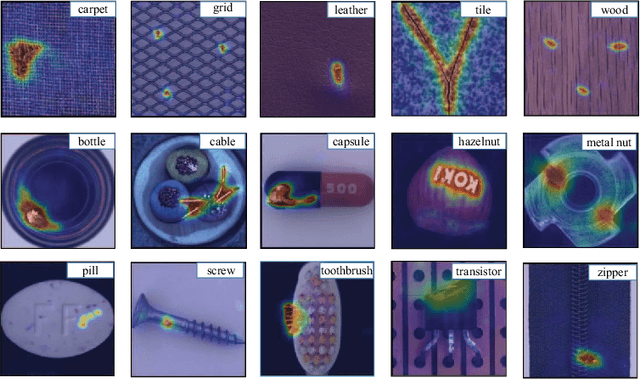
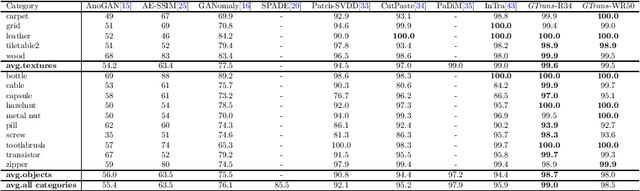
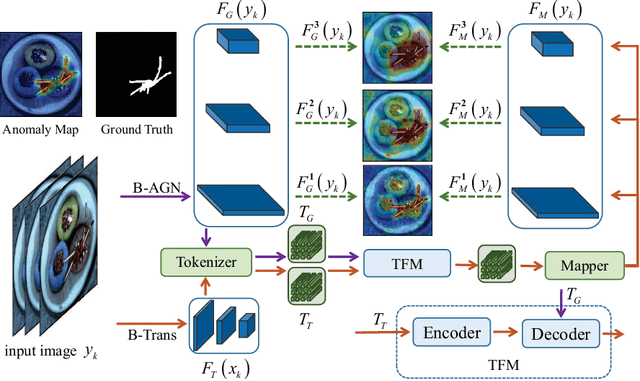
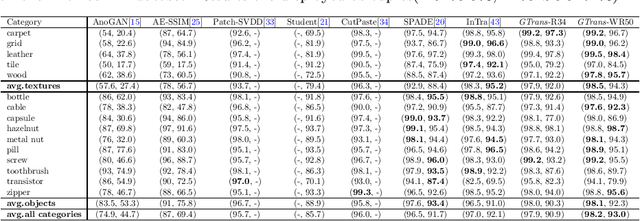
Anomaly detection is represented as an unsupervised learning to identify deviated images from normal images. In general, there are two main challenges of anomaly detection tasks, i.e., the class imbalance and the unexpectedness of anomalies. In this paper, we propose a multiresolution feature guidance method based on Transformer named GTrans for unsupervised anomaly detection and localization. In GTrans, an Anomaly Guided Network (AGN) pre-trained on ImageNet is developed to provide surrogate labels for features and tokens. Under the tacit knowledge guidance of the AGN, the anomaly detection network named Trans utilizes Transformer to effectively establish a relationship between features with multiresolution, enhancing the ability of the Trans in fitting the normal data manifold. Due to the strong generalization ability of AGN, GTrans locates anomalies by comparing the differences in spatial distance and direction of multi-scale features extracted from the AGN and the Trans. Our experiments demonstrate that the proposed GTrans achieves state-of-the-art performance in both detection and localization on the MVTec AD dataset. GTrans achieves image-level and pixel-level anomaly detection AUROC scores of 99.0% and 97.9% on the MVTec AD dataset, respectively.