 Add to Chrome
 Add to Firefox
 Add to Edge
RoboGaze: Evaluating Robot World Models via Structured Vision-Language Analysis
Jun 22, 2026
Recent advances in robot world models enable synthetic video generation for embodied prediction and planning. However, evaluating these videos is challenging: visually realistic outputs often violate physical laws, temporal consistency, or task logic, while conventional metrics and monolithic Vision-Language Model (VLM) judges fail to generalize or provide precise diagnostic value. We present RoboGaze, a training-free, multi-agent VLM framework that provides structured, interpretable evaluation for generated robot-manipulation videos. Given a task instruction and video, RoboGaze operates via a three-stage pipeline: task-scene grounding, dimension-specific specialist routing, and critic-based verification. It outputs temporally localized glitch reports categorized under a novel 6-dimension, 30-type robotics-specific taxonomy. To benchmark RoboGaze, we introduce a human-validated dataset of 382 clips spanning simulated and real-world multi-view manipulation. Evaluating eight open-source and proprietary VLM backbones, RoboGaze dramatically outperforms zero-shot baselines, improving description-F1 by up to +43 points and temporal alignment (F1 x IoU) by up to +37 points, closing approximately 85% of the gap to the human ceiling. Furthermore, its critic verifier mitigates the "cry-wolf" false-positive flaw of standard VLMs, lifting clean-clip accuracy from under 25% to over 80%. RoboGaze offers a scalable, highly interpretable diagnostic tool for the rigorous evaluation of robot world models.

Sailor2: Sailing in South-East Asia with Inclusive Multilingual LLMs
Feb 18, 2025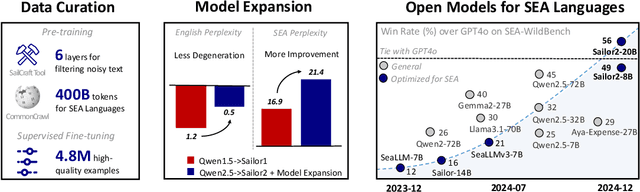
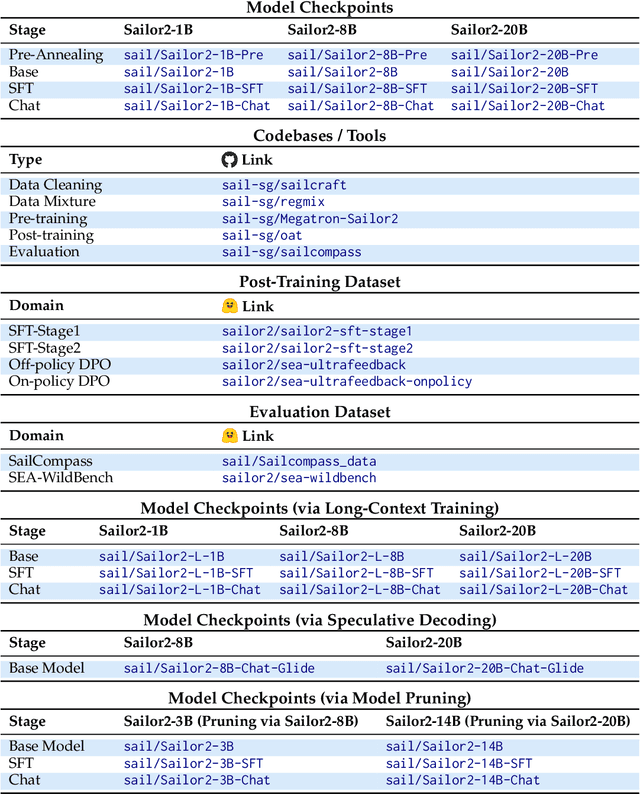
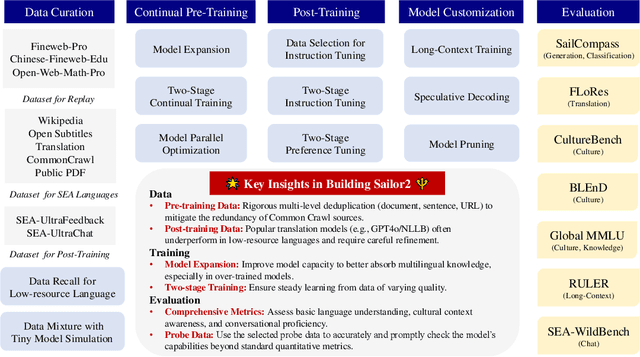
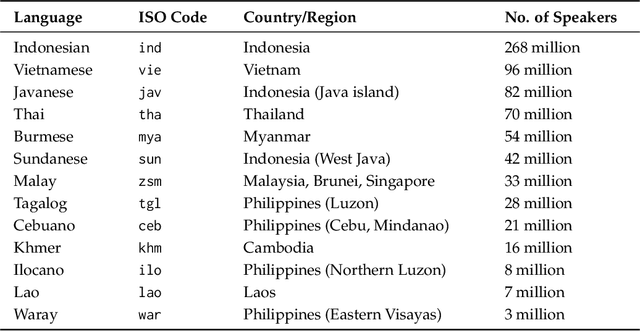
Sailor2 is a family of cutting-edge multilingual language models for South-East Asian (SEA) languages, available in 1B, 8B, and 20B sizes to suit diverse applications. Building on Qwen2.5, Sailor2 undergoes continuous pre-training on 500B tokens (400B SEA-specific and 100B replay tokens) to support 13 SEA languages while retaining proficiency in Chinese and English. Sailor2-20B model achieves a 50-50 win rate against GPT-4o across SEA languages. We also deliver a comprehensive cookbook on how to develop the multilingual model in an efficient manner, including five key aspects: data curation, pre-training, post-training, model customization and evaluation. We hope that Sailor2 model (Apache 2.0 license) will drive language development in the SEA region, and Sailor2 cookbook will inspire researchers to build more inclusive LLMs for other under-served languages.
OpenDevin: An Open Platform for AI Software Developers as Generalist Agents
Jul 23, 2024


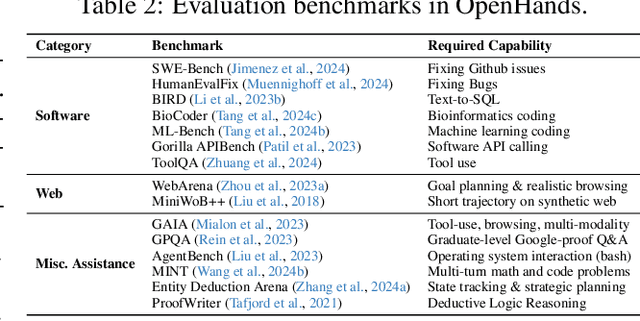
Software is one of the most powerful tools that we humans have at our disposal; it allows a skilled programmer to interact with the world in complex and profound ways. At the same time, thanks to improvements in large language models (LLMs), there has also been a rapid development in AI agents that interact with and affect change in their surrounding environments. In this paper, we introduce OpenDevin, a platform for the development of powerful and flexible AI agents that interact with the world in similar ways to those of a human developer: by writing code, interacting with a command line, and browsing the web. We describe how the platform allows for the implementation of new agents, safe interaction with sandboxed environments for code execution, coordination between multiple agents, and incorporation of evaluation benchmarks. Based on our currently incorporated benchmarks, we perform an evaluation of agents over 15 challenging tasks, including software engineering (e.g., SWE-Bench) and web browsing (e.g., WebArena), among others. Released under the permissive MIT license, OpenDevin is a community project spanning academia and industry with more than 1.3K contributions from over 160 contributors and will improve going forward.