 Add to Chrome
 Add to Firefox
 Add to Edge
DiffusionAnything: End-to-End In-context Diffusion Learning for Unified Navigation and Pre-Grasp Motion
Mar 27, 2026
Efficiently predicting motion plans directly from vision remains a fundamental challenge in robotics, where planning typically requires explicit goal specification and task-specific design. Recent vision-language-action (VLA) models infer actions directly from visual input but demand massive computational resources, extensive training data, and fail zero-shot in novel scenes. We present a unified image-space diffusion policy handling both meter-scale navigation and centimeter-scale manipulation via multi-scale feature modulation, with only 5 minutes of self-supervised data per task. Three key innovations drive the framework: (1) Multi-scale FiLM conditioning on task mode, depth scale, and spatial attention enables task-appropriate behavior in a single model; (2) trajectory-aligned depth prediction focuses metric 3D reasoning along generated waypoints; (3) self-supervised attention from AnyTraverse enables goal-directed inference without vision-language models and depth sensors. Operating purely from RGB input (2.0 GB memory, 10 Hz), the model achieves robust zero-shot generalization to novel scenes while remaining suitable for onboard deployment.

PhysicalAgent: Towards General Cognitive Robotics with Foundation World Models
Sep 17, 2025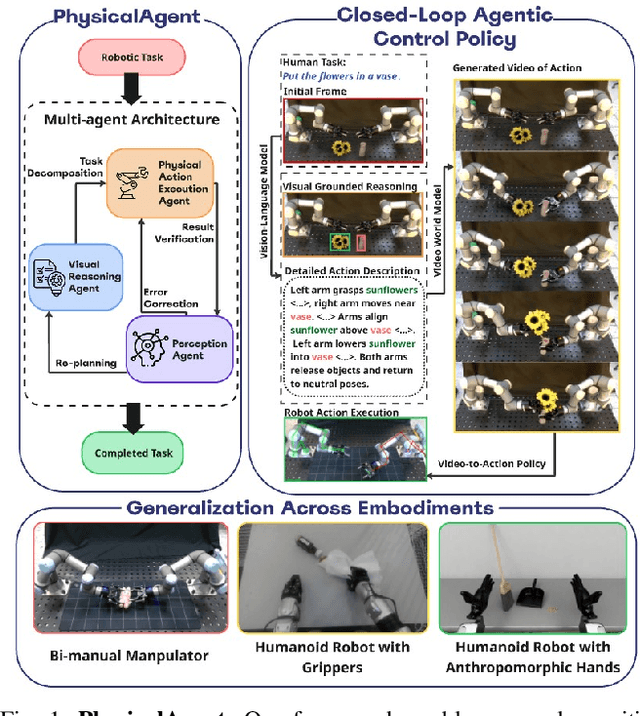
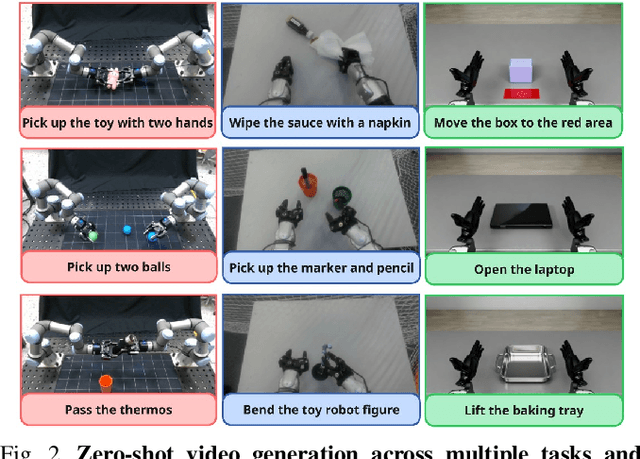
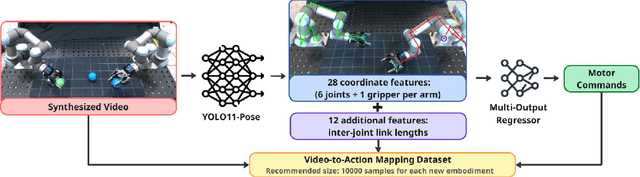
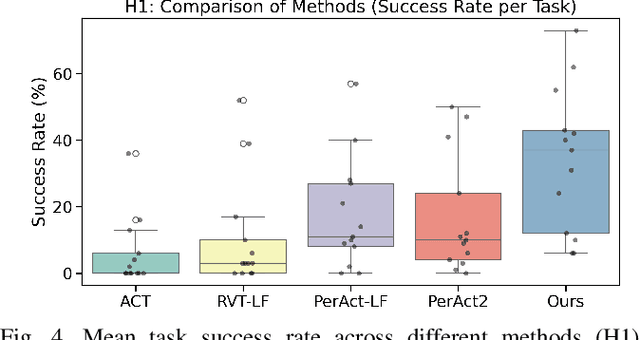
We introduce PhysicalAgent, an agentic framework for robotic manipulation that integrates iterative reasoning, diffusion-based video generation, and closed-loop execution. Given a textual instruction, our method generates short video demonstrations of candidate trajectories, executes them on the robot, and iteratively re-plans in response to failures. This approach enables robust recovery from execution errors. We evaluate PhysicalAgent across multiple perceptual modalities (egocentric, third-person, and simulated) and robotic embodiments (bimanual UR3, Unitree G1 humanoid, simulated GR1), comparing against state-of-the-art task-specific baselines. Experiments demonstrate that our method consistently outperforms prior approaches, achieving up to 83% success on human-familiar tasks. Physical trials reveal that first-attempt success is limited (20-30%), yet iterative correction increases overall success to 80% across platforms. These results highlight the potential of video-based generative reasoning for general-purpose robotic manipulation and underscore the importance of iterative execution for recovering from initial failures. Our framework paves the way for scalable, adaptable, and robust robot control.