 Add to Chrome
 Add to Firefox
 Add to Edge
Analysis of the Neglect-Zero Effect in Large Language Models
Jun 04, 2026
We investigate the extent to which the language processing of LLMs resembles human cognitive processes, focusing on a human cognitive bias called the $\textit{neglect-zero effect}$. This effect refers to the human tendency to ignore $\textit{zero-models}$, which are configurations that render a proposition vacuously true by virtue of an empty set. We focus on two types of inferences driven by the neglect-zero effect, and examine how LLMs process these inferences by comparing their behavior with that in an inference that does not involve the neglect-zero effect. For this purpose, we employ a paradigm based on $\textit{structural priming}$, where recent exposure to a preceding sentence (the $\textit{prime}$) facilitates the processing of a subsequent sentence (the $\textit{target}$) due to their structural similarity. We prepare primes to force LLMs to consider the zero-model, and analyze whether they also consider it in the target. The results suggest that the neglect-zero effect may not occur in the LLMs analyzed in this study. Our code is available at https://github.com/ynklab/neglect_zero

Evaluating Structural Generalization in Neural Machine Translation
Jun 19, 2024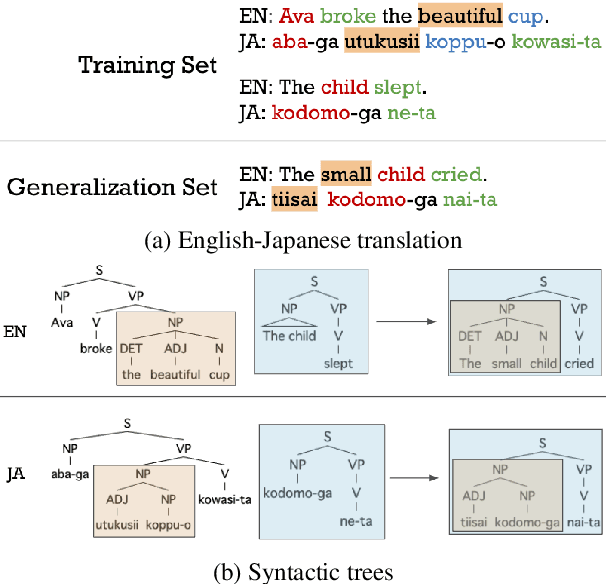

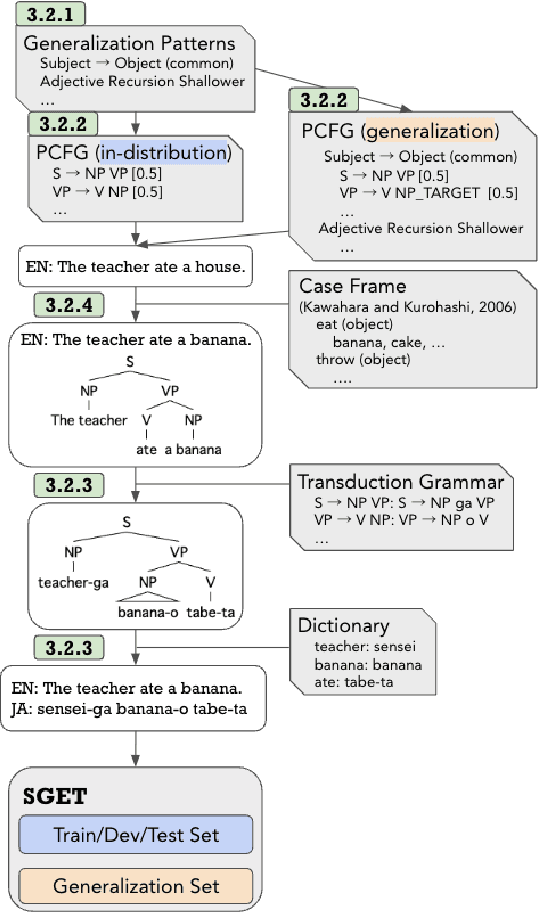

Compositional generalization refers to the ability to generalize to novel combinations of previously observed words and syntactic structures. Since it is regarded as a desired property of neural models, recent work has assessed compositional generalization in machine translation as well as semantic parsing. However, previous evaluations with machine translation have focused mostly on lexical generalization (i.e., generalization to unseen combinations of known words). Thus, it remains unclear to what extent models can translate sentences that require structural generalization (i.e., generalization to different sorts of syntactic structures). To address this question, we construct SGET, a machine translation dataset covering various types of compositional generalization with control of words and sentence structures. We evaluate neural machine translation models on SGET and show that they struggle more in structural generalization than in lexical generalization. We also find different performance trends in semantic parsing and machine translation, which indicates the importance of evaluations across various tasks.