 Add to Chrome
 Add to Firefox
 Add to Edge
Alternating Diffusion for Proximal Sampling with Zeroth Order Queries
Mar 20, 2026
This work introduces a new approximate proximal sampler that operates solely with zeroth-order information of the potential function. Prior theoretical analyses have revealed that proximal sampling corresponds to alternating forward and backward iterations of the heat flow. The backward step was originally implemented by rejection sampling, whereas we directly simulate the dynamics. Unlike diffusion-based sampling methods that estimate scores via learned models or by invoking auxiliary samplers, our method treats the intermediate particle distribution as a Gaussian mixture, thereby yielding a Monte Carlo score estimator from directly samplable distributions. Theoretically, when the score estimation error is sufficiently controlled, our method inherits the exponential convergence of proximal sampling under isoperimetric conditions on the target distribution. In practice, the algorithm avoids rejection sampling, permits flexible step sizes, and runs with a deterministic runtime budget. Numerical experiments demonstrate that our approach converges rapidly to the target distribution, driven by interactions among multiple particles and by exploiting parallel computation.

Interpreting Multi-Attribute Confounding through Numerical Attributes in Large Language Models
Nov 10, 2025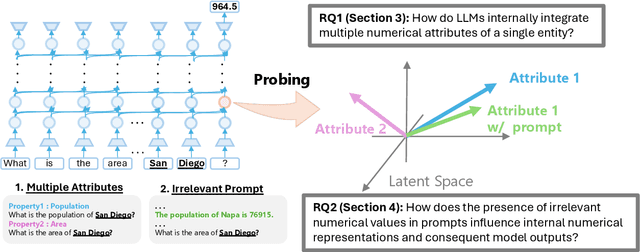
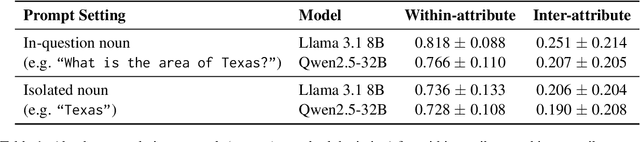
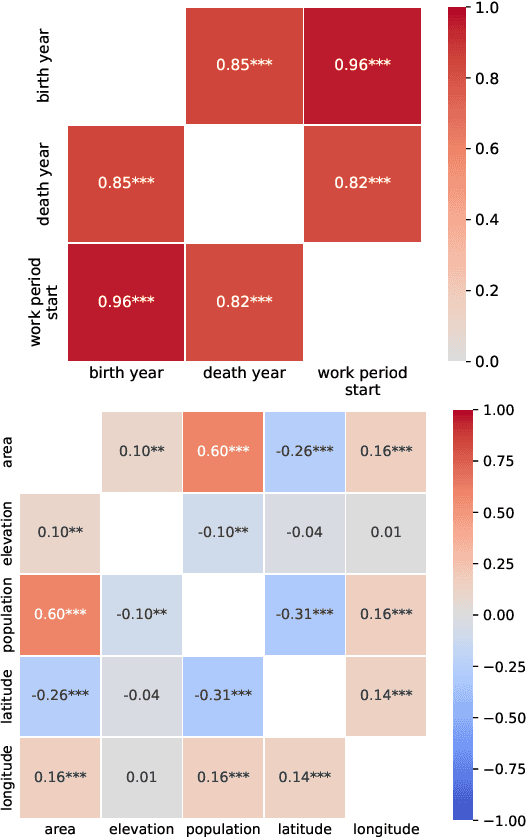
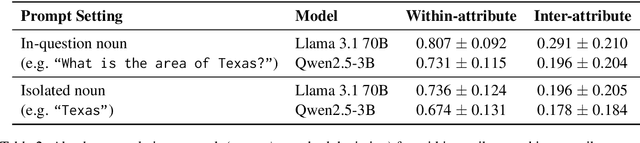
Although behavioral studies have documented numerical reasoning errors in large language models (LLMs), the underlying representational mechanisms remain unclear. We hypothesize that numerical attributes occupy shared latent subspaces and investigate two questions:(1) How do LLMs internally integrate multiple numerical attributes of a single entity? (2)How does irrelevant numerical context perturb these representations and their downstream outputs? To address these questions, we combine linear probing with partial correlation analysis and prompt-based vulnerability tests across models of varying sizes. Our results show that LLMs encode real-world numerical correlations but tend to systematically amplify them. Moreover, irrelevant context induces consistent shifts in magnitude representations, with downstream effects that vary by model size. These findings reveal a vulnerability in LLM decision-making and lay the groundwork for fairer, representation-aware control under multi-attribute entanglement.