 Add to Chrome
 Add to Firefox
 Add to Edge
AdaLens: Interactive Storyline for Monitoring and Steering Long-Running Agentic Data Analysis
Aug 18, 2026
Large language models are pushing data science toward increasingly autonomous and agentic workflows, with recent systems already supporting multi-step and long-running analyses. As these workflows become more autonomous, conventional interfaces no longer provide adequate support for two critical requirements: observability for understanding an agent's evolving reasoning and evidence, and steerability for redirecting low-value directions or deepening promising ones during execution. Existing interactive approaches improve process visibility and open intervention points, but they remain largely designed for discrete, turn-by-turn exchanges rather than the parallel branches and evolving decision structures of long-running agentic analysis. We study this need as interactive oversight in long-running agentic data analysis and present AdaLens, an interactive system for monitoring and steering ongoing runs. AdaLens combines a storyline-based representation that unifies analytical plans, execution progress, intermediate findings, and data-column involvement with steering interactions grounded in these analytical elements for directional guidance and execution control. We evaluate AdaLens through two case studies and a user study, examining how it supports analysts in monitoring and steering long-running agentic data analysis.

FalconTrack: Photorealistic Auto-Labeled Perception and Physics-Aware Vision-Based Aerial Tracking
Jun 29, 2026Vision-based aerial tracking is critical in GPS-denied environments. Reliable perception for tracking depends on large-scale labeled data, yet most photorealistic datasets rely on heavy manual annotation and are time-consuming to produce. We present FalconTrack, a unified perception-and-tracking framework that (i) leverages a photorealistic editable simulator for automated label generation and (ii) combines multi-head perception with physics-aware tracking for zero-shot sim-to-real transfer. FalconTrack provides an automated labeling pipeline in a Gaussian Splatting simulator that isolates target Gaussians from short object videos and composites them with randomized backgrounds to generate RGB, mask, class, and 6-DoF pose labels, producing about 10k labeled images in under 20 minutes. Using this dataset, we train a multi-head perception module with staged learning and reprojection consistency, and fuse its outputs with class-conditioned dynamics priors in an EKF for tracking. Our perception model outperforms two baselines and reaches 96-100% class accuracy in zero-shot sim-to-real transfer on three geometrically diverse objects and two environments, while maintaining consistent performance in unseen simulated and real scenes. In real hardware closed-loop visual tracking, the onboard system runs at about 25 Hz and achieves 100% success in sim-to-real F1-tenth and gate tracking in five trajectories across two environments, while a mask-centered vision baseline drops to 60% success on F1-tenth during fast out-of-view scenarios.
Task-Aware Environment Augmentation for Reliable Navigation via Shielded Conditional Diffusion
Jun 13, 2026Reliable trajectory planning under partial observability depends not only on computing a feasible geometric path, but also on whether the robot receives informative observations while executing that trajectory. Existing approaches usually keep the environment fixed and adapt the robot through belief-space planning, active localization, or added sensing, often incurring costly uncertainty propagation and brittle behavior in observation-poor regions. We flip this perspective and address the largely open problem of \emph{task-aware environment augmentation}: given a mapped environment, a planned task trajectory, and a small budget of visual fiducial markers, where should the environment be augmented so that the planned trajectory can be executed reliably under uncertainty? Our key observation is that useful marker layouts are defined by the localization support they provide along the task trajectory: a small number of well-timed observations can be sufficient to prevent uncertainty from accumulating in regions where state-estimation error would otherwise compromise control. Building on this observation, we present \tbp{SCoDA}, $\textbf{S}$hielded $\textbf{Co}$nditional $\textbf{D}$iffusion for Environment $\textbf{A}$ugmentation. \tbp{SCoDA} learns a conditional distribution over high-performing fiducial layouts from data, using the environment, planned trajectory, disturbance context, and desired execution profile as conditioning. Its shielded sampler reasons over where along the planned execution pose corrections should occur, and steers this distribution toward task-relevant, finite-budget augmentations. Across simulated benchmarks and hardware deployments, we show that \tbp{SCoDA} improves trajectory execution reliability and completion time over strong baselines. Code, models and dataset available at: \hyperlink{scoda-diffusion.github.io}{https://scoda-diffusion.github.io/}
Performance-Guided Refinement for Visual Aerial Navigation using Editable Gaussian Splatting in FalconGym 2.0
Oct 02, 2025Visual policy design is crucial for aerial navigation. However, state-of-the-art visual policies often overfit to a single track and their performance degrades when track geometry changes. We develop FalconGym 2.0, a photorealistic simulation framework built on Gaussian Splatting (GSplat) with an Edit API that programmatically generates diverse static and dynamic tracks in milliseconds. Leveraging FalconGym 2.0's editability, we propose a Performance-Guided Refinement (PGR) algorithm, which concentrates visual policy's training on challenging tracks while iteratively improving its performance. Across two case studies (fixed-wing UAVs and quadrotors) with distinct dynamics and environments, we show that a single visual policy trained with PGR in FalconGym 2.0 outperforms state-of-the-art baselines in generalization and robustness: it generalizes to three unseen tracks with 100% success without per-track retraining and maintains higher success rates under gate-pose perturbations. Finally, we demonstrate that the visual policy trained with PGR in FalconGym 2.0 can be zero-shot sim-to-real transferred to a quadrotor hardware, achieving a 98.6% success rate (69 / 70 gates) over 30 trials spanning two three-gate tracks and a moving-gate track.
Towards Unified Probabilistic Verification and Validation of Vision-Based Autonomy
Aug 19, 2025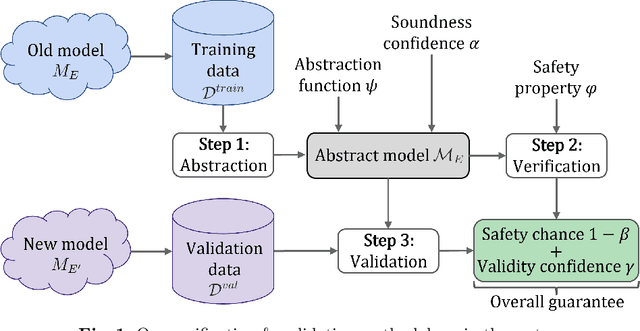
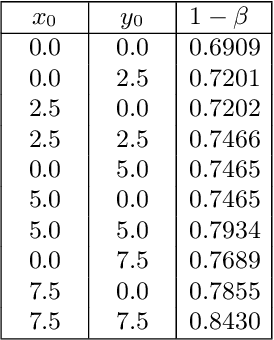
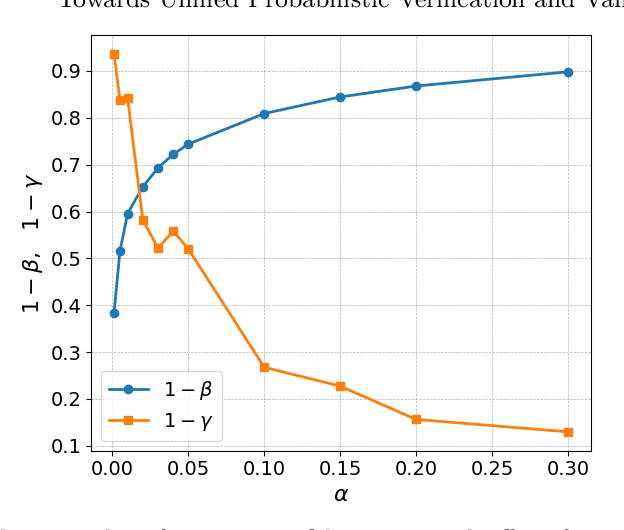
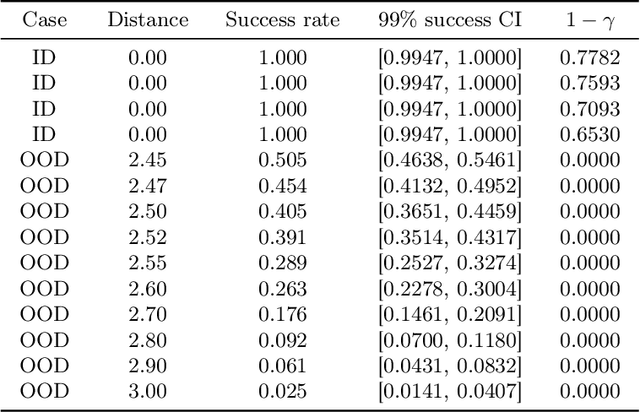
Precise and comprehensive situational awareness is a critical capability of modern autonomous systems. Deep neural networks that perceive task-critical details from rich sensory signals have become ubiquitous; however, their black-box behavior and sensitivity to environmental uncertainty and distribution shifts make them challenging to verify formally. Abstraction-based verification techniques for vision-based autonomy produce safety guarantees contingent on rigid assumptions, such as bounded errors or known unique distributions. Such overly restrictive and inflexible assumptions limit the validity of the guarantees, especially in diverse and uncertain test-time environments. We propose a methodology that unifies the verification models of perception with their offline validation. Our methodology leverages interval MDPs and provides a flexible end-to-end guarantee that adapts directly to the out-of-distribution test-time conditions. We evaluate our methodology on a synthetic perception Markov chain with well-defined state estimation distributions and a mountain car benchmark. Our findings reveal that we can guarantee tight yet rigorous bounds on overall system safety.
FalconWing: An Open-Source Platform for Ultra-Light Fixed-Wing Aircraft Research
May 02, 2025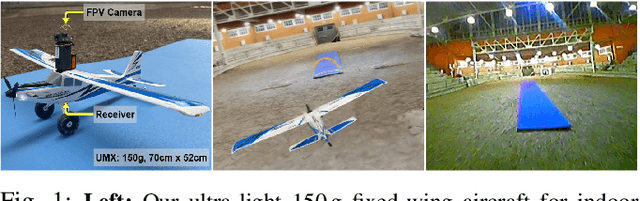
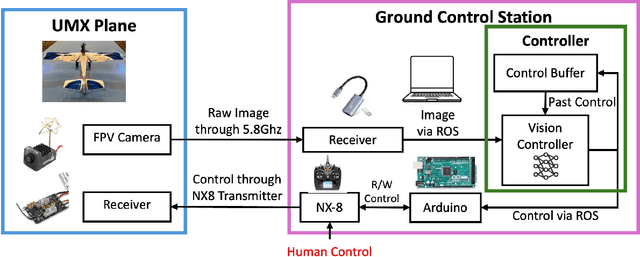
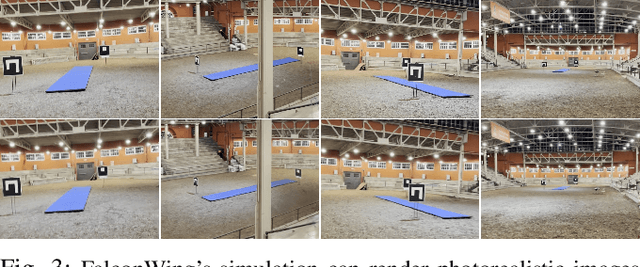
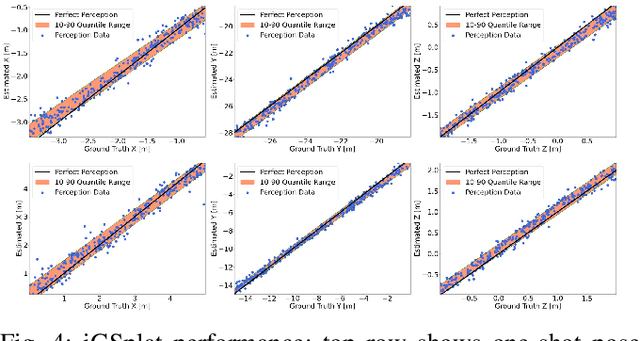
We present FalconWing -- an open-source, ultra-lightweight (150 g) fixed-wing platform for autonomy research. The hardware platform integrates a small camera, a standard airframe, offboard computation, and radio communication for manual overrides. We demonstrate FalconWing's capabilities by developing and deploying a purely vision-based control policy for autonomous landing (without IMU or motion capture) using a novel real-to-sim-to-real learning approach. Our learning approach: (1) constructs a photorealistic simulation environment via 3D Gaussian splatting trained on real-world images; (2) identifies nonlinear dynamics from vision-estimated real-flight data; and (3) trains a multi-modal Vision Transformer (ViT) policy through simulation-only imitation learning. The ViT architecture fuses single RGB image with the history of control actions via self-attention, preserving temporal context while maintaining real-time 20 Hz inference. When deployed zero-shot on the hardware platform, this policy achieves an 80% success rate in vision-based autonomous landings. Together with the hardware specifications, we also open-source the system dynamics, the software for photorealistic simulator and the learning approach.
Zero-Shot Sim-to-Real Visual Quadrotor Control with Hard Constraints
Mar 04, 2025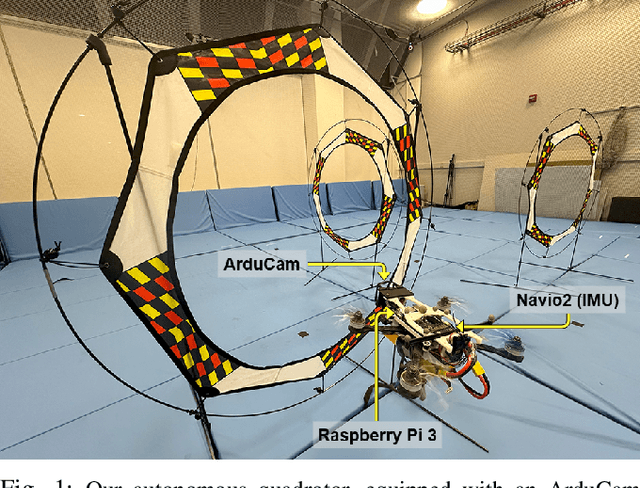
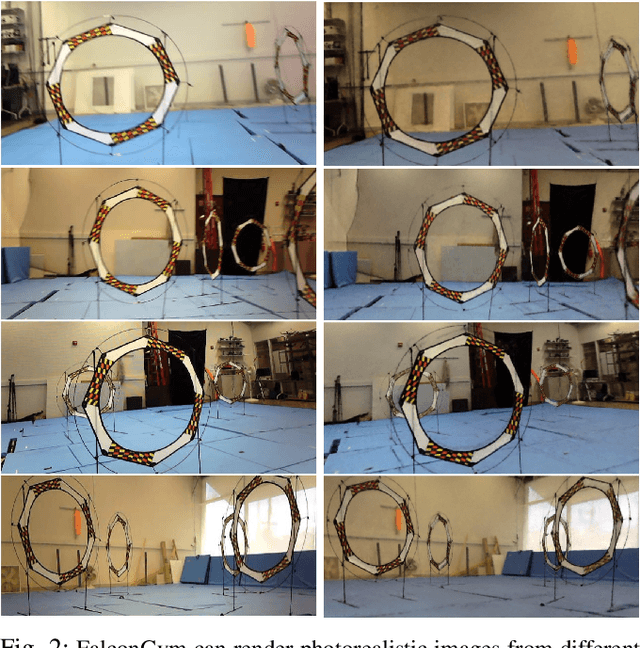
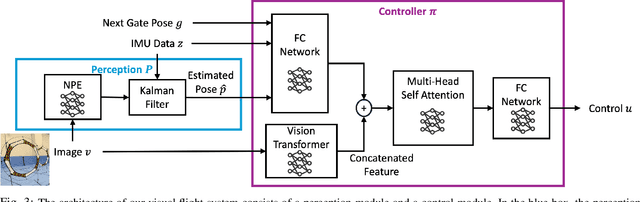
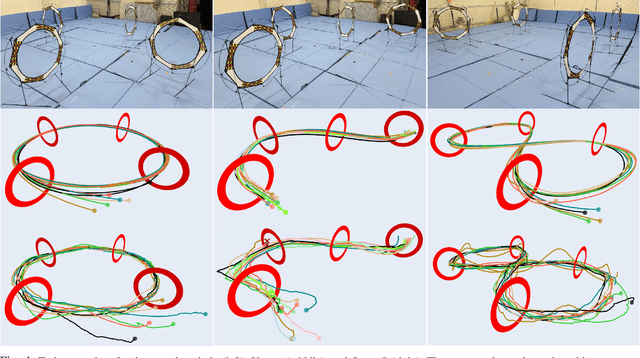
We present the first framework demonstrating zero-shot sim-to-real transfer of visual control policies learned in a Neural Radiance Field (NeRF) environment for quadrotors to fly through racing gates. Robust transfer from simulation to real flight poses a major challenge, as standard simulators often lack sufficient visual fidelity. To address this, we construct a photorealistic simulation environment of quadrotor racing tracks, called FalconGym, which provides effectively unlimited synthetic images for training. Within FalconGym, we develop a pipelined approach for crossing gates that combines (i) a Neural Pose Estimator (NPE) coupled with a Kalman filter to reliably infer quadrotor poses from single-frame RGB images and IMU data, and (ii) a self-attention-based multi-modal controller that adaptively integrates visual features and pose estimation. This multi-modal design compensates for perception noise and intermittent gate visibility. We train this controller purely in FalconGym with imitation learning and deploy the resulting policy to real hardware with no additional fine-tuning. Simulation experiments on three distinct tracks (circle, U-turn and figure-8) demonstrate that our controller outperforms a vision-only state-of-the-art baseline in both success rate and gate-crossing accuracy. In 30 live hardware flights spanning three tracks and 120 gates, our controller achieves a 95.8% success rate and an average error of just 10 cm when flying through 38 cm-radius gates.
From Dashcam Videos to Driving Simulations: Stress Testing Automated Vehicles against Rare Events
Nov 25, 2024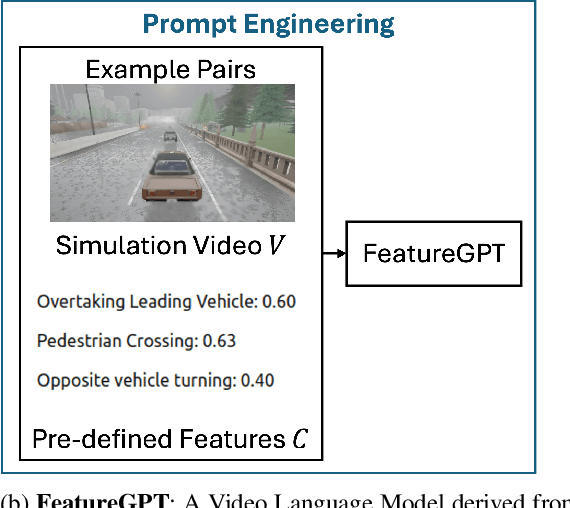
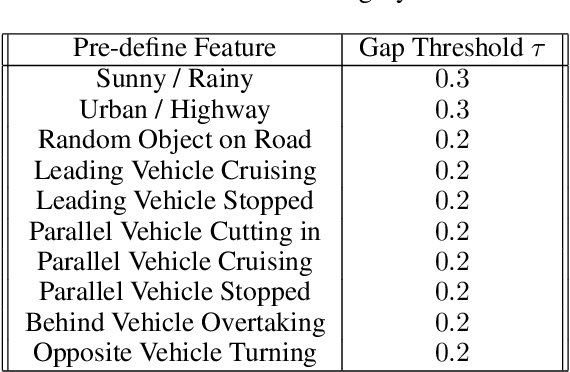

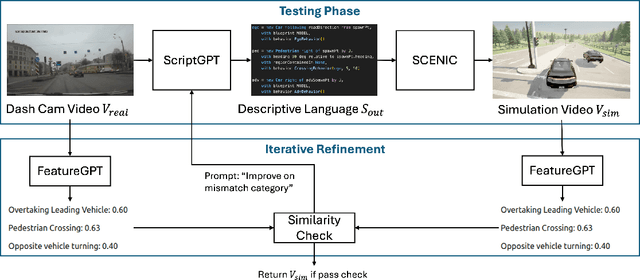
Testing Automated Driving Systems (ADS) in simulation with realistic driving scenarios is important for verifying their performance. However, converting real-world driving videos into simulation scenarios is a significant challenge due to the complexity of interpreting high-dimensional video data and the time-consuming nature of precise manual scenario reconstruction. In this work, we propose a novel framework that automates the conversion of real-world car crash videos into detailed simulation scenarios for ADS testing. Our approach leverages prompt-engineered Video Language Models(VLM) to transform dashcam footage into SCENIC scripts, which define the environment and driving behaviors in the CARLA simulator, enabling the generation of realistic simulation scenarios. Importantly, rather than solely aiming for one-to-one scenario reconstruction, our framework focuses on capturing the essential driving behaviors from the original video while offering flexibility in parameters such as weather or road conditions to facilitate search-based testing. Additionally, we introduce a similarity metric that helps iteratively refine the generated scenario through feedback by comparing key features of driving behaviors between the real and simulated videos. Our preliminary results demonstrate substantial time efficiency, finishing the real-to-sim conversion in minutes with full automation and no human intervention, while maintaining high fidelity to the original driving events.
MuST: Multimodal Spatiotemporal Graph-Transformer for Hospital Readmission Prediction
Nov 11, 2023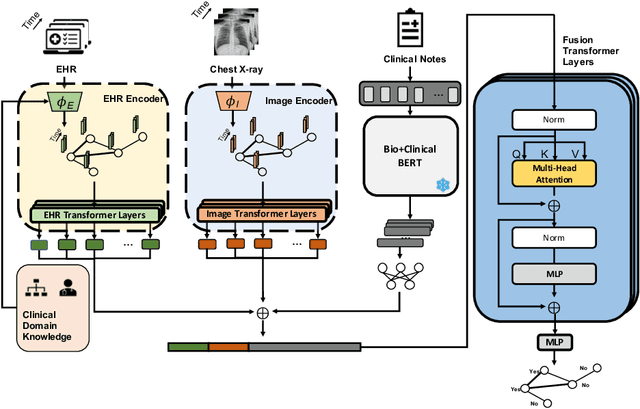
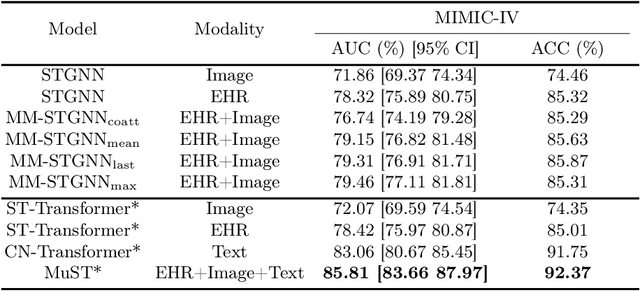
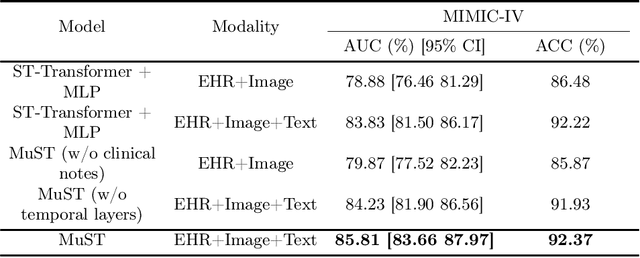
Hospital readmission prediction is considered an essential approach to decreasing readmission rates, which is a key factor in assessing the quality and efficacy of a healthcare system. Previous studies have extensively utilized three primary modalities, namely electronic health records (EHR), medical images, and clinical notes, to predict hospital readmissions. However, the majority of these studies did not integrate information from all three modalities or utilize the spatiotemporal relationships present in the dataset. This study introduces a novel model called the Multimodal Spatiotemporal Graph-Transformer (MuST) for predicting hospital readmissions. By employing Graph Convolution Networks and temporal transformers, we can effectively capture spatial and temporal dependencies in EHR and chest radiographs. We then propose a fusion transformer to combine the spatiotemporal features from the two modalities mentioned above with the features from clinical notes extracted by a pre-trained, domain-specific transformer. We assess the effectiveness of our methods using the latest publicly available dataset, MIMIC-IV. The experimental results indicate that the inclusion of multimodal features in MuST improves its performance in comparison to unimodal methods. Furthermore, our proposed pipeline outperforms the current leading methods in the prediction of hospital readmissions.
Watch out for the risky actors: Assessing risk in dynamic environments for safe driving
Oct 19, 2021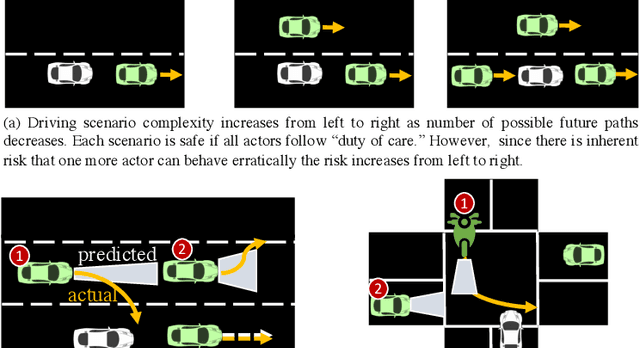
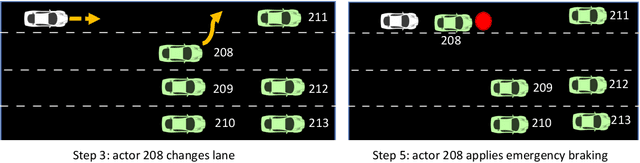
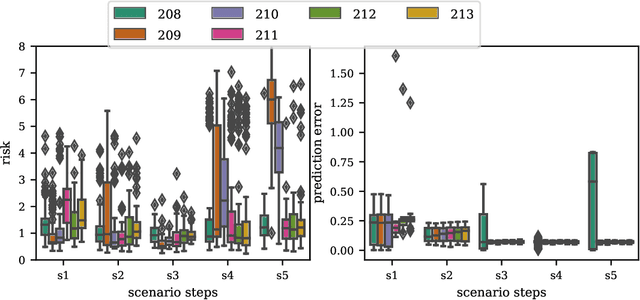
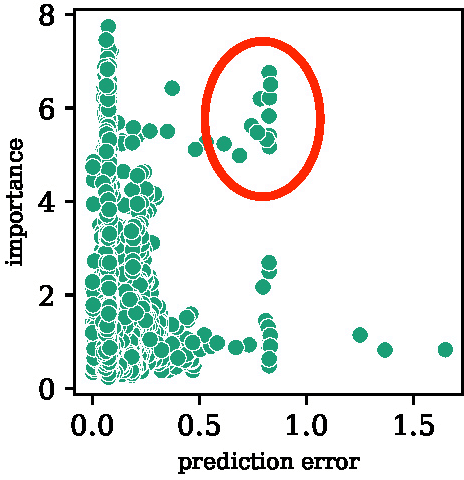
Driving in a dynamic environment that consists of other actors is inherently a risky task as each actor influences the driving decision and may significantly limit the number of choices in terms of navigation and safety plan. The risk encountered by the Ego actor depends on the driving scenario and the uncertainty associated with predicting the future trajectories of the other actors in the driving scenario. However, not all objects pose a similar risk. Depending on the object's type, trajectory, position, and the associated uncertainty with these quantities; some objects pose a much higher risk than others. The higher the risk associated with an actor, the more attention must be directed towards that actor in terms of resources and safety planning. In this paper, we propose a novel risk metric to calculate the importance of each actor in the world and demonstrate its usefulness through a case study.