 Add to Chrome
 Add to Firefox
 Add to Edge
Sample-Efficient Learning of Probabilistic Causes for Reachability in Markov Decision Processes with Probabilistic Guarantees
Jun 29, 2026
Probabilistic model checking for Markov decision processes (MDPs) provides quantitative guarantees, but often offers limited insight into why undesired outcomes occur. Probability-raising (PR) causality addresses this by identifying states whose visitation increases the probability of reaching designated states. Existing PR-cause identification methods, however, use MDP modifications not well-suited for learning: the gap between conditional and unconditional reachability probabilities can be hard to detect from transition samples, and construction requires reachability probabilities of the MDP, which are unavailable when transition probabilities are unknown. We study unknown MDPs and propose a learning approach with probabilistic guarantees for PR-cause identification. Our key ingredient is a restart-based MDP modification that reduces PR-cause checking to two conditional reachability queries without using reachability values of the original MDP. We prove correctness, establish sample-complexity bounds, and develop an anytime learning-and-checking algorithm based on two-sided value iteration that progressively classifies states as causal, non-causal, or undecided. Experiments on two benchmarks demonstrate reliable and fast identification of PR causes.

Reinforcement Learning of Control Policy for Linear Temporal Logic Specifications Using Limit-Deterministic Generalized Büchi Automata
Feb 21, 2020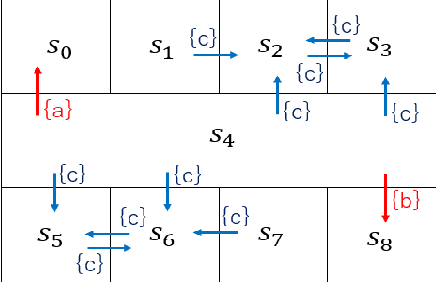
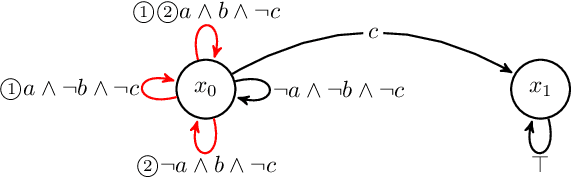
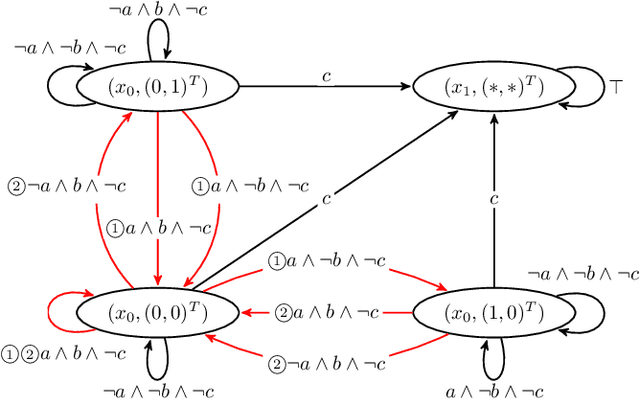
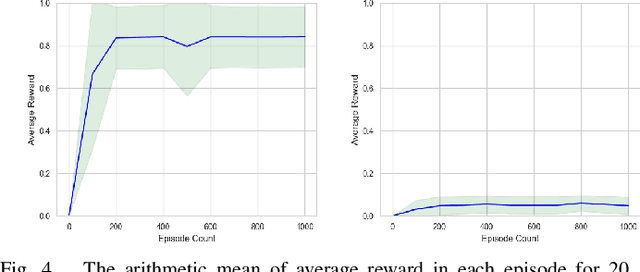
This letter proposes a novel reinforcement learning method for the synthesis of a control policy satisfying a control specification described by a linear temporal logic formula. We assume that the controlled system is modeled by a Markov decision process (MDP). We convert the specification to a limit-deterministic generalized B\"uchi automaton (LDGBA) with several accepting sets that accepts all infinite sequences satisfying the formula. The LDGBA is augmented so that it explicitly records the previous visits to accepting sets. We take a product of the augmented LDGBA and the MDP, based on which we define a reward function. The agent gets rewards whenever state transitions are in an accepting set that has not been visited for a certain number of steps. Consequently, sparsity of rewards is relaxed and optimal circulations among the accepting sets are learned. We show that the proposed method can learn an optimal policy when the discount factor is sufficiently close to one.