 Add to Chrome
 Add to Firefox
 Add to Edge
HT-Bench: Benchmarking and Learning Dexterous Full-Hand Tactile Representations with Egocentric Vision
Jun 17, 2026
Establishing a universal benchmark for tactile representation learning in robotic manipulation remains challenging due to the diversity of tactile sensor designs, data formats, and robot embodiments. Rather than seeking to establish such, we explore a scalable and promising direction for future development: egocentric vision paired with full-hand tactile data. To this end, we introduce \textbf{HT-Bench}, a large-scale multi-task benchmark for dexterous full-hand tactile sensing, comprising 10M RGB frames and 7.8M tactile frames collected across 226 tasks. HT-Bench evaluates tactile representations from three key perspectives: whether they encode meaningful contact geometry, whether they can align tactile observations with visual information, and whether they generalize to unseen tasks. To assess these capabilities, HT-Bench includes four tasks: fine-grained tactile similarity retrieval, masked tactile inpainting, vision-to-tactile synthesis, and multimodal tactile frame prediction. We further propose \textbf{HandTouch}, a vector-quantized vision--tactile encoder that learns tactile representations through progressive spatial, cross-modal, and temporal training. Across HT-Bench, HandTouch consistently outperforms representative tactile encoder baselines, improving Recall@5 on fine-grained tactile similarity retrieval from 74.65\% to 85.23\%, reducing RMSE on masked tactile inpainting from 0.022 to 0.010, and increasing OOD cIoU on vision-to-tactile synthesis from 0.628 to 0.705. These results demonstrate the effectiveness of HandTouch and suggest that large-scale egocentric full-hand tactile data provides a scalable basis for evaluating and advancing tactile representation learning in dexterous manipulation.

FASIONAD++ : Integrating High-Level Instruction and Information Bottleneck in FAt-Slow fusION Systems for Enhanced Safety in Autonomous Driving with Adaptive Feedback
Mar 11, 2025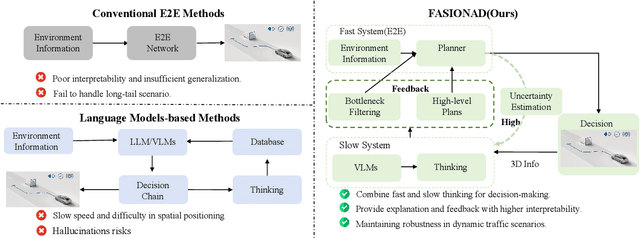
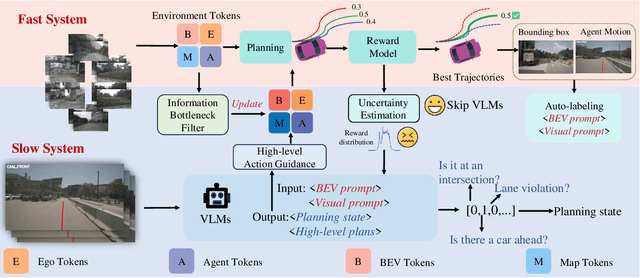
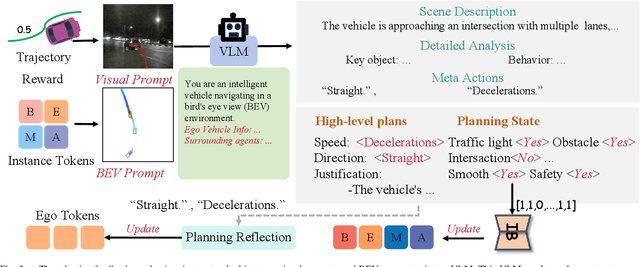
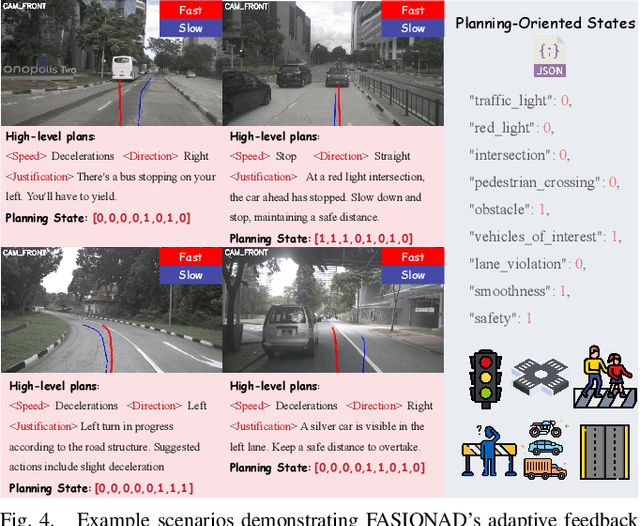
Ensuring safe, comfortable, and efficient planning is crucial for autonomous driving systems. While end-to-end models trained on large datasets perform well in standard driving scenarios, they struggle with complex low-frequency events. Recent Large Language Models (LLMs) and Vision Language Models (VLMs) advancements offer enhanced reasoning but suffer from computational inefficiency. Inspired by the dual-process cognitive model "Thinking, Fast and Slow", we propose $\textbf{FASIONAD}$ -- a novel dual-system framework that synergizes a fast end-to-end planner with a VLM-based reasoning module. The fast system leverages end-to-end learning to achieve real-time trajectory generation in common scenarios, while the slow system activates through uncertainty estimation to perform contextual analysis and complex scenario resolution. Our architecture introduces three key innovations: (1) A dynamic switching mechanism enabling slow system intervention based on real-time uncertainty assessment; (2) An information bottleneck with high-level plan feedback that optimizes the slow system's guidance capability; (3) A bidirectional knowledge exchange where visual prompts enhance the slow system's reasoning while its feedback refines the fast planner's decision-making. To strengthen VLM reasoning, we develop a question-answering mechanism coupled with reward-instruct training strategy. In open-loop experiments, FASIONAD achieves a $6.7\%$ reduction in average $L2$ trajectory error and $28.1\%$ lower collision rate.